
Andean cock-of-the-rock
Rupicola peruvianus
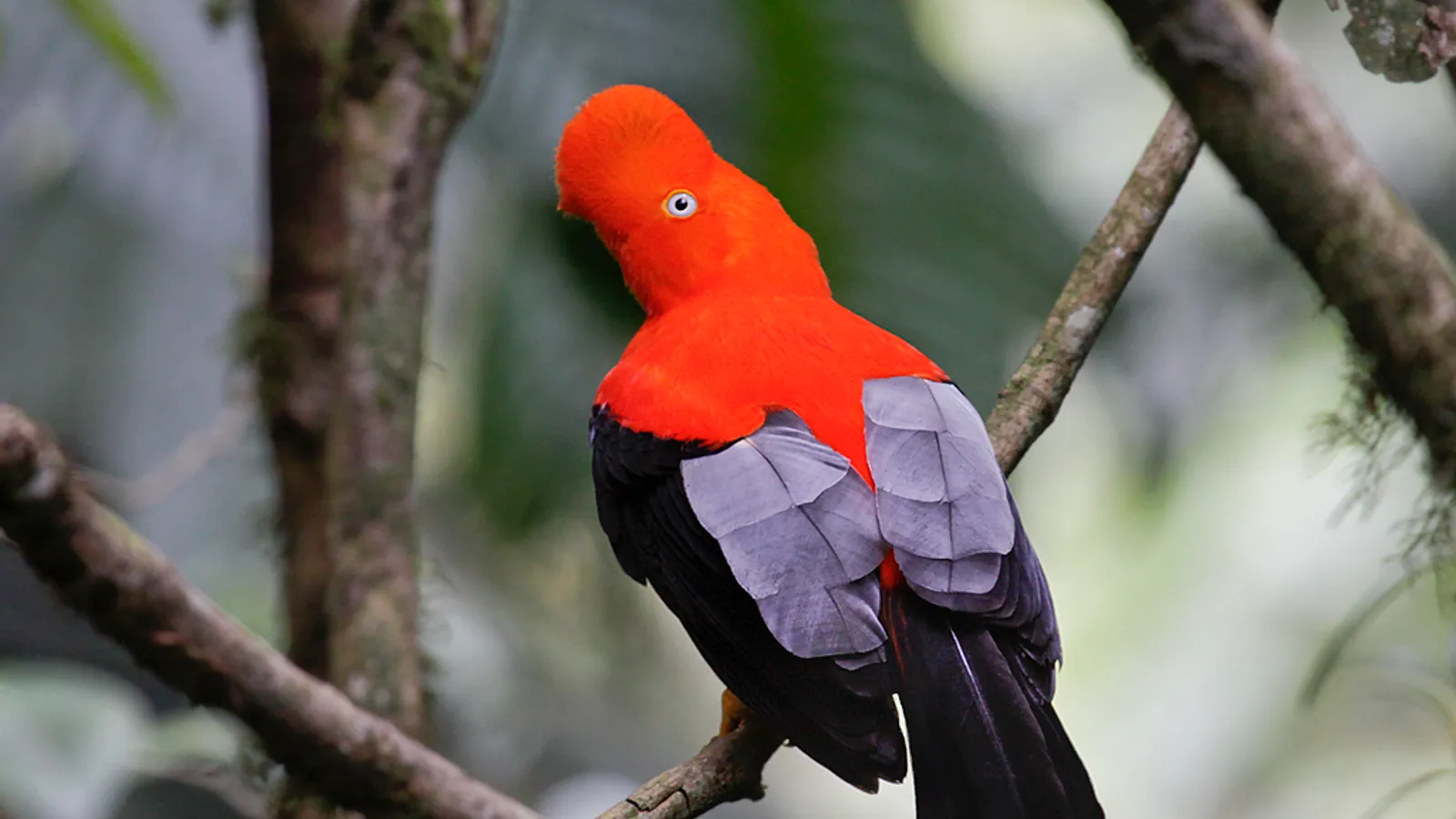
— Where the name comes from
Rupicola is “dweller on the rocks”, from rupes and colere: it builds a mud nest against a vertical face, often in a gorge with a stream running through it. Peruvianus names Peru, whose national bird it is. The male has a disc-shaped crest that covers even his bill, and seen in profile he looks like an animal with no face.
— Facts
- Group
- Birds · Aves
- Order
- Passerines
- Habitat
- Andean cloud forest between 500 and 2,400 metres
- Range
- The Andes of Venezuela, Colombia, Ecuador, Peru and Bolivia
- Size
- 30–32 cm, 200–300 g
- Diet
- Fruit, insects, small reptiles and amphibians
- Lifespan
- 7 years in the wild
— Characteristics
- 01
The male is bright orange, the female reddish brown and invisible.
- 02
The females build the nest and raise the young alone.
- 03
It spreads the seeds of the fruit it eats throughout the cloud forest.
— What sets it apart
The males gather at a fixed point in the forest and display there together, leaping, screaming and beating their wings in front of the females who come to choose: an arena that ethologists call a lek. These places are stable for decades, handed down from one generation to the next, and at many of them the same handful of males takes nearly all the matings while the rest serve as extras. That orange costs a great deal in a forest full of raptors, and the whole reason it exists is there, in half an hour of noise a day.
