
Western capercaillie
Tetrao urogallus
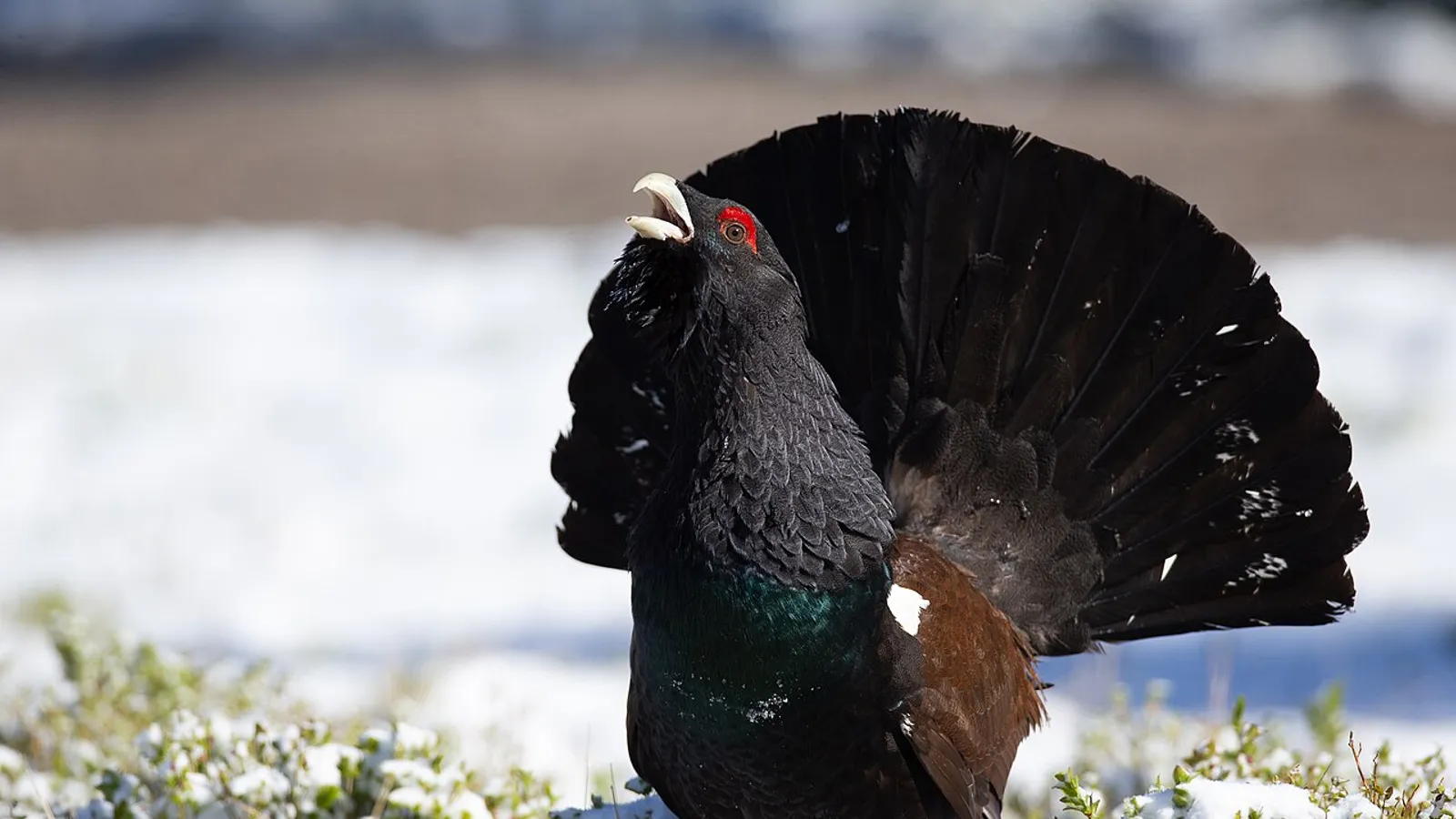
— Where the name comes from
Tetraōn was the Greek name of a large ground game bird. Urogallus is a Latinisation of the German Auerhahn, where Auer recalls the aurochs, the wild ox: “the bull-cock”, for the size and the call. The Italian name comes instead from the belief that it fed on cedars, that is on conifers, and in winter pine needles really are nearly all it eats.
— Facts
- Group
- Birds · Aves
- Order
- Gamebirds
- Habitat
- Mature conifer forest with a bilberry understorey
- Range
- Scandinavia, the Alps, Pyrenees, Carpathians, Siberia
- Size
- 74–110 cm, wingspan 90–125 cm, males 3.3–6.5 kg
- Diet
- Conifer needles in winter, bilberries, shoots, insects
- Lifespan
- 10 years in the wild
— Characteristics
- 01
The male weighs twice as much as the female and fans his tail.
- 02
The song ends with the sound of a cork popping and a grinding rasp.
- 03
In winter horny lamellae grow along his toes, like snowshoes.
— What sets it apart
During the last part of the song he hears nothing. For two or three seconds, while he produces the closing rasp, a flap of bone closes the ear canal and the male goes deaf: hunters in the Alps and Scandinavia have known this for centuries and advance three paces at a time, freezing the moment the call ends. Why the mechanism exists is not clear — perhaps it protects the ear from his own volume — but the effect is that the most wary animal in the wood, for a few seconds a day, makes himself half blind.
