Hawfinch
Coccothraustes coccothraustes
— Where the name comes from
Coccothraustes joins the Greek kókkos, “kernel, seed”, and thraúō, “to break”: “the stone-breaker”. The binomial repeats it twice, and there is no better way to describe a bird that lives on very hard seeds. In English it is the hawfinch, the finch of hawthorn fruit.
— Facts
- Group
- Birds · Aves
- Order
- Passerines
- Habitat
- Broadleaf woodland with hornbeam and beech, parks, orchards
- Range
- Europe, North Africa, Asia to Japan
- Size
- 16–18 cm, 48–62 g
- Diet
- Hard seeds: hornbeam, beech, cherry and olive stones
- Lifespan
- A few years, about 12 the record
— Characteristics
- 01
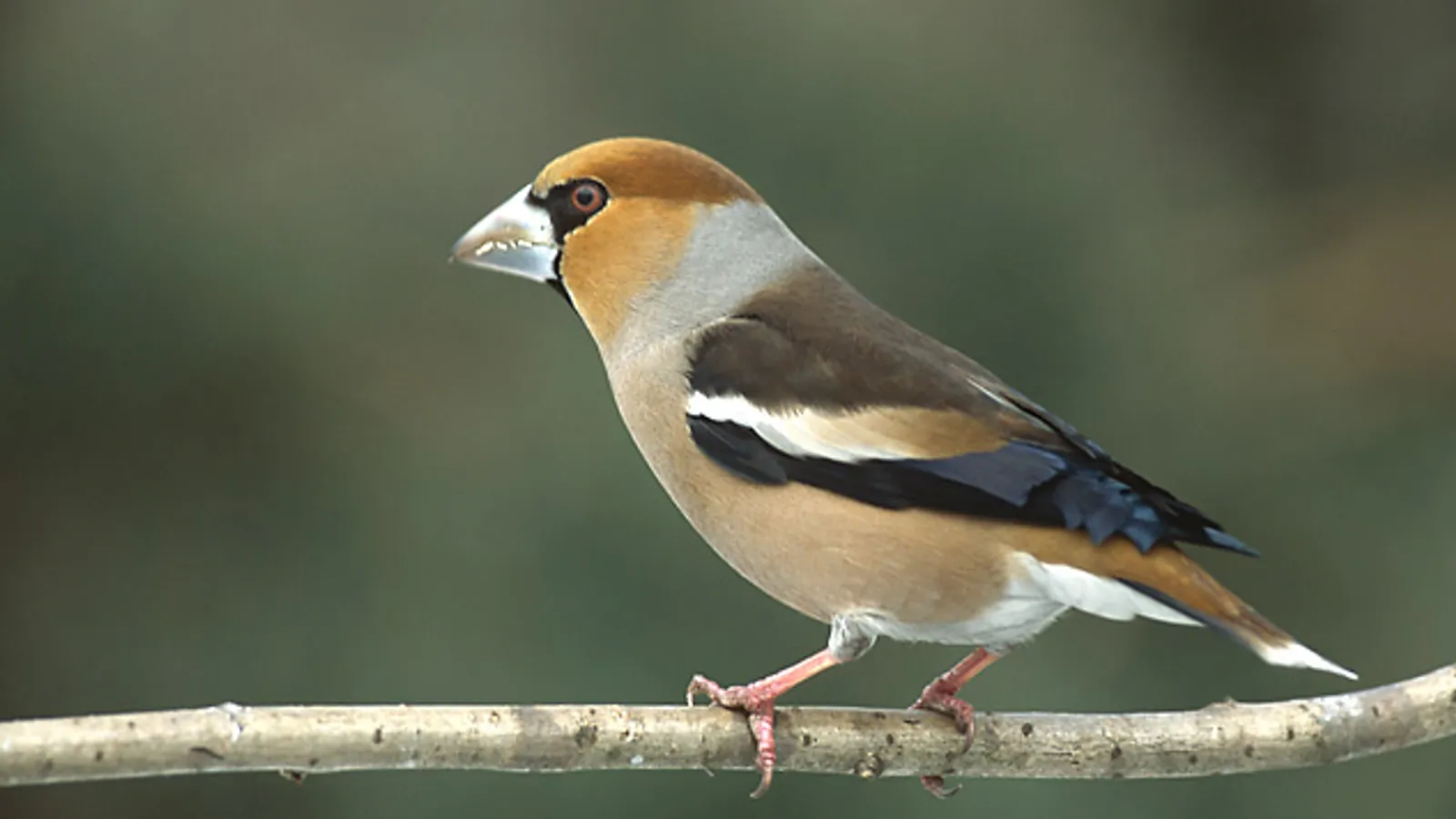
It has an enormous bill, blue-grey in summer and horn-coloured in winter.
- 02
It is shy and spends much time in the treetops.
- 03
Its neck is thick and muscular, to take the force of its bite.
— What sets it apart
For its size it has one of the most powerful bites in the animal kingdom. Its cone-shaped bill is driven by massive jaw muscles and rests on horny pads that act as an anvil, and it can split a cherry or olive stone, which takes a force equivalent to tens of kilograms to break. A fifty-gram bird thus exerts a pressure hundreds of times its own weight. The dry crack of split stones is often the first clue to its presence in a wood.