
Silky anteater
Cyclopes didactylus
— Where the name comes from
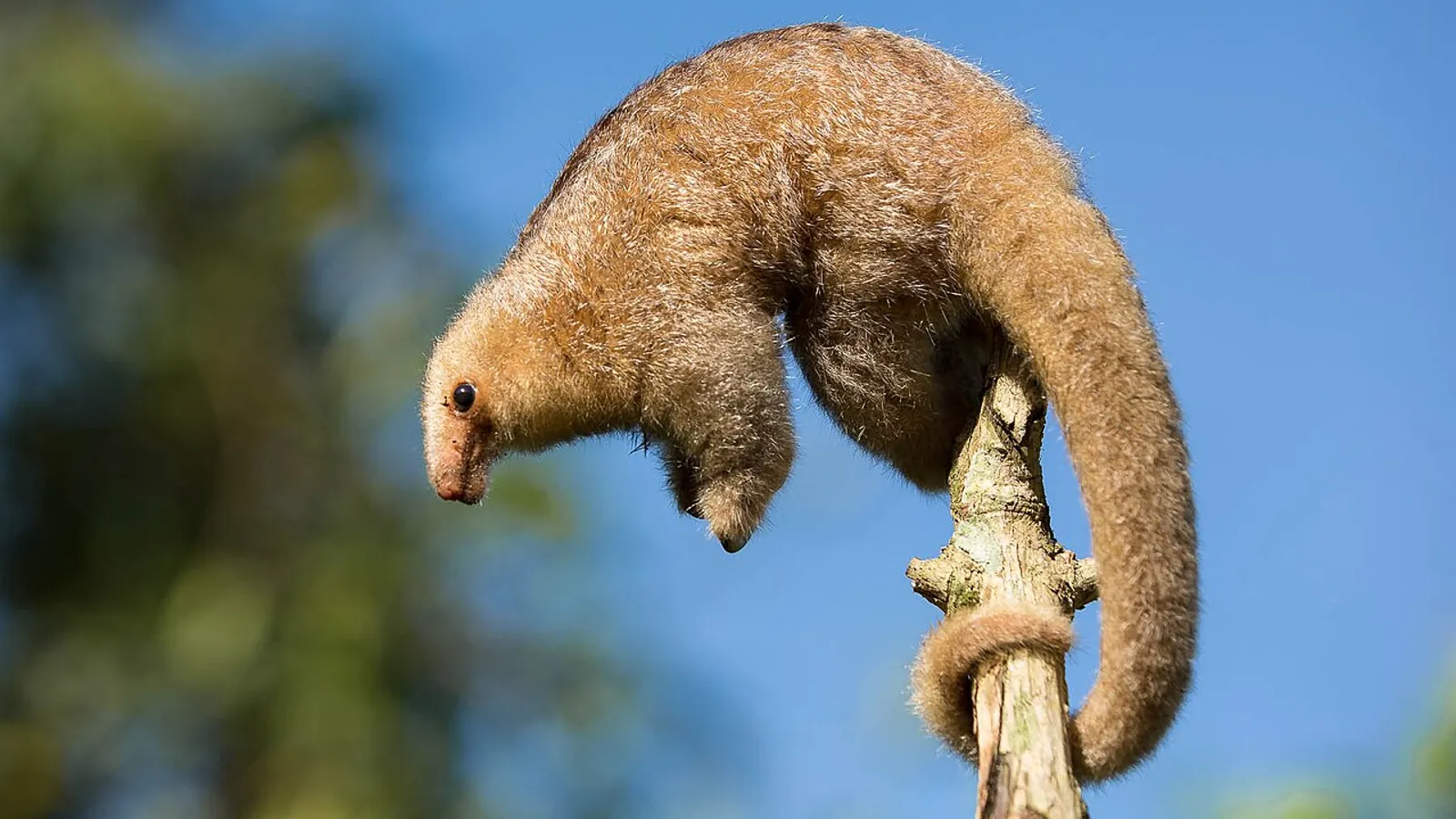
Didactylus counts the working digits of the forefoot: two, against the three or four of the other anteaters. Cyclopes points to the Cyclopes of myth, and the exact reason for the choice is debated — perhaps the small forward-set eyes, perhaps the rounded shape of the skull. In English it is the silky anteater, for the golden, silky fur, and the pygmy anteater, for its size.
— Facts
- Group
- Mammals · Mammalia
- Order
- Sloths and anteaters
- Habitat
- Rainforest canopy, particularly among silk-cotton trees
- Range
- From southern Mexico to Bolivia and Brazil
- Size
- 16–21 cm of body plus a nearly equal prehensile tail, 175–400 g
- Diet
- Insectivore — ants, up to five thousand a day
- Lifespan
- 2–3 years in the wild
— Characteristics
- 01
It is the smallest anteater in the world: it weighs about as much as an orange.
- 02
It has a prehensile tail and spends its entire life in the trees, never coming down.
- 03
It has no teeth: it crushes ants against its palate with a worm-like tongue.
— What sets it apart
It lives almost exclusively in silk-cotton trees, and this is no dietary preference: its golden silky fur is indistinguishable from the fibres that fill those trees’ pods, and curled up on a branch among the open pods the animal vanishes completely. It is a camouflage so specific that it ties the animal to a single plant — and makes it, for researchers, nearly impossible to find: sightings depend more on somebody looking at the wrong pod than on how common the species is.
