
Army ant
Eciton burchellii
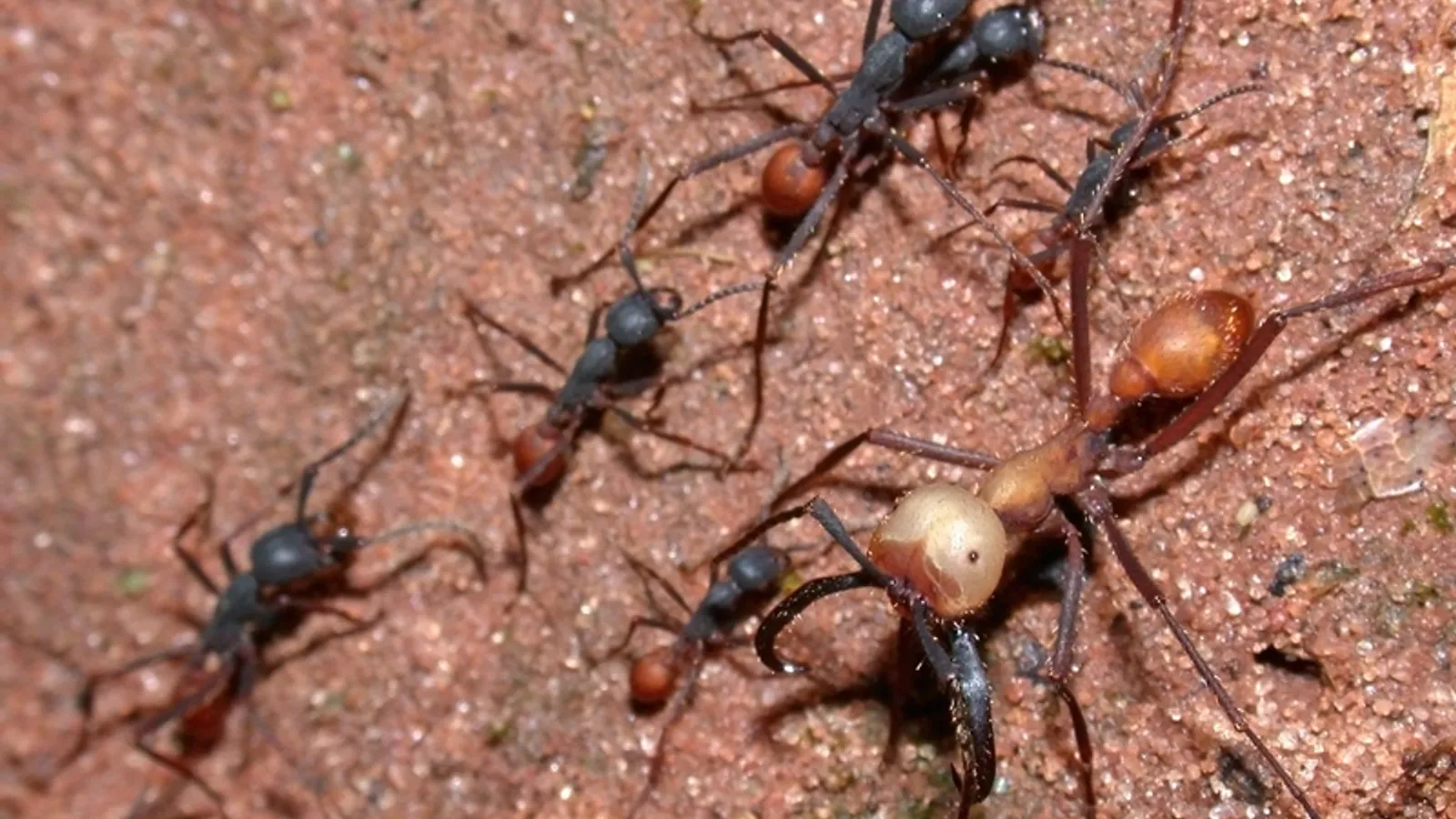
— Where the name comes from
The scientific name is no help: Eciton is a word coined by Latreille whose formation is not securely known, and burchellii commemorates the English explorer William Burchell. It is the common names that say what this ant is, and they all say it in the vocabulary of war: army ant in English, “legionary” in Italian, hormiga guerrera in Spanish, Wanderameise in German. Four languages, and not one able to describe it without an army.
— Facts
- Group
- Insects · Insecta
- Order
- Bees, wasps and ants
- Habitat
- The floor and litter of rainforest
- Range
- From southern Mexico to Amazonia
- Size
- Workers 3–12 mm; the queen up to 25 mm
- Diet
- Arthropods and small vertebrates taken during raids
- Lifespan
- The colony years; the queen several years
— Characteristics
- 01
It builds no nest: it camps, forming a bivouac from its own bodies.
- 02
A raiding column can number two hundred thousand individuals.
- 03
The workers are blind and navigate only by pheromones.
— What sets it apart
The nest is made of ants. When the colony halts, hundreds of thousands of workers hook onto one another with the claws of their legs and form a mass hanging from a branch — the bivouac — with chambers, corridors and a central cell for the queen: a building of living bodies that dissolves at dawn and is rebuilt at dusk. The same workers use their bodies to fill the potholes of the trail, lying down in the gap so that laden nestmates can walk over them, each sizing herself to the hole she must plug. Specialised birds follow the columns and do not eat the ants: they eat the insects fleeing from them.
