
Glasswing butterfly
Greta oto
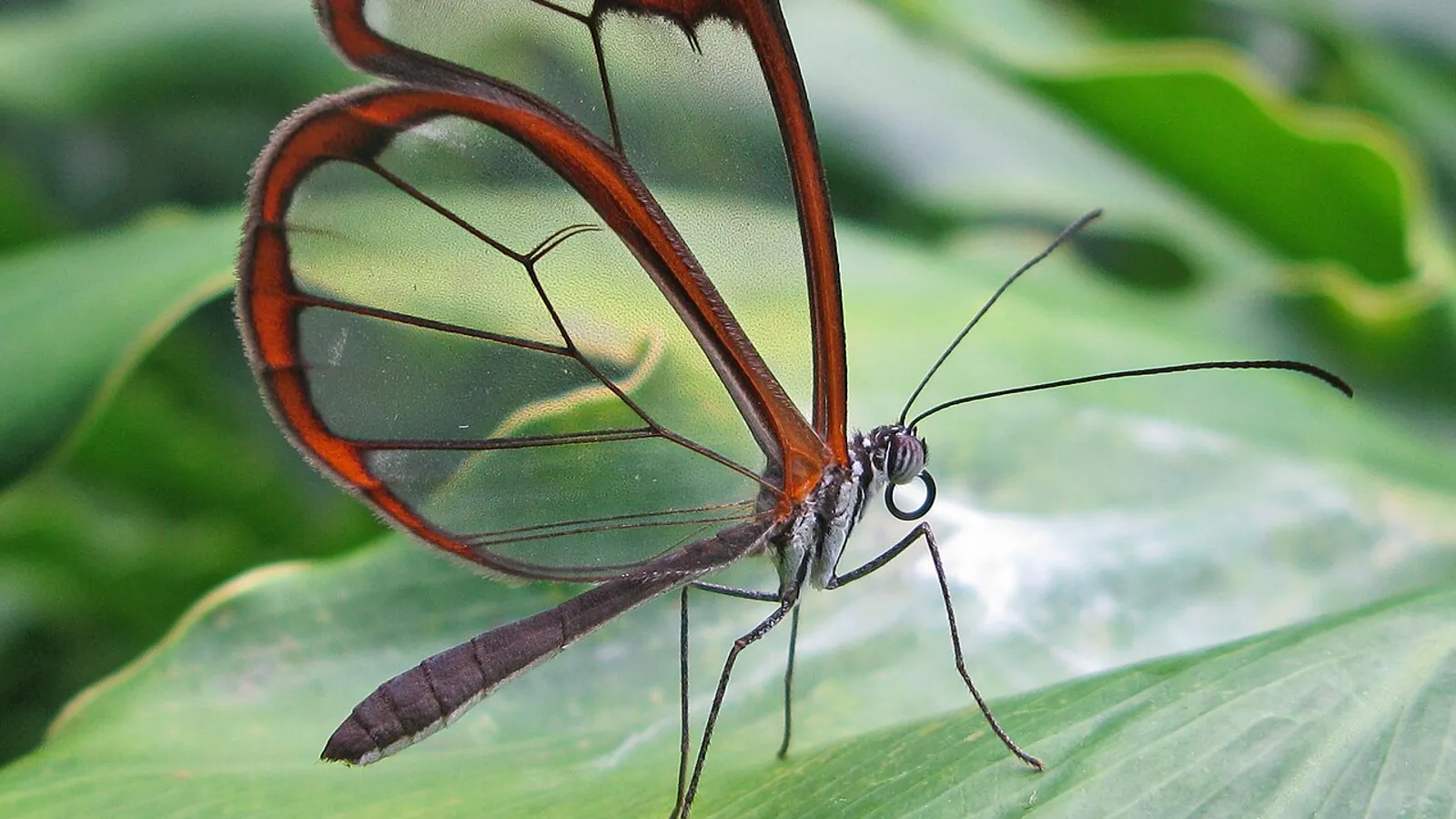
— Where the name comes from
This is one of the rare cases in which the scientific name says nothing and the common names all say the same thing. In English it is the glasswing, in Italian “glass wings”, in German Glasflügler, in Spanish espejitos, “little mirrors”. Four languages that did not consult one another looked at the same animal and all chose the same metaphor: a transparent object made by human beings, because nature offered nothing to compare it to.
— Facts
- Group
- Insects · Insecta
- Order
- Butterflies and moths
- Habitat
- The understorey of rainforest
- Range
- From Mexico to Panama, and in the Andean valleys
- Size
- 5.5–6 cm wingspan
- Diet
- Nectar and bird droppings as an adult; nightshades as a caterpillar
- Lifespan
- 2–3 months
— Characteristics
- 01
The wing membrane has no scales and lets the light through.
- 02
The surface is covered in nanostructures that cancel reflections.
- 03
The caterpillars feed on toxic nightshades and the butterfly stays poisonous.
— What sets it apart
Removing the scales is not enough to become invisible: glass is visible because it reflects, and a bare wing would reflect just the same. The solution is a carpet of tiny irregular pillars, shorter than a wavelength of light, covering the membrane so that the refractive index changes gradually rather than all at once: reflection drops below two per cent at any angle. It is the principle of the anti-reflective coatings on camera lenses, except that the disorder of the pillars makes it work across all wavelengths at once, and laboratories designing screens and solar panels are copying it.
