
Yellow-winged bat
Lavia frons
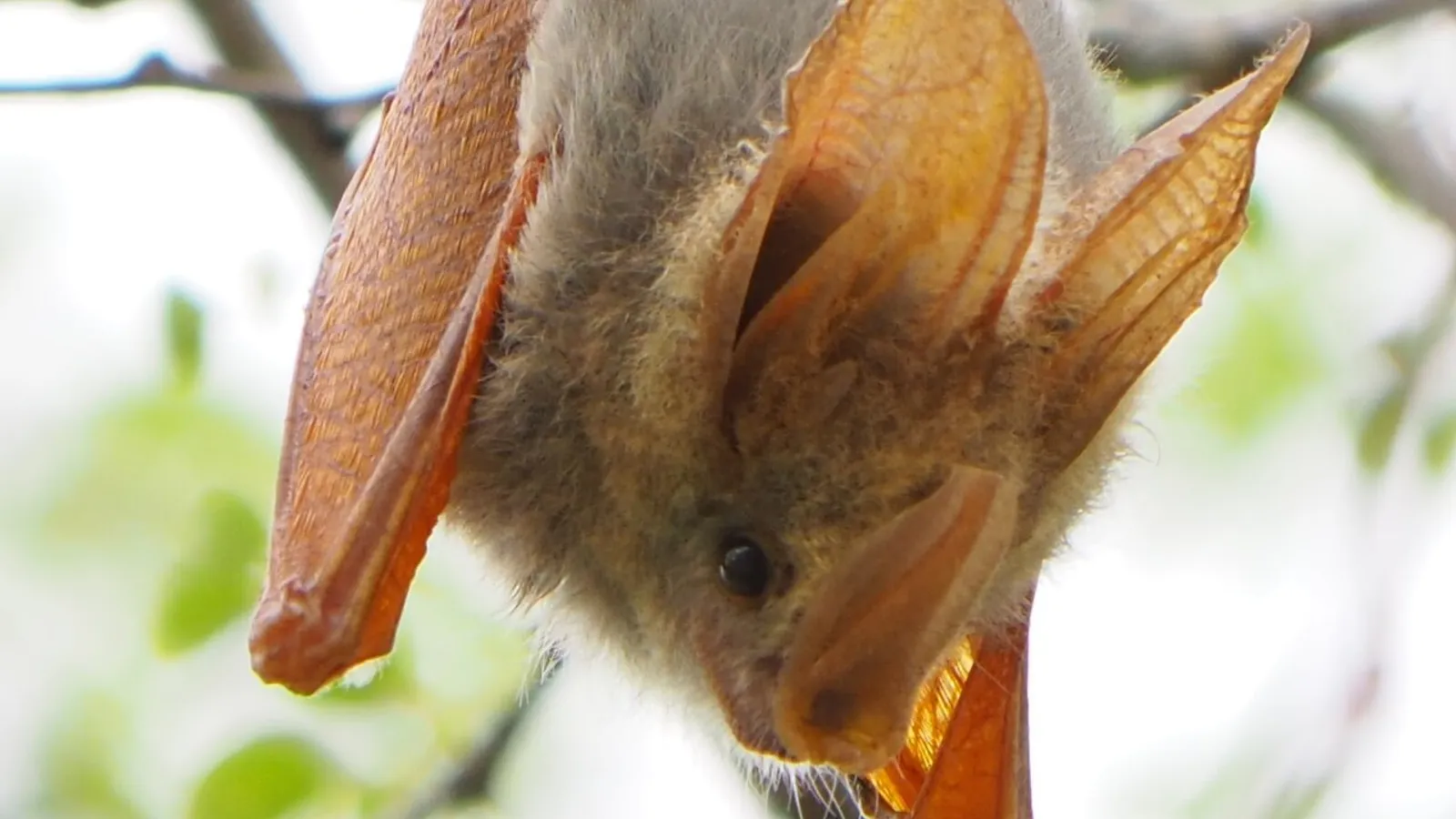
— Where the name comes from
Frons is the Latin “forehead”, for the broad upright nose leaf that covers the face as far as the eyes. “False vampire” is the name of the family, the Megadermatidae, and it is a defensive clarification: they are large, they have unsettling faces and they eat flesh, but they do not drink blood — that is done by three South American species with nothing to do with them.
— Facts
- Group
- Mammals · Mammalia
- Order
- Bats
- Habitat
- Wooded savannah and bush along watercourses, in acacias and shrubs
- Range
- The sub-Saharan belt from Senegal to Kenya and down to Zambia
- Size
- 5.8–8 cm of body, 36 cm wingspan, 28–36 g
- Diet
- Insectivore — large insects taken in flight or off foliage
- Lifespan
- Little known
— Characteristics
- 01
Wings, ears and nose leaf are bright yellow or orange, rare among bats.
- 02
It does not roost in caves: it hangs among the foliage, in plain sight, by day.
- 03
Pairs are monogamous and defend the same territory together all year.
— What sets it apart
It does not hide. Where almost every bat spends the day in a crevice, this one stays hanging from a branch in full view, and the yellow of its wings works as camouflage: among the yellowing leaves of an acacia and the patches of light, a yellow body hanging does not read as an animal. It lives in stable pairs that defend the same bush for years, each hunting from its own perch and returning to sleep side by side — a territorial monogamy that among bats is extremely rare.
