
Luna moth
Actias luna
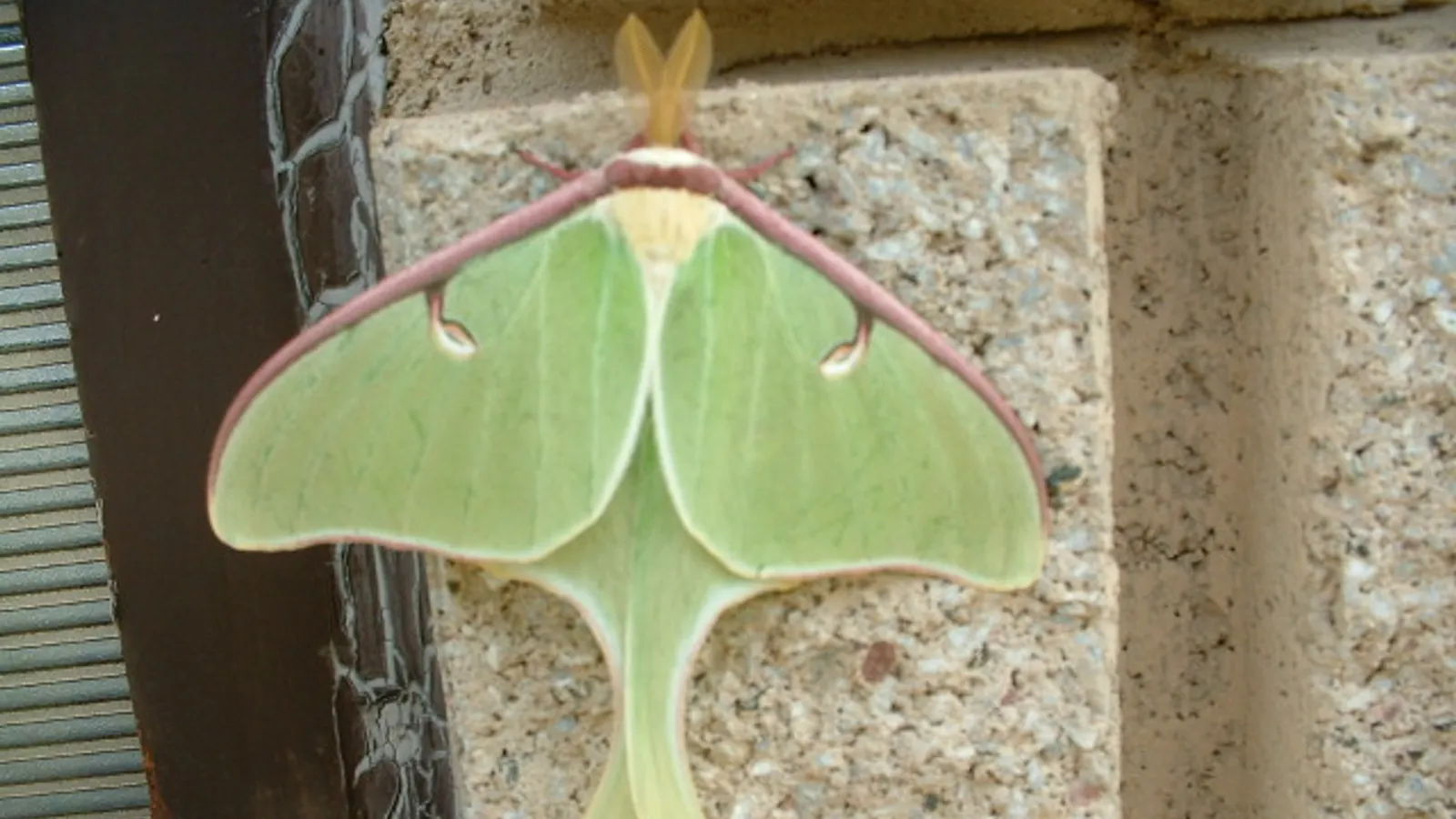
— Where the name comes from
Luna is the name Linnaeus gave it in 1758, looking at the four pale marks on the wings, each ringed like a crescent or a disc: the same image eighteenth-century naturalists saw in the eyespots of the Saturniidae. The pale green and the two long tails do the rest. The genus name is usually traced to the Greek aktís, a ray of light, which would be fitting — but of that there is no certainty.
— Facts
- Group
- Insects · Insecta
- Order
- Butterflies and moths
- Habitat
- Broadleaf woodland: birch, hickory, sweetgum
- Range
- Eastern North America, from Canada to Florida
- Size
- 8–11 cm wingspan, with tails up to 4 cm
- Diet
- Leaves as a caterpillar; as an adult it does not feed
- Lifespan
- About a week as an adult
— Characteristics
- 01
It flies only at night and lives less than ten days.
- 02
The two hindwing tails are an acoustic weapon against bats.
- 03
The male’s feathered antennae are among the finest noses in nature.
— What sets it apart
The tails are not there to improve flight: they are there to lie to bats. Spinning as the moth flies, they return to the predator’s sonar an echo stronger than the body’s, and the bat attacks the tail rather than the thorax: experiments with moths whose tails had been removed showed that intact ones survive attacks nearly three times as often. It is a decoy built for a sense that is not sight, and it has an exact counterpart in the false heads other butterflies offer to birds.
