
Atlas moth
Attacus atlas
— Where the name comes from
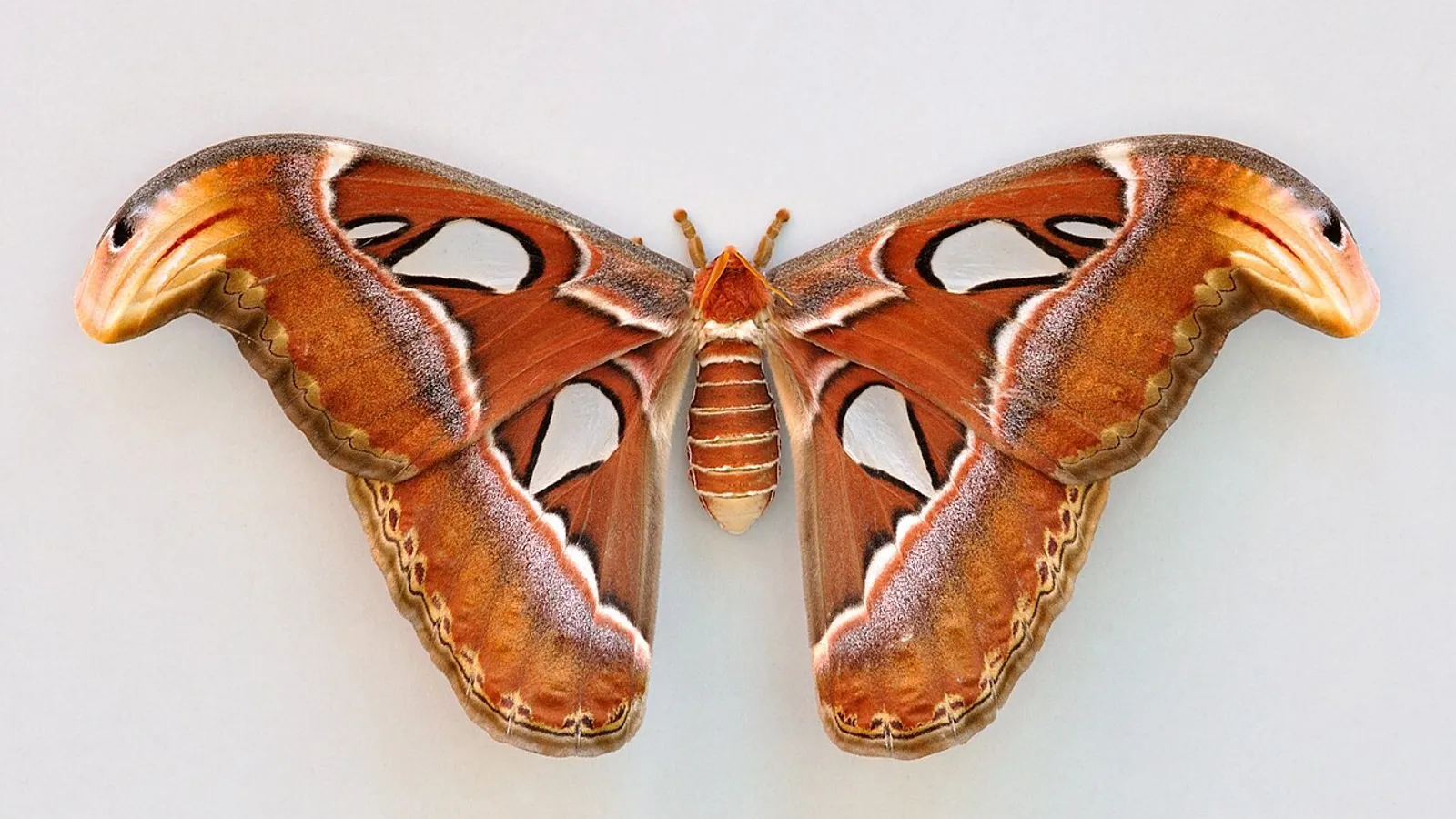
Atlas is the titan condemned to hold up the sky, and the name alludes to size. But the word has a second life that fits even better: from the titan comes the atlas, the book of maps, because Mercator put his likeness on the cover — and this moth’s wings are crossed by brown lines and clear windows that really do resemble a chart. The name says the strength and, without meaning to, the pattern.
— Facts
- Group
- Insects · Insecta
- Order
- Butterflies and moths
- Habitat
- Humid tropical forest and secondary woodland
- Range
- South-East Asia, from India to southern China and Indonesia
- Size
- 24–30 cm wingspan; among the largest wing areas in the world
- Diet
- Leaves as a caterpillar; as an adult it does not feed
- Lifespan
- 1–2 weeks as an adult
— Characteristics
- 01
The adult has no working mouth and lives on reserves.
- 02
The tip of each forewing mimics the head of a snake.
- 03
The male scents a female kilometres away with his feathered antennae.
— What sets it apart
The tips of the forewings are not decoration: curved, with a dark patch where the eye would be and a pale scale for the highlight, they mimic a snake’s head, and when the moth is disturbed it moves its wings slowly so that the false reptile “looks” towards the intruder. It is one of the most elaborate mimicries known. The adult lives a week or two and does not eat: it is born with its mouthparts already atrophied, and everything it has was gathered as a caterpillar. It has one task, and the time to do it is counted out by the fat it carries.
