European honey buzzard
Pernis apivorus
— Where the name comes from
Apivorus is Latin, “bee-eater”, from apis and vorare. It is only half right: it eats few bees, and lives mostly on the larvae of wasps and hornets, which it digs out of underground nests. Pernis comes from pérnēs, a name for a bird of prey found in Aristotle, which Cuvier revived without anyone knowing which bird Aristotle meant. The Italian pecchiaiolo also speaks of bees: pecchia is the Tuscan word for the insect.
— Facts
- Group
- Birds · Aves
- Order
- Diurnal birds of prey
- Habitat
- Broadleaf and mixed woodland interspersed with clearings and meadows
- Range
- Breeds in Europe and western Asia, winters in tropical Africa
- Size
- 52–60 cm, wingspan 113–150 cm, 0.5–1 kg
- Diet
- Larvae and combs of wasps and hornets; amphibians, reptiles and nestlings when insects are scarce
- Lifespan
- Over 20 years the record in the wild
— Characteristics
- 01
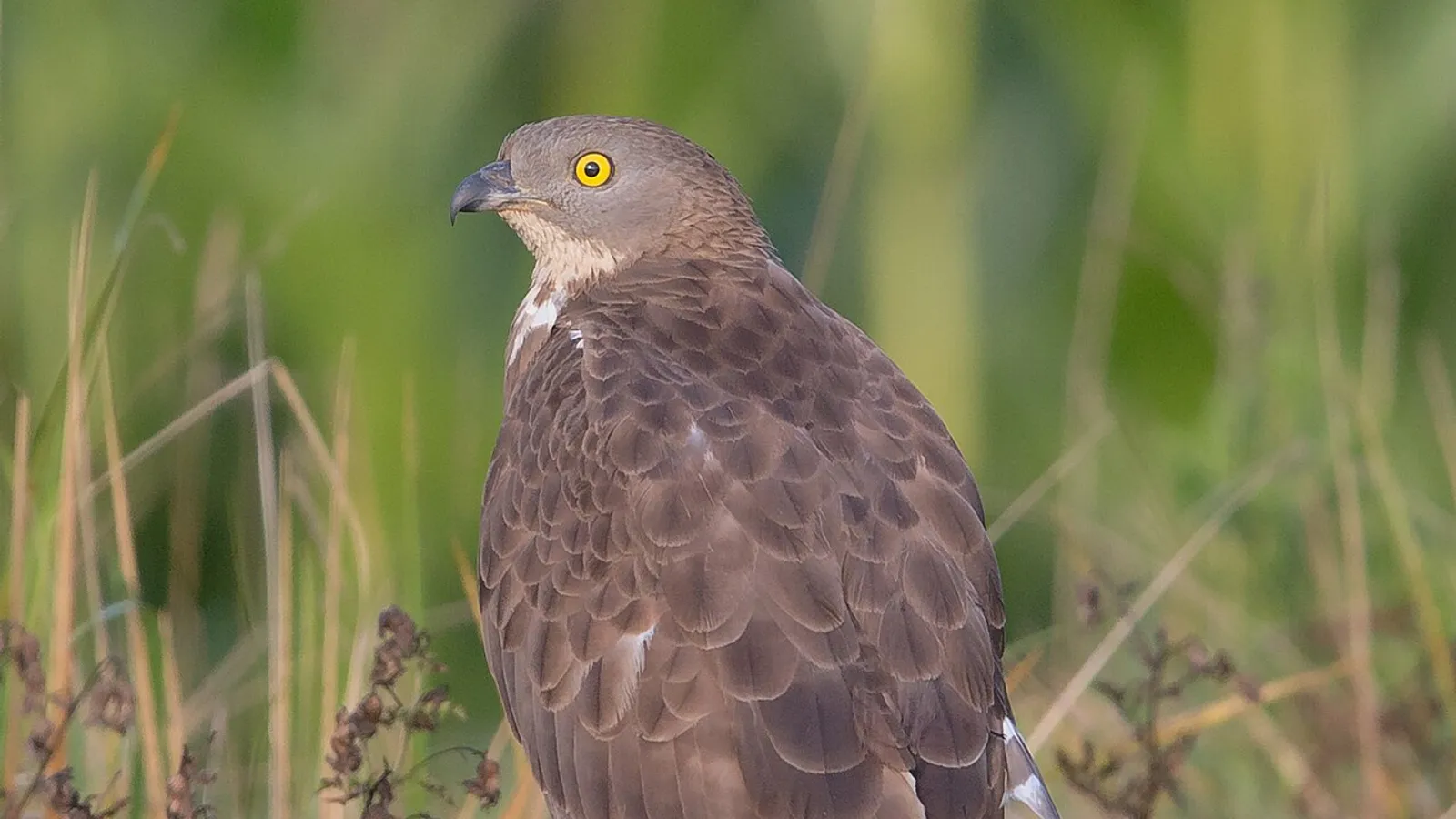
Its face is covered in short, stiff feathers packed like scales.
- 02
It digs out wasp nests with its feet, whose claws are only slightly curved, like a digger’s.
- 03
In spring it crosses the Strait of Messina by the thousand within a few days.
— What sets it apart
It is built to withstand stings. The feathers on its face are small overlapping plates in which a sting finds no gap, and its nostrils are narrow slits that do not clog with soil and wax. Over the Strait of Messina its spring passage has a sad history: in Calabria and Sicily the “adorni”, as they were called, were shot by tradition, and folk belief held that a man who failed to kill one risked being betrayed by his wife. The volunteer watch camps run since the 1980s have all but ended the poaching.