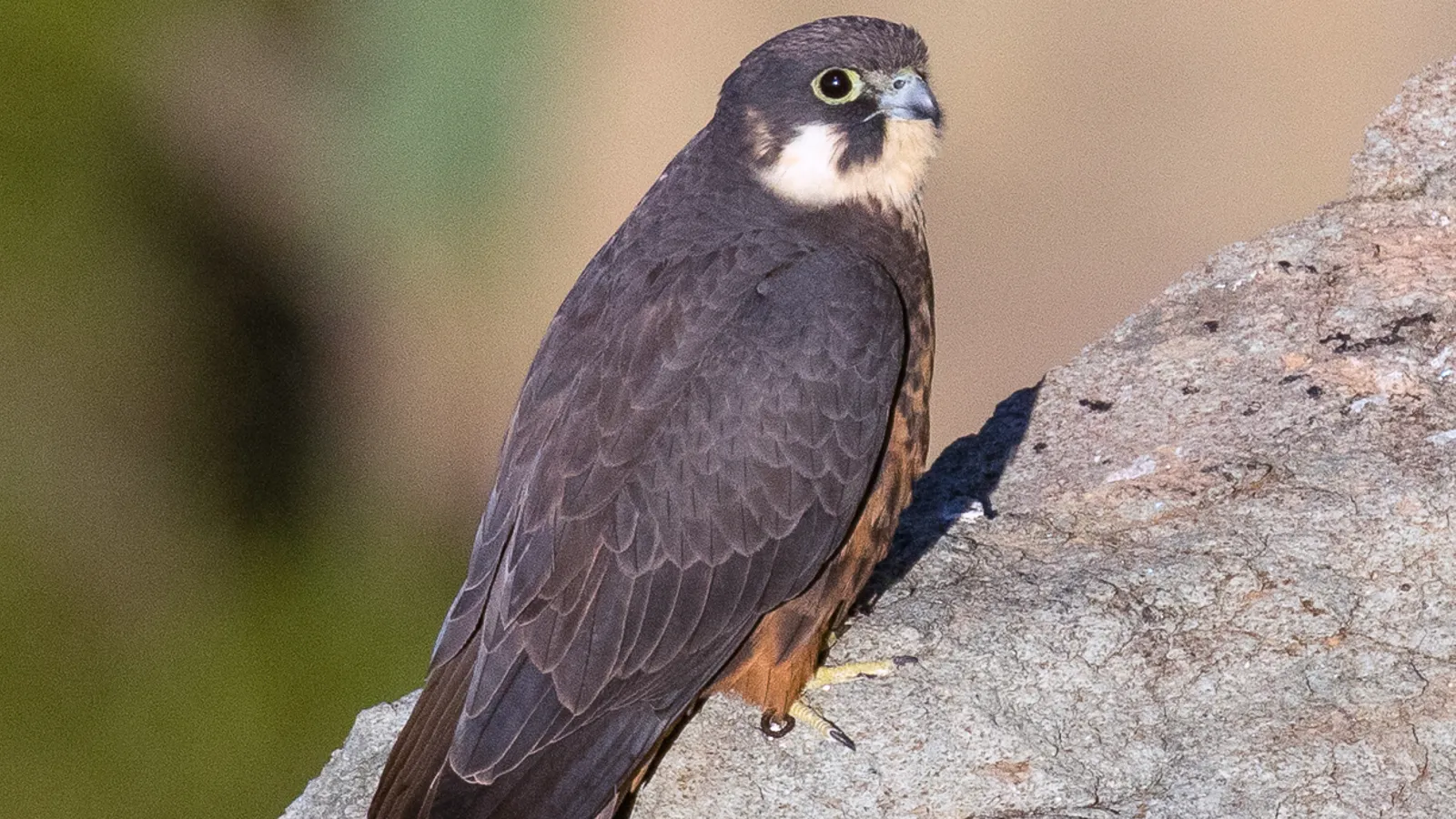
Eleonora's falcon
Falco eleonorae
— Where the name comes from
Eleonorae recalls Eleonora of Arborea, who ruled one of the Sardinian kingdoms at the end of the fourteenth century. The Carta de Logu, the legal code she issued, protected the nests of falcons and punished anyone who took the young: when the naturalist Giuseppe Gené described this species in Sardinia in 1839, he dedicated its name to her. Falco, in late Latin, has a disputed origin: some link it to falx, the sickle, for the shape of the wings.
— Facts
- Group
- Birds · Aves
- Order
- Falcons
- Habitat
- Sea cliffs and rocky islets
- Range
- Mediterranean islands, the Canaries and the coast of Morocco; winters in Madagascar
- Size
- 36–42 cm, wingspan 87–104 cm, 350–460 g
- Diet
- Large insects for most of the year; small migrating birds while breeding
- Lifespan
- 10–15 years
— Characteristics
- 01
It comes in two forms, one pale and one almost black.
- 02
It nests in colonies on sea cliffs, a few metres from one nest to the next.
- 03
To winter it flies all the way to Madagascar, by night as well as by day.
— What sets it apart
It has shifted its breeding season to coincide with a banquet. Almost every European bird of prey raises its young in spring; Eleonora’s falcon lays at the end of July, and its chicks are hungry in September, when millions of songbirds cross the Mediterranean bound for Africa. The colonies spread along the cliffs like a net and intercept tired migrants over the sea. When the season ends it sets off in turn, and spends the winter in Madagascar, more than seven thousand kilometres away.