
Stoat
Mustela erminea
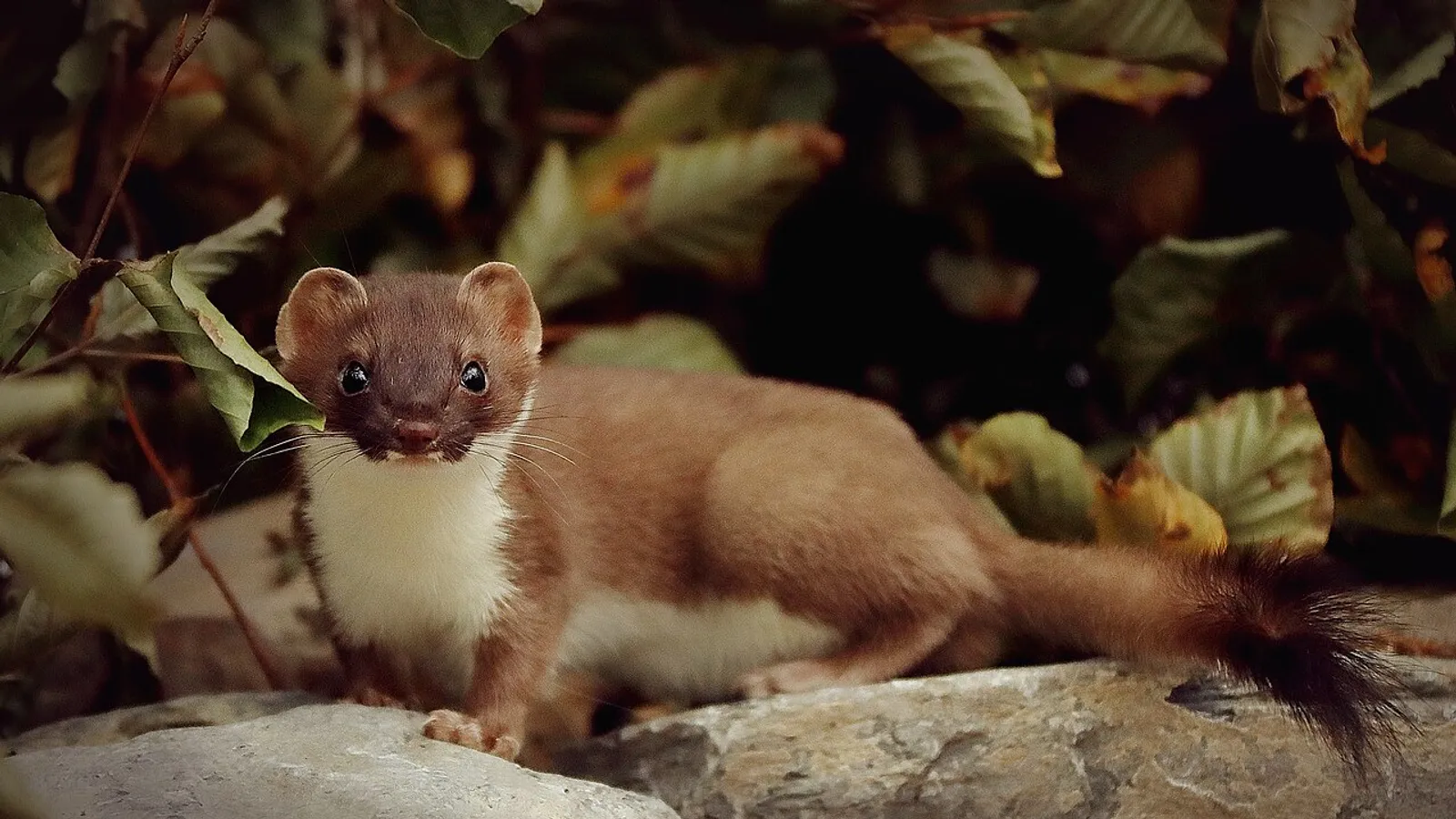
— Where the name comes from
Mustela is the old Latin name of the weasel, of disputed etymology and perhaps linked to mus, “mouse”. The epithet erminea goes back to the medieval Latin (mus) armenius, “Armenian mouse”: the white winter fur reached Europe along the eastern routes and was credited to that origin, though the animal is widespread across northern latitudes. An alternative theory derives it from the Old High German harmo, “weasel”. In Italian ermellino names both the beast and its pelt: a name born more in furriers’ workshops than in the woods.
— Facts
- Group
- Mammals · Mammalia
- Order
- Carnivores
- Habitat
- Woodland, grassland, heath and tundra, up to alpine altitudes
- Range
- Northern and temperate Eurasia, from Ireland to Siberia and Japan, with outposts in far northern North America; introduced to New Zealand
- Size
- 17–33 cm of body plus 4–12 cm of tail, 100–445 g
- Diet
- Carnivore — voles, mice, young rabbits, eggs and nestlings
- Lifespan
- 1–2 years in the wild, up to 7 in captivity
— Characteristics
- 01
In autumn it moults to pure white, except the tip of the tail, which stays black in every season.
- 02
It kills prey up to five times its own weight with a precise bite to the nape.
- 03
It practises embryonic diapause: implantation is postponed for months and the young are born almost a year after mating.
- 04
Females can be mated in the nest, still blind and suckling, by adult males.
— What sets it apart
The black tip of the tail, the one mark on an otherwise immaculate coat, is probably a decoy: stooping hawks and owls aim at the contrast and miss the body by a few centimetres. But it is precisely that detail that made the animal’s symbolic fortune, because the pelts were sewn so as to dot the white of royal robes with black, a pattern heraldry later codified. From there came the legend that the ermine would rather be caught than cross mud and soil itself, summed up in the motto malo mori quam foedari, “better to die than be stained”. It became an emblem of purity for orders of chivalry, for the dukes of Brittany and, in the portrait of Cecilia Gallerani, for Ludovico il Moro. A small carnivore capable of emptying a nest of rabbits thus became the image of innocence.
