
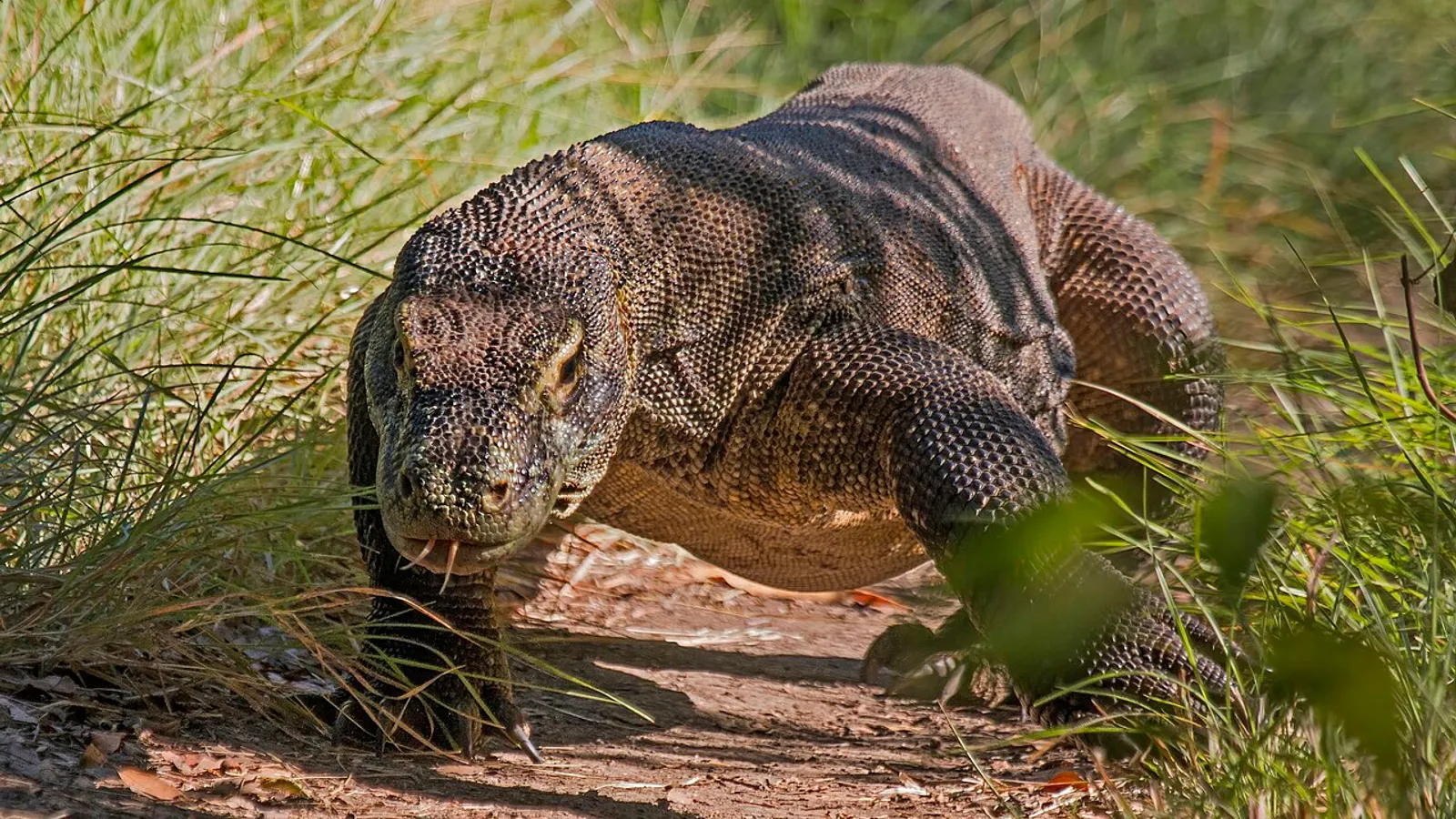
Komodo dragon
Varanus komodoensis
— Where the name comes from
Varanus comes from the Arabic waral, “lizard”, by way of scientific French. Komodoensis is simply “of Komodo”, the Indonesian island where the first specimens were described in 1912, after pilots had reported them as land crocodiles.
— Facts
- Group
- Reptiles · Reptilia
- Order
- Squamates
- Habitat
- Arid savannah, monsoon forest
- Range
- A few of the Sunda islands: Komodo, Rinca, Flores
- Size
- 2–3 m, up to 90 kg
- Diet
- Carnivore — deer, buffalo, carrion
- Lifespan
- about 30 years
— Characteristics
- 01
The largest living lizard.
- 02
The forked tongue carries scent molecules to the Jacobson’s organ: it smells in stereo.
- 03
It has venom glands in the lower jaw, long mistaken for mere bacteria.
— What sets it apart
Female Komodo dragons can reproduce by parthenogenesis, with no male at all. In reptiles sex is set by ZW chromosomes: the female is ZW, the male ZZ. An unfertilised egg can only yield ZZ or WW — and WW is not viable. So a female alone on an island produces exclusively male offspring, and can then mate with them to repopulate. It is a strategy for colonising an island with a single individual.
