
Ornate wrasse
Thalassoma pavo
— Where the name comes from
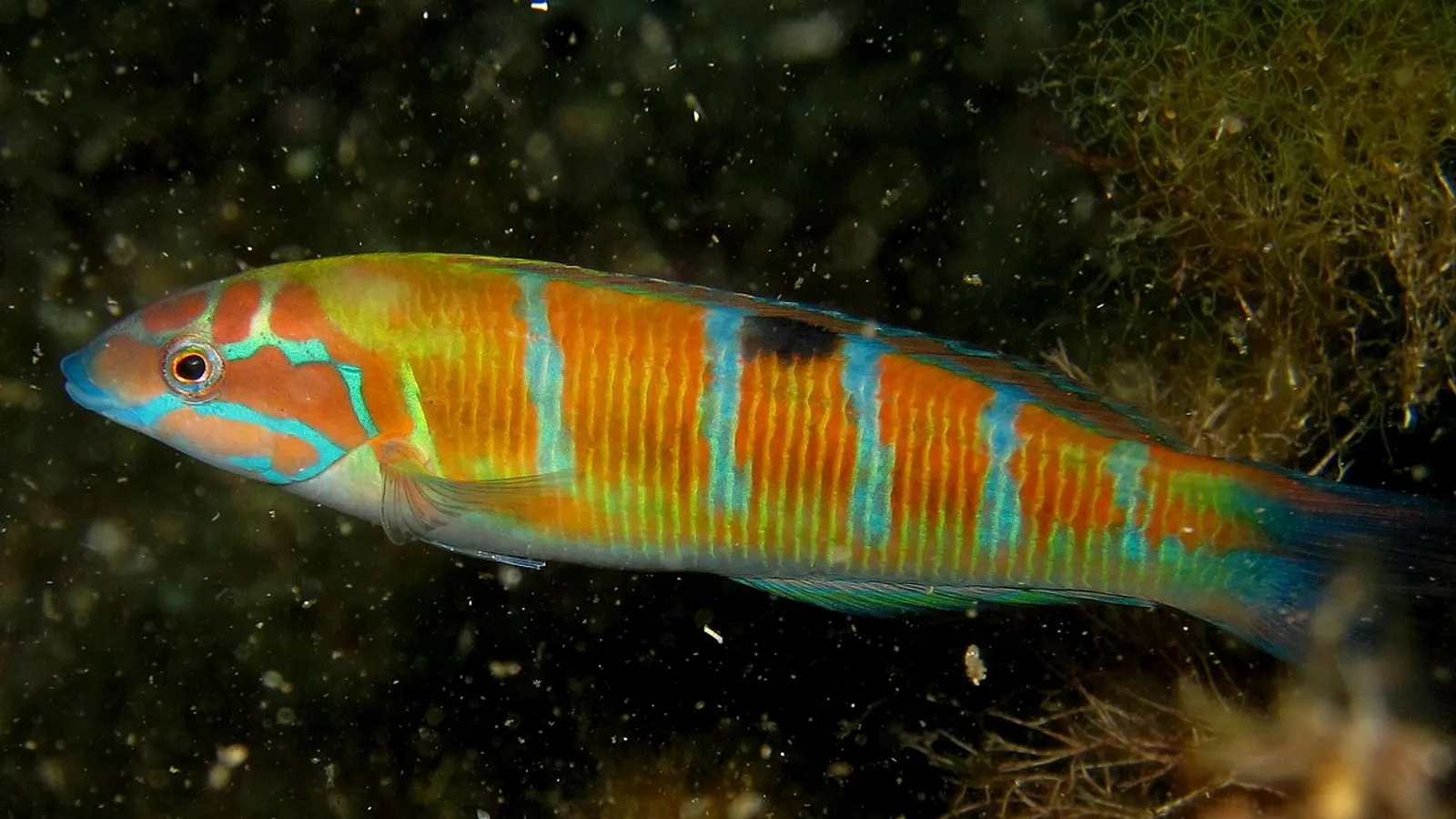
Thalassoma is “sea body”, from thálassa and sôma; pavo is the peacock, for the colours of the adult male — green, blue, orange and a blue crescent behind the head. The Italian donzella, “damsel”, refers instead to the delicate look of the females, and is one of the rare common names that describes the less showy sex.
— Facts
- Group
- Fish · Actinopterygii · Chondrichthyes
- Order
- Perch-likes
- Habitat
- Rocky bottoms and seagrass beds down to 30 metres
- Range
- The Mediterranean and the subtropical eastern Atlantic
- Size
- 15–25 cm, 80–150 g
- Diet
- Molluscs, crustaceans, urchins, fish eggs
- Lifespan
- 8 years
— Characteristics
- 01
At night it buries itself in the sand to sleep.
- 02
It is born female and the largest become male, changing colour.
- 03
It follows divers and bottom-feeding fish to profit from what they uncover.
— What sets it apart
It is the Mediterranean’s thermometer. A warm-water species, until the 1980s it was common only in the southern basin and rare north of Tuscany; today it is abundant in Liguria, in the northern Adriatic and along the French coast, and its advance northwards has been measured year by year by underwater surveys. With other southern species it makes up what ecologists call the tropicalisation of the Mediterranean, and it can be watched with a mask in two metres of water.
