
Mediterranean rainbow wrasse
Coris julis
— Where the name comes from
Coris comes from the Greek kóris, the bug, for reasons now obscure; julis was the Greek name of a small colourful Mediterranean fish, and from it comes the dialect name giulia used across half of Italy for this species’ female phase. That male and female have different names is no accident: they were long believed to be two species.
— Facts
- Group
- Fish · Actinopterygii · Chondrichthyes
- Order
- Perch-likes
- Habitat
- Rocky bottoms, seagrass and sand between 1 and 120 metres
- Range
- The Mediterranean and the eastern Atlantic
- Size
- 15–25 cm, 50–120 g
- Diet
- Small crustaceans, molluscs, worms
- Lifespan
- 10 years
— Characteristics
- 01
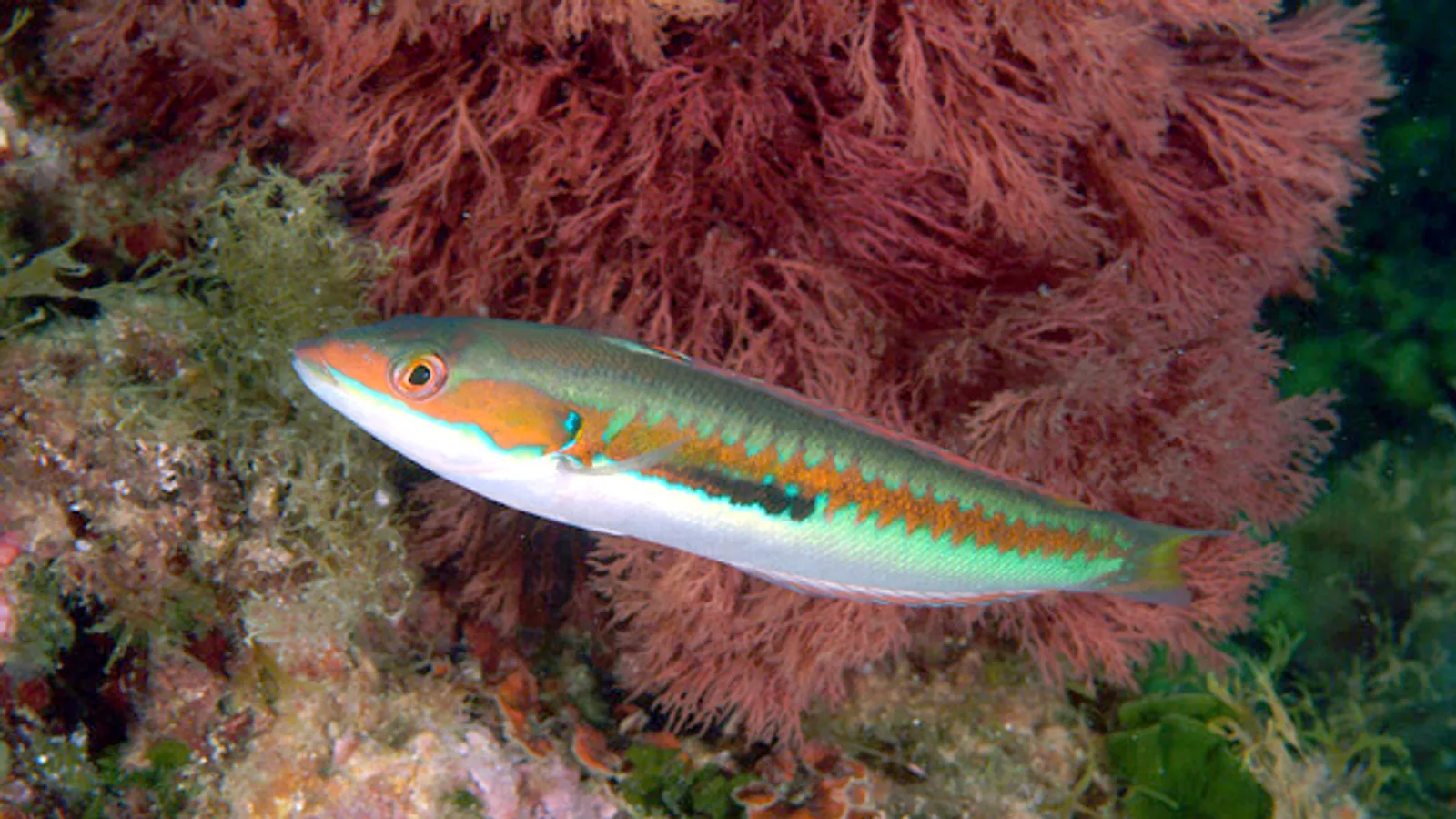
The female is brown-orange with a pale stripe; the male has an orange zigzag band.
- 02
It sleeps buried in sand and takes refuge there if startled.
- 03
It is the first fish to arrive whenever anybody turns over a stone.
— What sets it apart
Every male was once a female. This species is born female and lives so for some years; then, if its social position allows, an individual changes sex and with it its colours, passing within weeks from the drab livery to the bright zigzag one. In the nineteenth century the two phases were catalogued as separate species, and it is one of the cases in which taxonomy based on preserved specimens got wrong for a century something anyone would have grasped by watching living animals for one summer.
