
Kirk's dik-dik
Madoqua kirkii
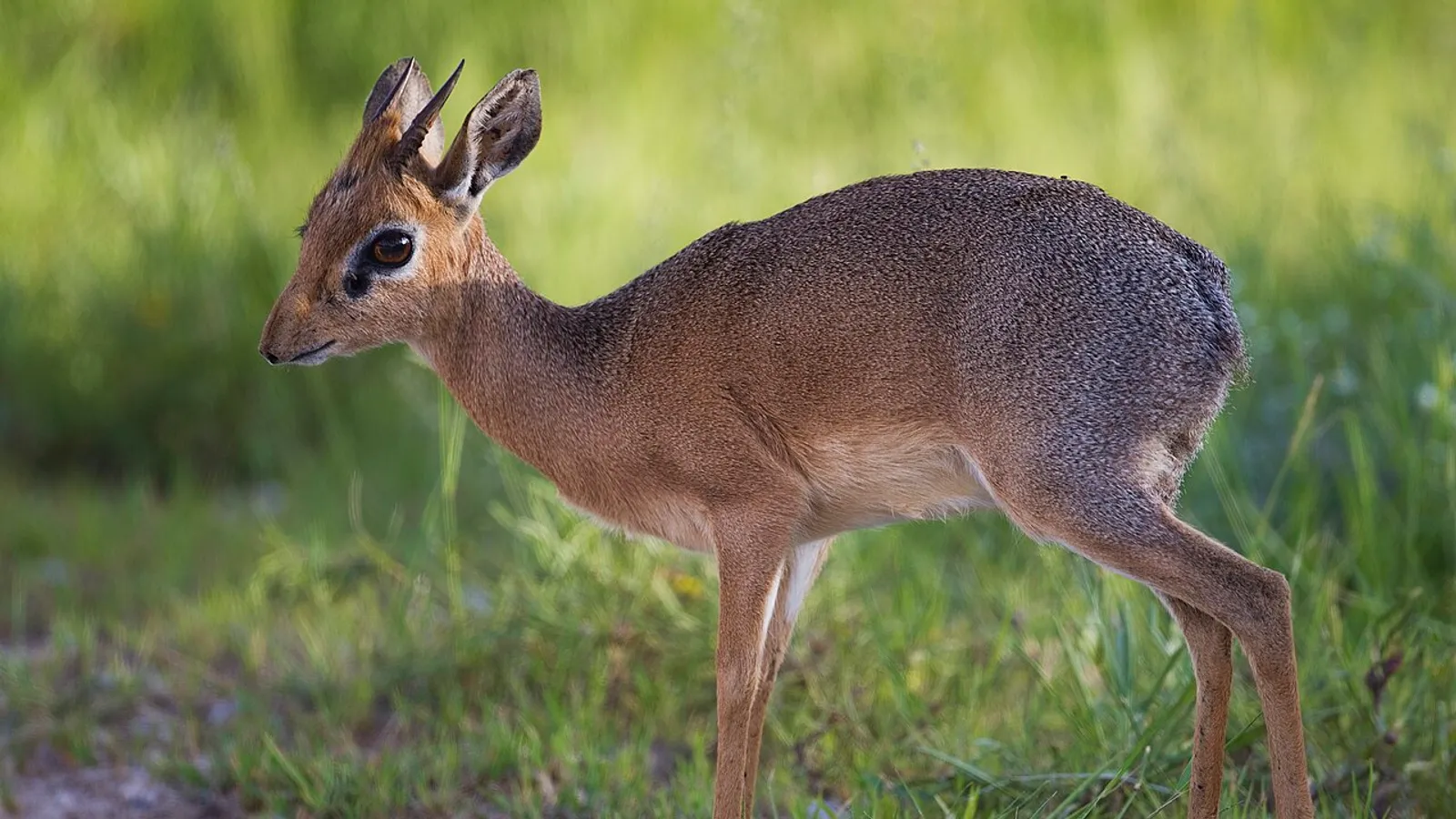
— Where the name comes from
Madoqua latinises midaqqwa, the animal’s Amharic name. Kirkii recalls John Kirk, a Scottish physician and naturalist, consul at Zanzibar. But “dik-dik” is pure onomatopoeia: it is the female’s alarm call, a dry repeated whistle that carries far through the bush and that gave the animal its name in Swahili, in English and by now in every language.
— Facts
- Group
- Mammals · Mammalia
- Order
- Even-toed ungulates
- Habitat
- Arid bushland with dense cover and bare ground
- Range
- Eastern and south-western Africa, in two widely separated populations
- Size
- 55–72 cm of body, 3–7 kg
- Diet
- Herbivore — leaves, shoots, fruit, flowers
- Lifespan
- 10 years in the wild
— Characteristics
- 01
The muzzle is a short mobile proboscis run through with blood vessels.
- 02
It lives in monogamous pairs that stay together for life and defend the same territory.
- 03
It does not drink: like the gerenuk it takes its water from food.
— What sets it apart
The elongated nose is a cooling plant. Inside it runs a very dense network of blood vessels, and when the animal is hot it starts breathing rapidly through the snout: the passing air evaporates moisture from the membranes and cools the blood on its way to the brain, without spending a drop of water on sweat. It is the principle of the evaporative cooling tower, and it lets a seven-kilo antelope endure temperatures that would kill it, in a place where there is nothing to drink.
