
Sable antelope
Hippotragus niger
— Where the name comes from
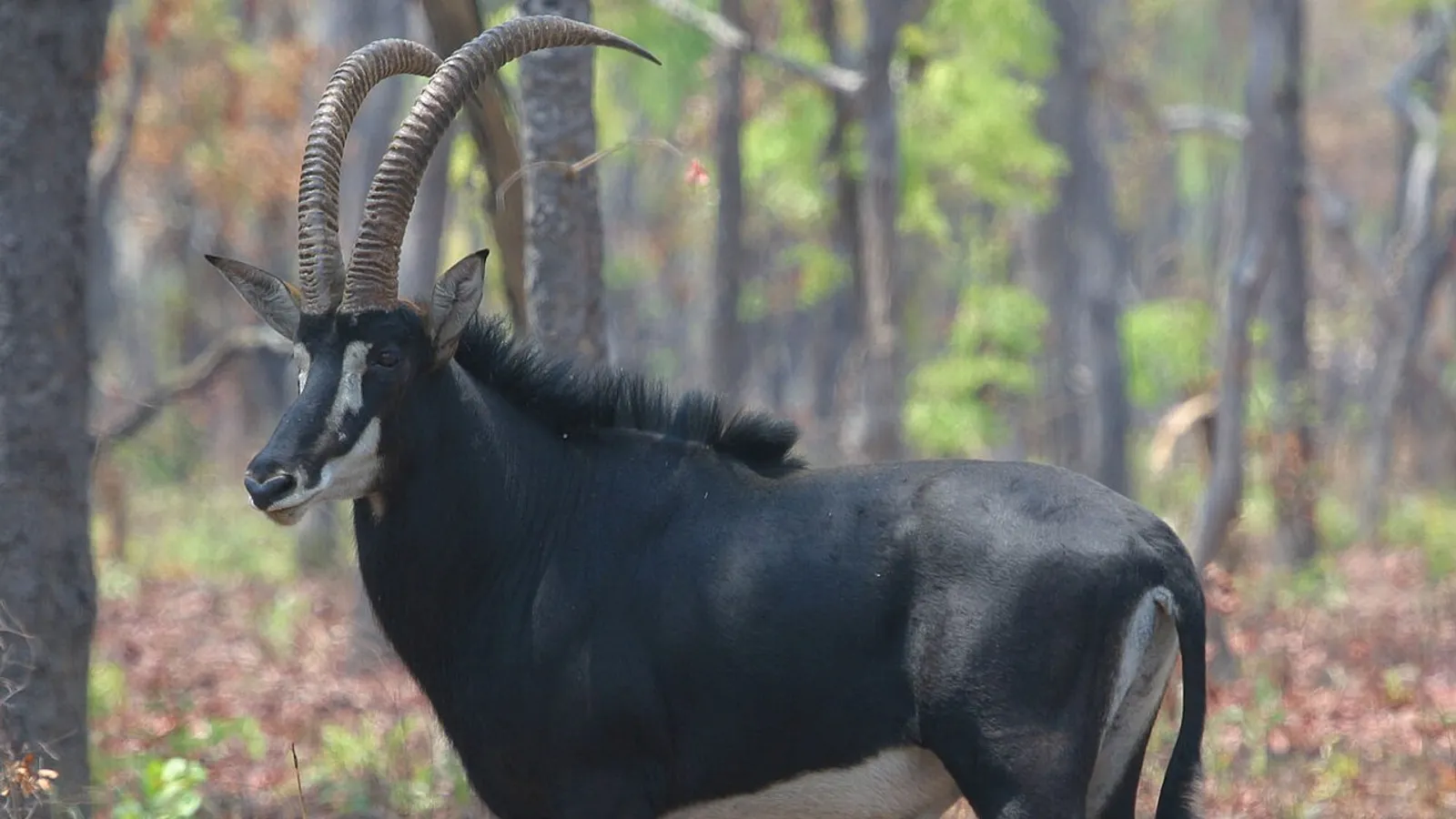
Hippotragus is “horse-goat”, from the Greek híppos and trágos: another chimera, the third in this group after the hartebeest and the takin. Niger is the Latin for “black”, and applies only to the adult male, who with age turns from chestnut to glossy black. In English it is the sable antelope, sable being the fur of the marten — there too, a blackness borrowed from another animal’s name.
— Facts
- Group
- Mammals · Mammalia
- Order
- Even-toed ungulates
- Habitat
- Wooded savannah, especially miombo forest with grassy glades
- Range
- Eastern and southern Africa, from Kenya to Angola and South Africa
- Size
- 190–255 cm of body, 190–270 kg
- Diet
- Herbivore — grasses, leaves, and it gnaws bones for calcium
- Lifespan
- 17 years in the wild
— Characteristics
- 01
The horns, carried by both sexes, reach a metre and sixty in males.
- 02
It defends itself by kneeling and slashing backwards with its arched horns.
- 03
It gnaws old bones to make up phosphorus and calcium, a behaviour called osteophagy.
— What sets it apart
It is one of the few antelope a lion would rather avoid. Cornered, it does not flee: it drops onto its front knees, lowers its head and uses the curved horns as two sabres, lashing backwards over its shoulders with a force that has killed adult lions. There are accounts of lions impaled and dead on the spot. It is why, where it is abundant, predators concentrate on gentler prey — and why colonial sport hunters reckoned it the most dangerous trophy in southern Africa.
