
Amazon river dolphin
Inia geoffrensis
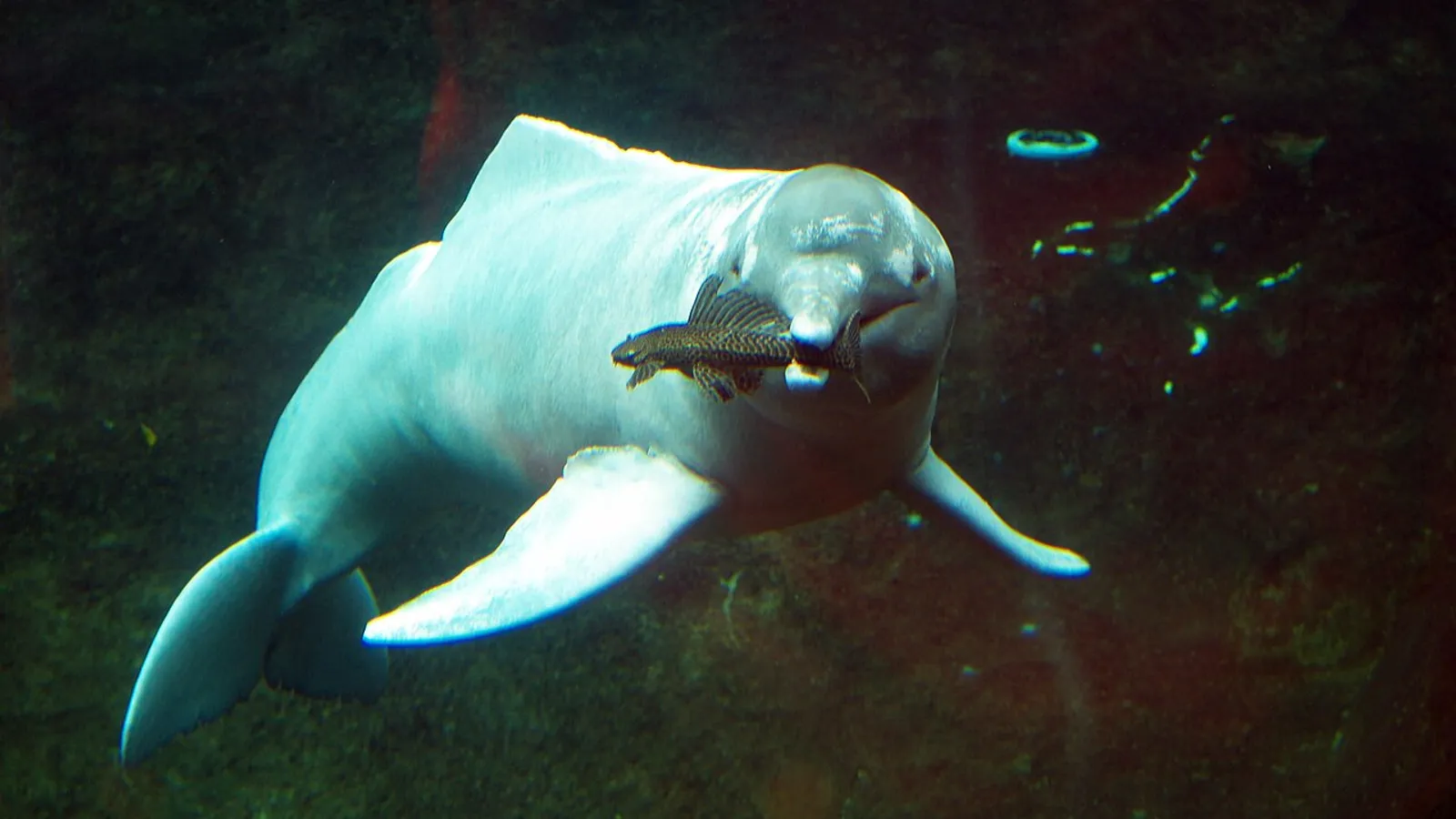
— Where the name comes from
Inia is an indigenous Bolivian name gathered by the first naturalists; geoffrensis honours Étienne Geoffroy Saint-Hilaire, who brought a specimen to Paris. In Amazonia it is the boto, and in folklore it is an enchanter: legend says that on festival nights it turns into a beautiful man dressed in white, with a hat hiding the blowhole, and seduces the girls of the village — the traditional explanation for pregnancies with no father named.
— Facts
- Group
- Mammals · Mammalia
- Order
- Cetaceans
- Habitat
- Rivers, lakes, and flooded forest during the high water
- Range
- The Amazon and Orinoco basins
- Size
- 2–2.5 m, 85–185 kg
- Diet
- Carnivore — over fifty species of fish, crabs, small turtles
- Lifespan
- About 30 years
— Characteristics
- 01
Its neck vertebrae are not fused: it turns its head ninety degrees, unique among cetaceans.
- 02
In the flood season it swims among the trunks of the flooded forest, kilometres from the river bed.
- 03
The pink deepens with age in males, and is scar tissue from fighting.
— What sets it apart
It swims in the forest. When the Amazon floods, the water rises more than ten metres and drowns thousands of square kilometres of forest, and the boto leaves the river to hunt among the submerged trunks. To do so it has had to give up almost everything that makes a dolphin fast: a mobile neck for turning in tight spaces, broad flexible flippers instead of tapered ones, a long bristled snout for probing the bottom. It is a cetacean that traded speed for the ability to manoeuvre between trees.
