
Common degu
Octodon degus
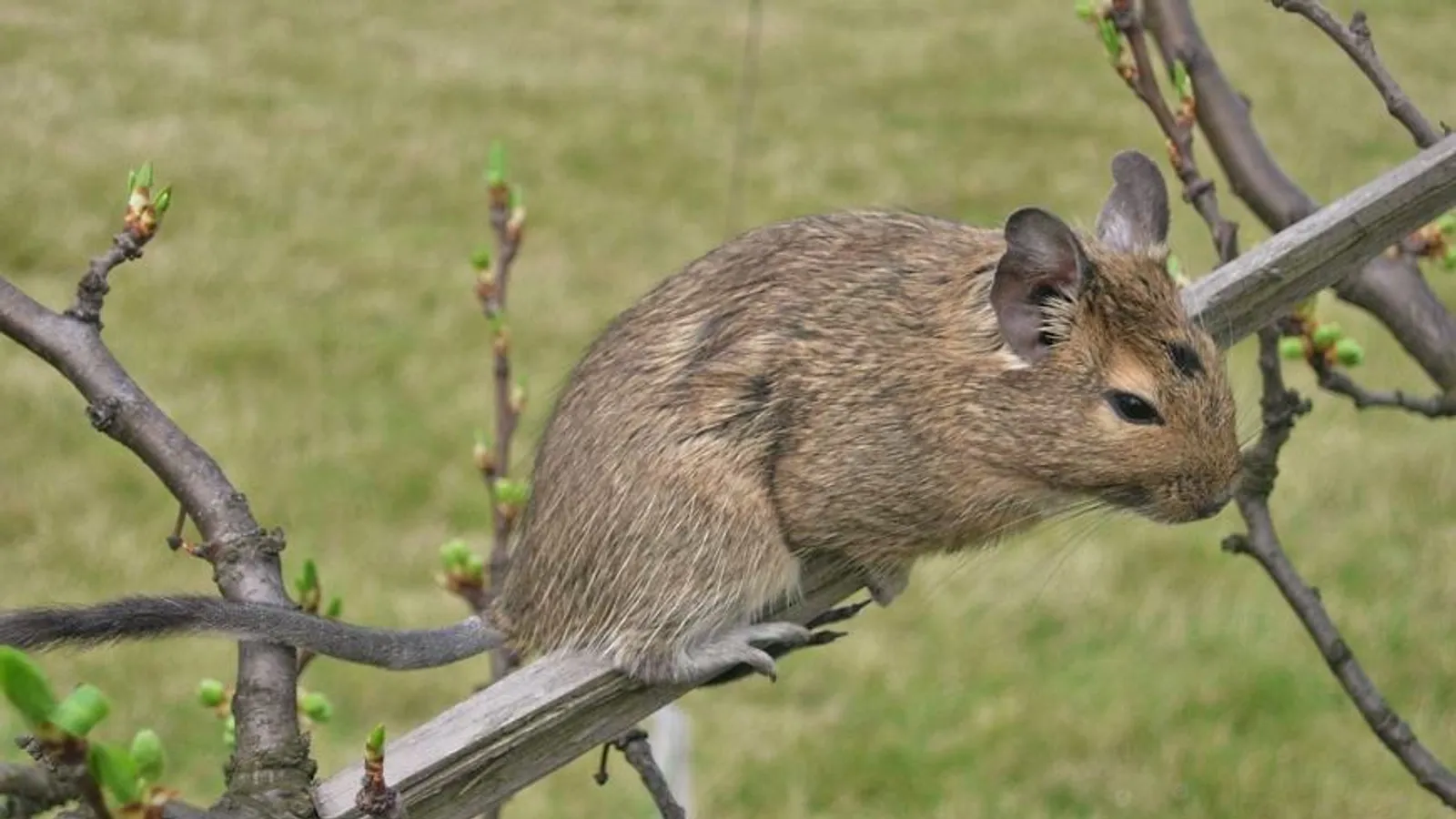
— Where the name comes from
Octodon is “eight teeth”, from októ and odoús: the chewing surfaces of the molars, seen from above, draw a figure of eight. Degus, on the other hand, comes from the Mapudungun dewü, the name the Mapuche of central Chile gave this rodent. The binomial thus joins a dental detail observed under the microscope to an indigenous Andean word.
— Facts
- Group
- Mammals · Mammalia
- Order
- Rodents
- Habitat
- Chilean matorral, arid slopes, farmland
- Range
- Central Chile, from sea level to 1,200 m
- Size
- 25–31 cm including the tail, 170–300 g
- Diet
- Grasses, seeds, bark, leaves
- Lifespan
- 7 years in captivity
— Characteristics
- 01
It is diurnal, rare among rodents, and its eyes perceive ultraviolet.
- 02
The tail breaks off if seized and never grows back.
- 03
It lives in colonies with shared burrows and sentries taking turns.
— What sets it apart
With age it spontaneously develops beta-amyloid plaques in the brain, the same as in human Alzheimer’s, and it is one of the very few animals in which the disease appears without being artificially induced. Together with the fact that it is diurnal, social and able to learn complex tasks, this has made it an increasingly used model in studies of cognitive ageing, with the ethical complication that it is an intelligent, affectionate animal also kept as a pet.
