
European fallow deer
Dama dama
— Where the name comes from
Dama takes up the Latin dama or damma, which named any small deer or antelope in general; the ultimate origin is uncertain, perhaps Celtic, perhaps pre-Roman Mediterranean, and it is the same root that through vulgar Latin gave the Italian daino. In ancient authors the term has no zoological precision at all: roe deer, fallow deer, gazelle, any swift horned beast fleeing before the hounds. It was Linnaeus, in 1758, who fixed it on a single species, and then doubled it into Dama dama. A vague name for two thousand years, made exact in one line.
— Facts
- Group
- Mammals · Mammalia
- Order
- Even-toed ungulates
- Habitat
- Open broadleaf woodland with wide glades, and Mediterranean scrub
- Range
- Native to Anatolia and the southern Balkans; introduced across almost all of Europe and into Africa, the Americas and Oceania
- Size
- 130–175 cm long, 85–95 cm at the shoulder, 35–100 kg
- Diet
- Herbivore — grasses, leaves, buds, acorns and chestnuts
- Lifespan
- 10–16 years in the wild, over 20 in captivity
— Characteristics
- 01
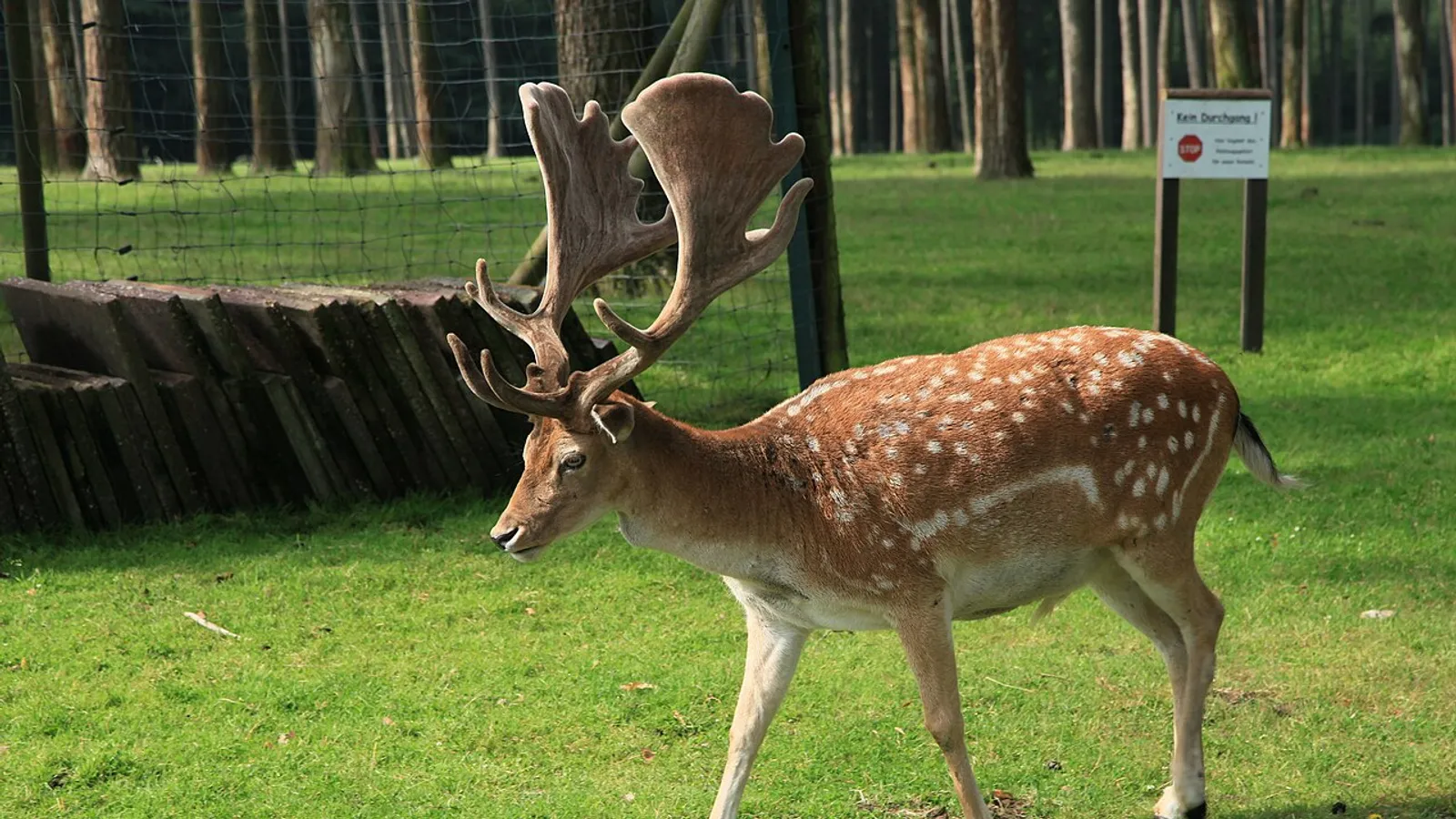
It is the only European deer with palmate antlers, flattened into a blade at the top.
- 02
The white-spotted coat persists into adulthood, with variants running from near-black to pure white.
- 03
In the rut the bucks give a deep, measured groan, repeated for hours from the same small courtship arena.
— What sets it apart
The fallow deer grazing in English parks, on Tuscan estates or on Mediterranean islands is almost never a relic of wild fauna: it is the descendant of animals carried there by people. The ice ages confined it to a strip of Anatolia and southern Greece, and from there it was brought back first by the Phoenicians and the Romans, who kept it in their vivaria, then by the Normans, who stocked the English hunting parks with it. The “wild” European populations all derive from those releases, and genetics confirms it by following the trail of ancient trade. The fallow deer is less an animal of Europe than a souvenir of the eastern Mediterranean, released and forgotten for three thousand years.
