
Red crossbill
Loxia curvirostra
— Where the name comes from
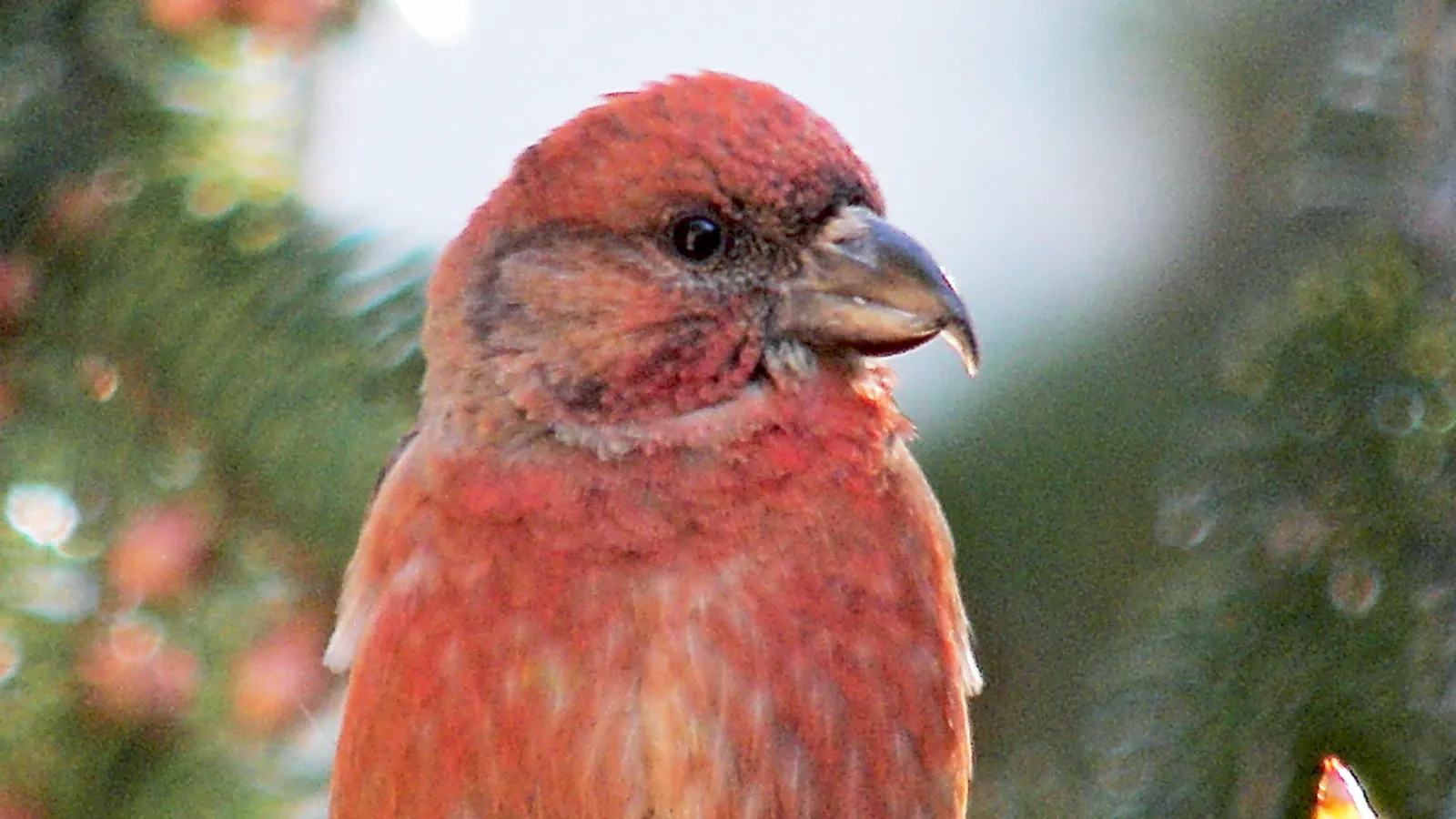
Loxia comes from the Greek loxós, “slanting, crooked”, and curvirostra is Latin for “curved bill”: the binomial insists twice on the same deformity, which is no deformity at all. The two tips of the bill cross like the blades of a pair of scissors, and it is the only tool in the world capable of prising apart the scales of a closed cone.
— Facts
- Group
- Birds · Aves
- Order
- Passerines
- Habitat
- Coniferous forest, spruce woods, mountain pinewoods
- Range
- Europe, Asia and North America, wherever there are conifers
- Size
- 15–17 cm, wingspan 27–30 cm, 34–48 g
- Diet
- Almost entirely conifer seeds
- Lifespan
- 5 years in the wild
— Characteristics
- 01
It slides the closed bill between two scales and opens it: the cone gives way.
- 02
It nests even in January, in snow, if the cones are ripe.
- 03
Nomadic: it follows the cone crops for thousands of kilometres.
— What sets it apart
Half of all crossbills have the bill tip crossed to the right and half to the left, and each turns around the cone in the direction its own bill dictates: two populations of left- and right-handers living in the same wood. Within the species there are then at least ten “call types”, each tied to a different conifer and each with a slightly different bill size, which do not interbreed although they look identical. It is a species coming apart into many, and the cutting plan is the shape of a cone.
