
Common raven
Corvus corax
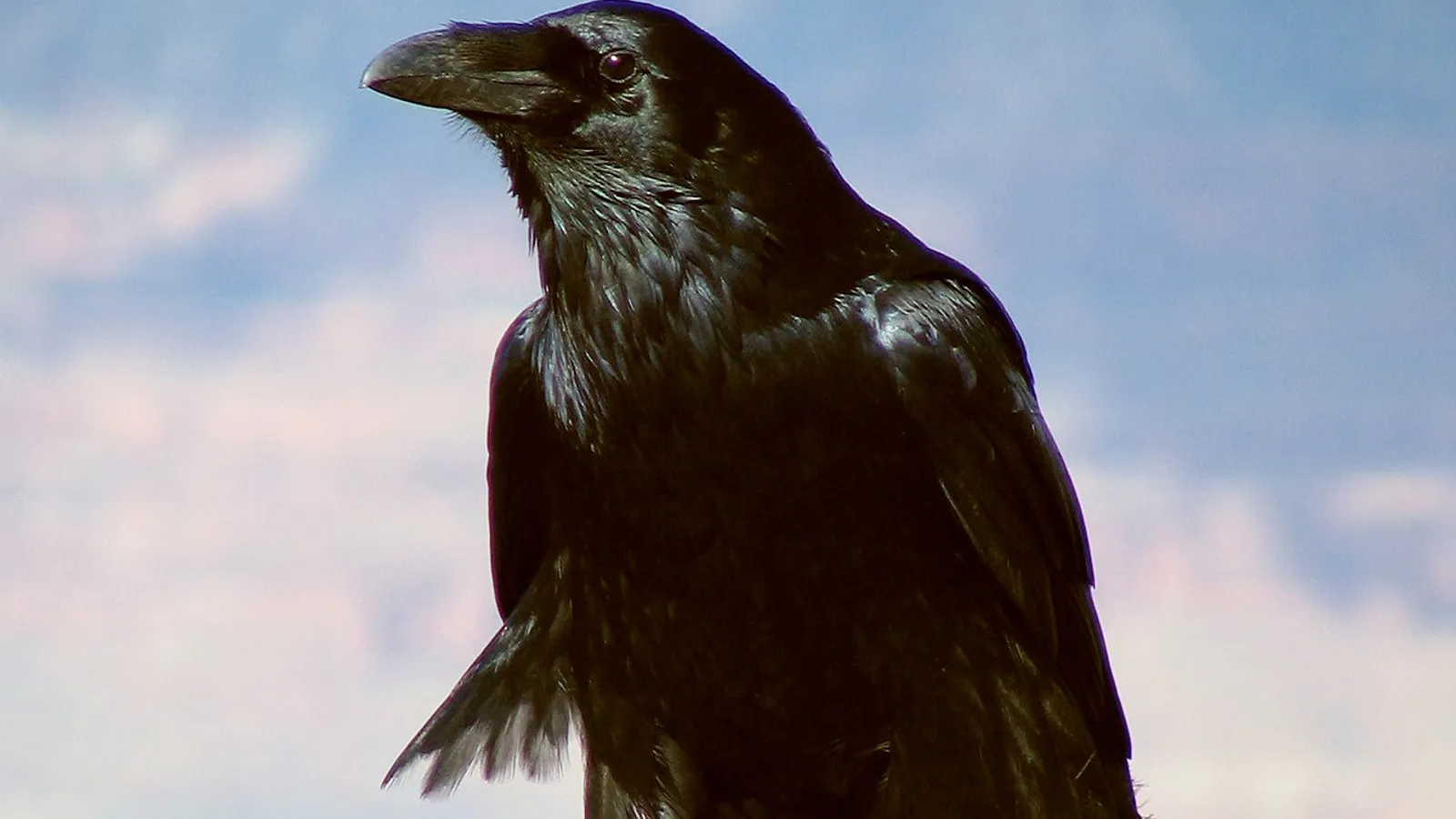
— Where the name comes from
The Latin corvus and the Greek kórax are both onomatopoeic: they reproduce the croak. It is among the oldest and most stable animal names in the Indo-European languages — the word never changed because the call never changed.
— Facts
- Group
- Birds · Aves
- Order
- Passerines
- Habitat
- Mountains, rocky coasts, deserts, forests
- Range
- The whole northern hemisphere
- Size
- 54–67 cm, 115–150 cm wingspan
- Diet
- Omnivorous and opportunistic
- Lifespan
- 15–20 years in the wild
— Characteristics
- 01
The largest of the perching birds.
- 02
Solves problems in several steps and plans for the future.
- 03
Flies acrobatically, with rolls and upside-down passes, apparently for play.
— What sets it apart
Ravens hide food, and in hiding it they take account of who is watching: if another raven is looking, they come back later to move the cache. In controlled experiments they do it even when no rival is visible but one could be — an open peephole is enough. They are modelling another individual’s state of mind, which is to say doing something very close to what we call theory of mind.
