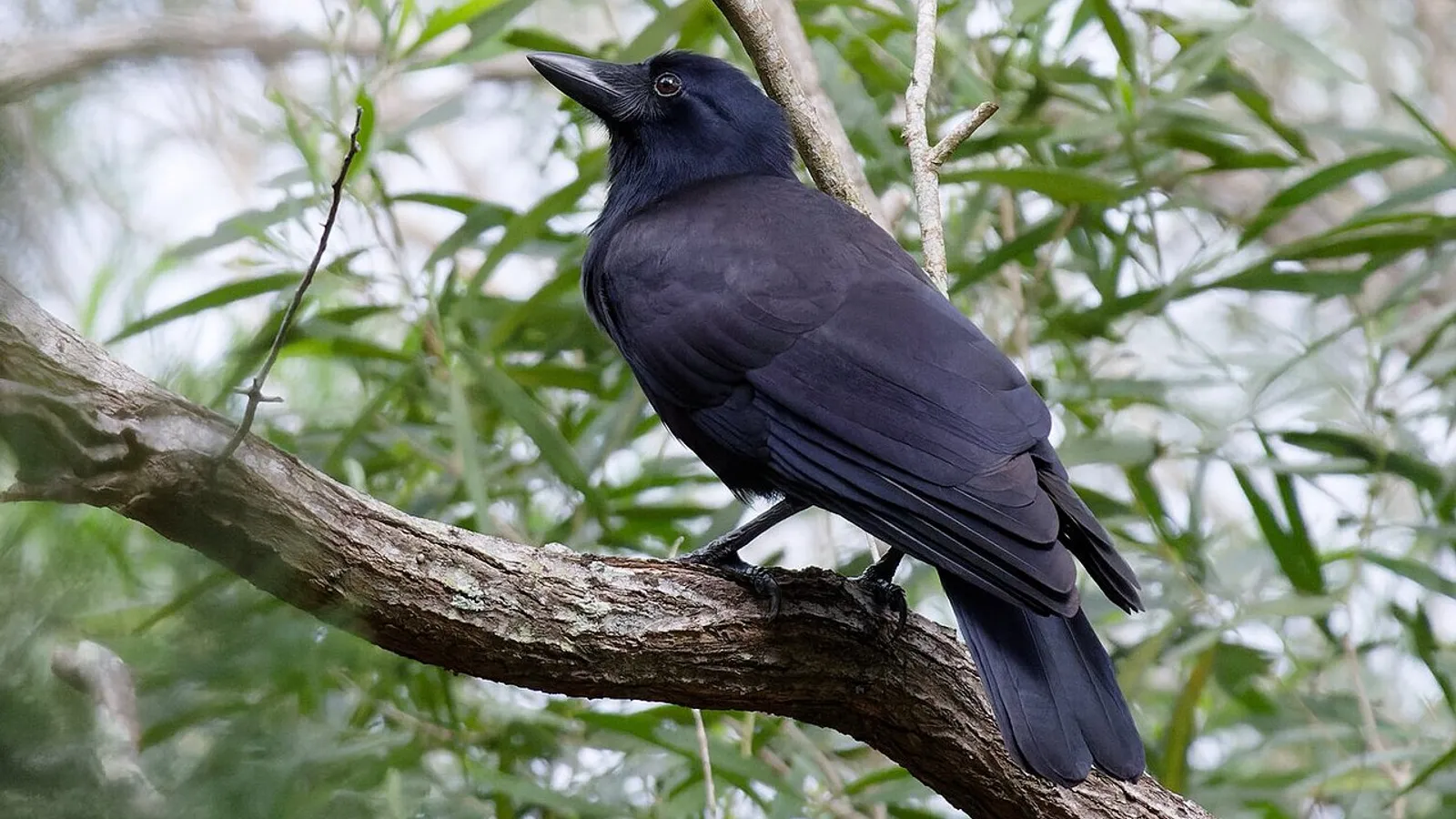
New Caledonian crow
Corvus moneduloides
— Where the name comes from
Corvus is Latin for crow; moneduloides means “jackdaw-like”, from monedula, the Latin name of the jackdaw, and the Greek suffix -oeidḗs, “resembling”. Lesson described it in 1831 without suspecting that it was one of the most ingenious animals on the planet.
— Facts
- Group
- Birds · Aves
- Order
- Passerines
- Habitat
- Humid and dry forest, scrub
- Range
- New Caledonia: Grande Terre and the island of Maré
- Size
- 40 cm, about 250–300 g
- Diet
- Beetle larvae extracted from wood, snails, nuts, seeds
- Lifespan
- Not precisely known
— Characteristics
- 01
It is all black, with a straight bill it uses like a tool.
- 02
It makes hooks from forked twigs to extract larvae from wood.
- 03
Young birds learn to build tools by watching adults.
— What sets it apart
It does not just use tools: it makes them, and improves them. In the wild it breaks off twigs and shapes one end into a hook, or cuts stepped, serrated strips from pandanus leaves, with a technique that varies from one part of the island to another like a local tradition. In 2002, in Oxford, a female called Betty bent a piece of wire into a hook on her own to fish a basket out of a tube, and in 2018 other crows assembled compound tools by fitting together pieces too short to work on their own.