
Crown-of-thorns starfish
Acanthaster planci
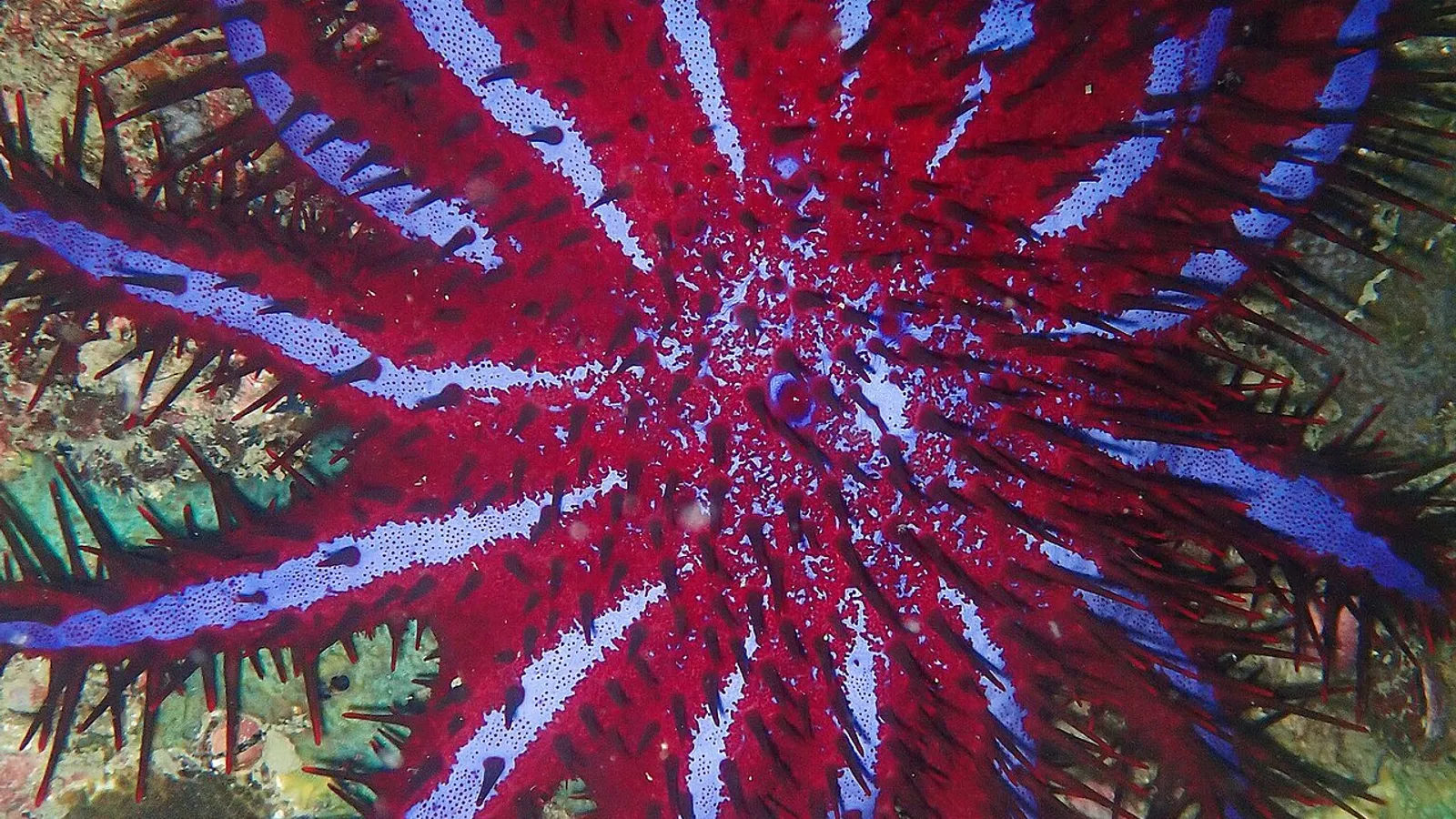
— Where the name comes from
Acanthaster joins the Greek ákantha, spine, and astḗr, star: the “spiny star”; planci honours the naturalist Giovanni Bianchi, latinised as Janus Plancus. The common name comes from the venomous spines that cover it like a crown. It is among the most feared starfish of the coral reefs.
— Facts
- Group
- Echinoderms · Echinodermata
- Order
- Sea stars
- Habitat
- Tropical coral reefs
- Range
- The Indo-Pacific, from the Red Sea to the Pacific coast of the Americas
- Size
- 25–35 cm, up to 80 cm, with 7–23 arms
- Diet
- Carnivore — coral polyps
- Lifespan
- 8 years and more
— Characteristics
- 01
It has up to twenty-one arms, against the five of most starfish.
- 02
It is covered in venomous spines up to 5 cm long, painful to humans.
- 03
It digests coral by pushing its stomach out directly onto the polyps.
— What sets it apart
The crown-of-thorns starfish eats living coral: it flattens itself onto a colony, turns its stomach out through its mouth and digests the polyps where they sit, leaving white dead skeletons behind. Normally it is rare and harmless, but every so often its numbers explode into outright invasions — tens of thousands of animals devouring whole stretches of reef, the Australian Great Barrier Reef among them. The causes of these outbreaks, perhaps tied to nutrient run-off and to the loss of its predators, remain one of the great puzzles of marine ecology.
