
Sword-billed hummingbird
Ensifera ensifera
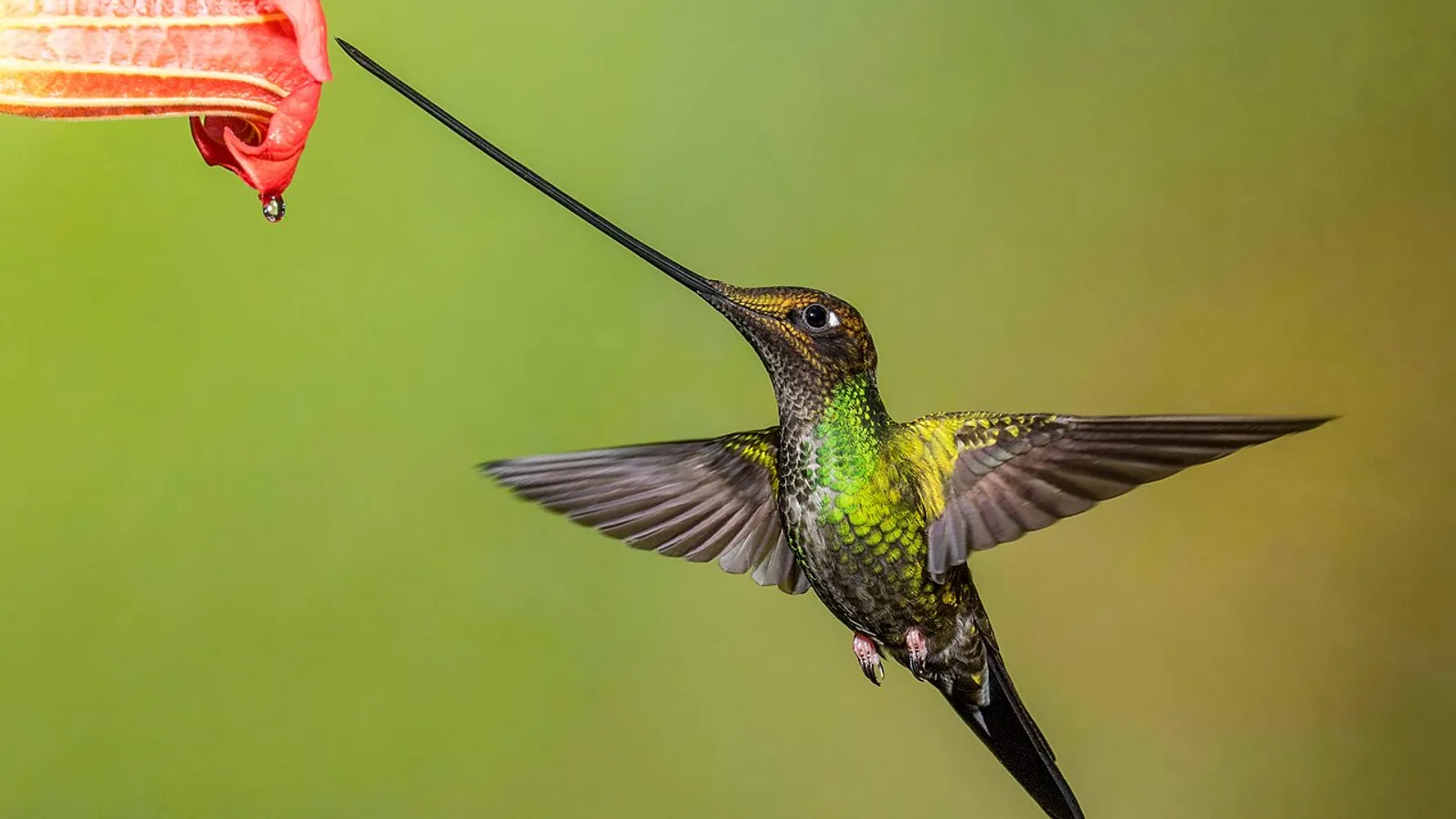
— Where the name comes from
Ensifera means “sword-bearer”, from ensis and ferre, and the binomial repeats it twice because there was nothing to add. It is the only bird in the world whose bill is longer than its body, tail excluded: eleven centimetres of slender blade on an animal that measures fourteen.
— Facts
- Group
- Birds · Aves
- Order
- Hummingbirds and swifts
- Habitat
- Andean cloud forest between 1,700 and 3,500 metres
- Range
- The Andes, from Venezuela to Bolivia
- Size
- 13–14 cm of body plus 8–11 cm of bill, 10–15 g
- Diet
- Nectar from flowers with very long corollas, small insects
- Lifespan
- 8 years in the wild
— Characteristics
- 01
Perched, it holds the bill pointing upwards to keep its balance.
- 02
It cannot preen with its bill: it does so with its feet.
- 03
It has the longest tongue, in proportion, of any bird.
— What sets it apart
It exists for a flower, and that flower exists for it. Certain Andean passionflowers have a corolla tube eleven centimetres long and no other animal can reach the bottom: if this hummingbird went, those plants would set no seed, and if the plants went the bird would have nothing to eat. It is the most extreme case of coevolution documented between a bird and a flower, and it looks like a wager: two species that gave up every alternative rather than share anyone.
