
Titan beetle
Titanus giganteus
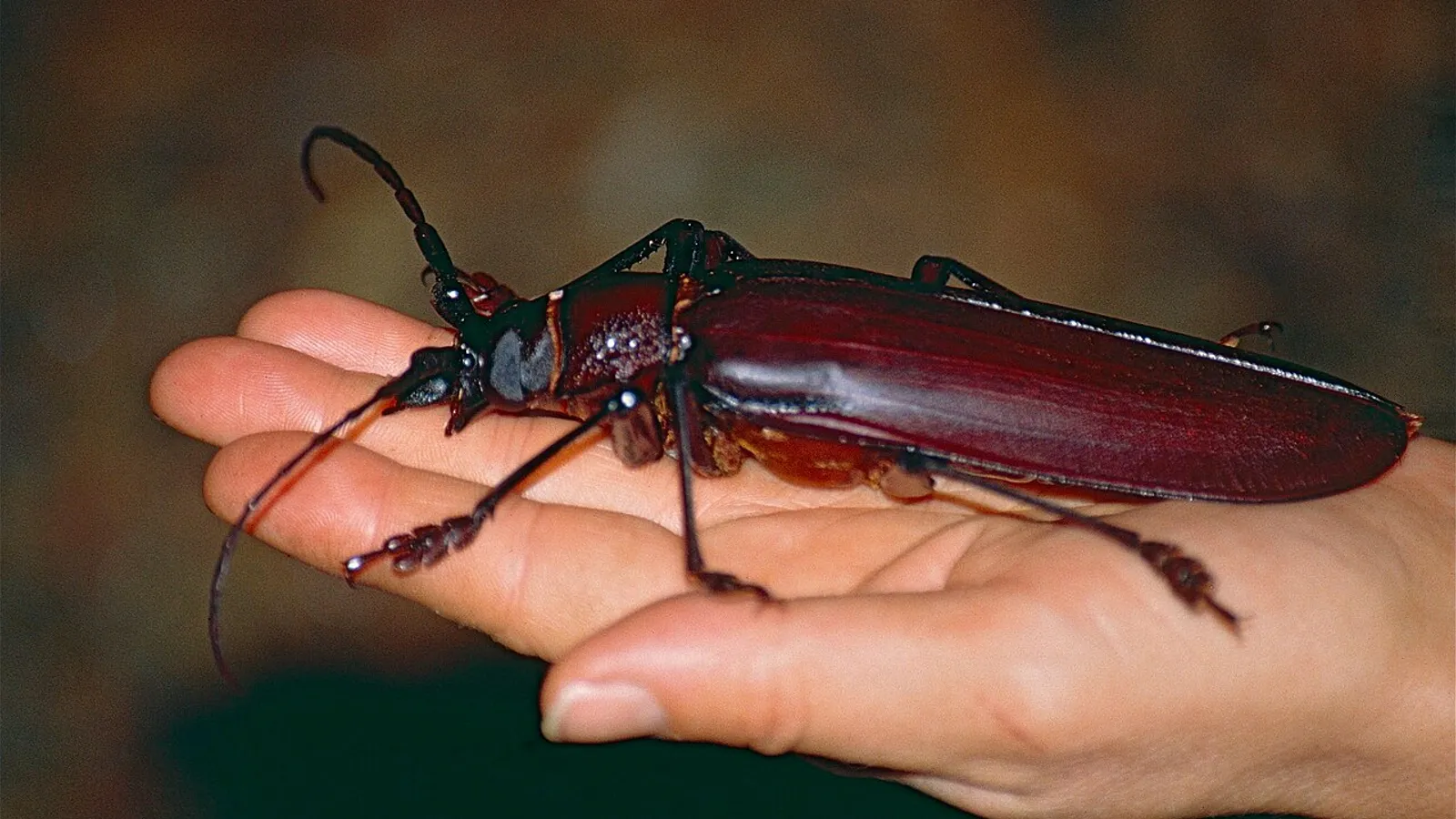
— Where the name comes from
Titanus giganteus is, literally, “the gigantic titan”: two words saying the same thing, one Greek and one Latin, both taken from the mythology of the giants who preceded the gods. It is a doubled superlative, and in zoological nomenclature that happens almost only when the describer is holding something that has never passed through his fingers before.
— Facts
- Group
- Insects · Insecta
- Order
- Beetles
- Habitat
- Primary Amazonian forest, at night
- Range
- The Amazon basin: the Guianas, northern Brazil, Peru, Colombia
- Size
- 13–17 cm, the longest beetle in the world
- Diet
- The adult does not feed; the larva is unknown in the wild
- Lifespan
- A few weeks as an adult
— Characteristics
- 01
Its mandibles snap a wooden pencil in two.
- 02
The adult does not eat: it lives on reserves laid down as a larva.
- 03
Nobody has ever found a larva of this species in the wild.
— What sets it apart
Of its life we know only the end. Adults are caught at the lamps of forest camps, but the larva — which, judging by the size of the adult, ought to be over twenty centimetres long — has never been found: it is presumed to bore deep inside the rotting wood of roots, and nobody has yet seen it. It is the largest beetle in the world by body length and one of the most imposing animals whose life cycle is unknown. The adult has no working mouth: it emerges, flies, seeks a mate and dies within weeks, never having eaten.
