
Bombardier beetle
Brachinus crepitans
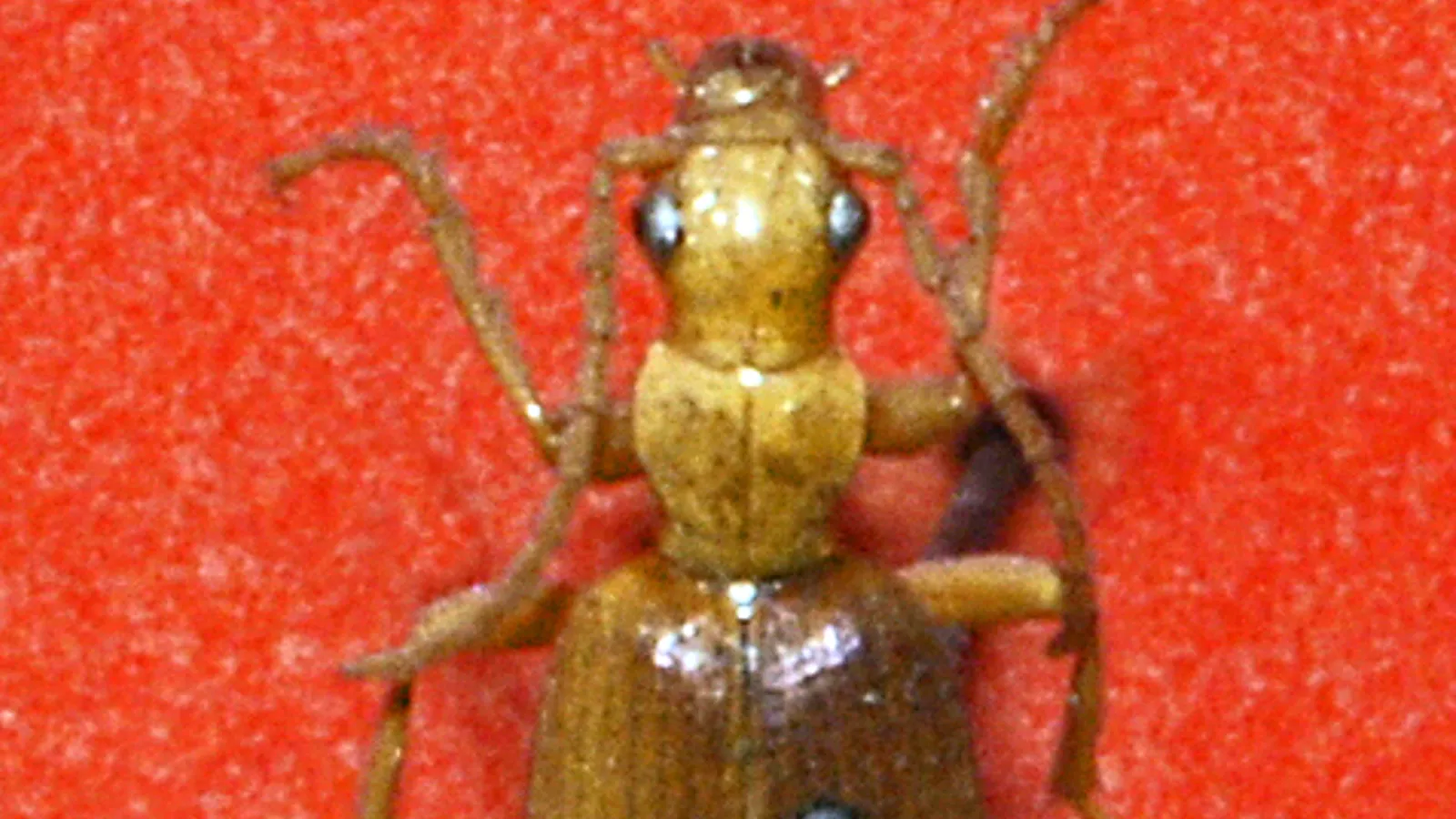
— Where the name comes from
Crepitans is Latin for “crackling”: it is the dry report heard when the insect fires, and anyone holding one hears it distinctly. Brachinus comes from the Greek brachýs, short, after the truncated elytra that leave the tip of the abdomen exposed — which is, as it happens, exactly the end the jet comes out of.
— Facts
- Group
- Insects · Insecta
- Order
- Beetles
- Habitat
- Dry stony ground, under stones
- Range
- Europe, western Asia, North Africa
- Size
- 6–10 mm
- Diet
- Larvae and small invertebrates of the soil
- Lifespan
- 1 year
— Characteristics
- 01
It fires a boiling jet at a hundred degrees from the tip of its abdomen.
- 02
It can aim the nozzle and hit an attacker in almost any direction.
- 03
The report is audible and the little cloud visible to the naked eye.
— What sets it apart
It keeps two harmless substances in separate chambers — hydroquinones and hydrogen peroxide — and mixes them only at the moment of firing, in an armoured cell where an enzyme awaits them. The reaction is violent: the mixture reaches boiling point and is expelled in pulses, five hundred a second, so that the jet leaves intermittently and the chamber is not destroyed. It is the principle of the pulsejet, the engine of the first flying bombs. The insect can rotate the tip of its abdomen and hit precisely the leg of an ant that has seized it, and a frog that swallows it spits it out alive.
