
Cochineal insect
Dactylopius coccus
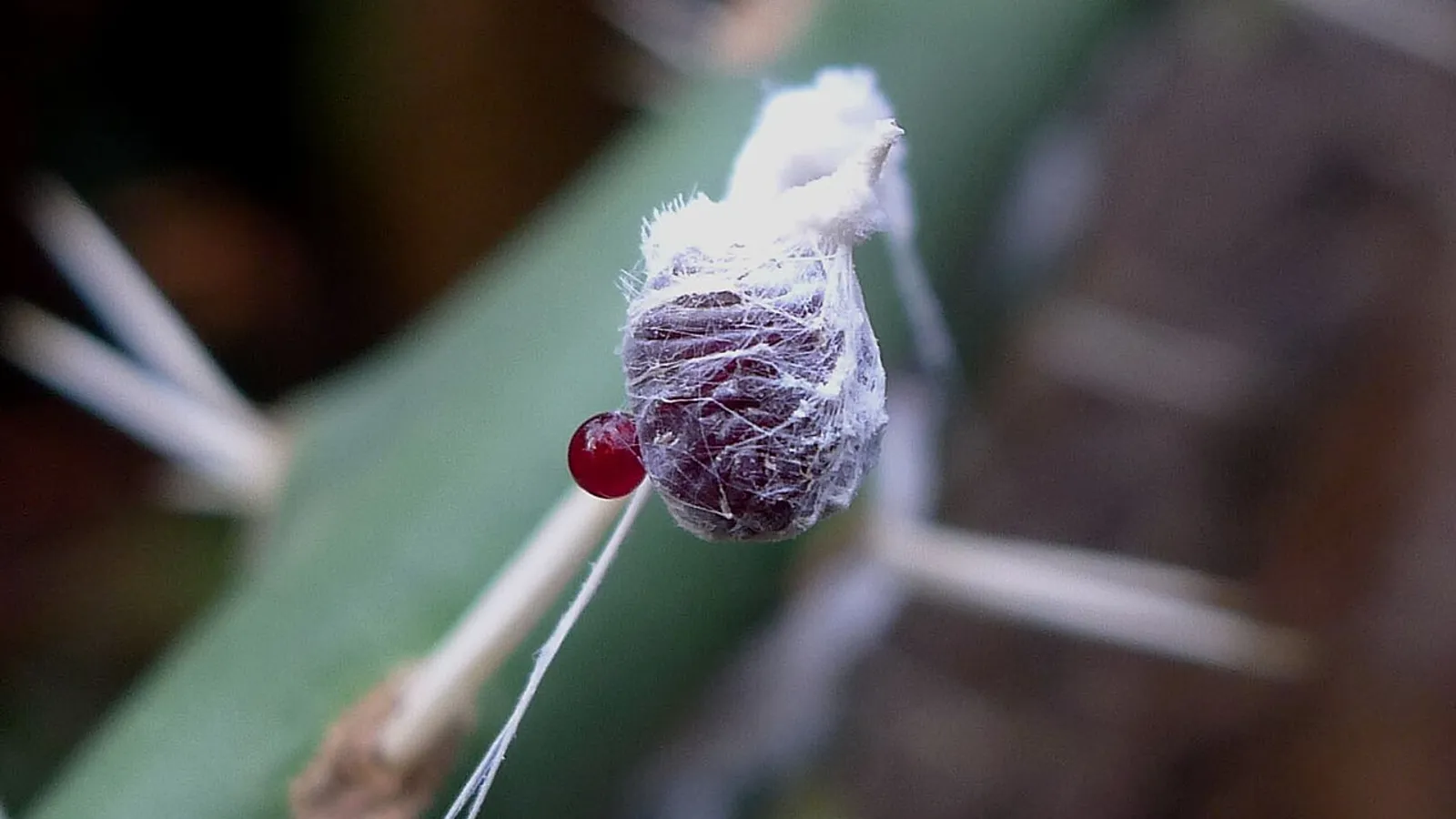
— Where the name comes from
Coccus comes from the Greek kókkos, the grain, the berry: for centuries these insects were believed to be plant granules, and from that misunderstanding grew a chain of words we still use — the Latin coccineus, “scarlet”, the Italian cocciniglia, and the English grain, which in the cloth trade meant precisely red. A colour, in three languages, bears the name of a seed that was in fact an animal.
— Facts
- Group
- Insects · Insecta
- Order
- True bugs
- Habitat
- Prickly pear pads, in colonies covered with white wax
- Range
- Mexico and Andean South America; farmed in the Canary Islands
- Size
- Female 5 mm; the winged male half that
- Diet
- Prickly pear sap
- Lifespan
- 2–3 months for the female; a few days for the male
— Characteristics
- 01
About a hundred thousand insects are needed for a kilo of dye.
- 02
The female is wingless and immobile: she fixes to the pad and never moves again.
- 03
The white powder covering her is wax the insect makes itself.
— What sets it apart
For three centuries it was Mexico’s second export after silver, and Spain kept its nature secret: Europeans bought dried grains without knowing they were insects, and attempts to find out — a French botanist was sent to Mexico expressly in the eighteenth century — amounted to industrial espionage. The red of cardinals’ robes, of English tunics and of Titian’s paintings comes from here. Wiped out by synthetic dyes at the end of the nineteenth century, it returned when those proved suspect: today it is food additive E120, and it is the red of many yoghurts, drinks and cosmetics.
