
South American coati
Nasua nasua
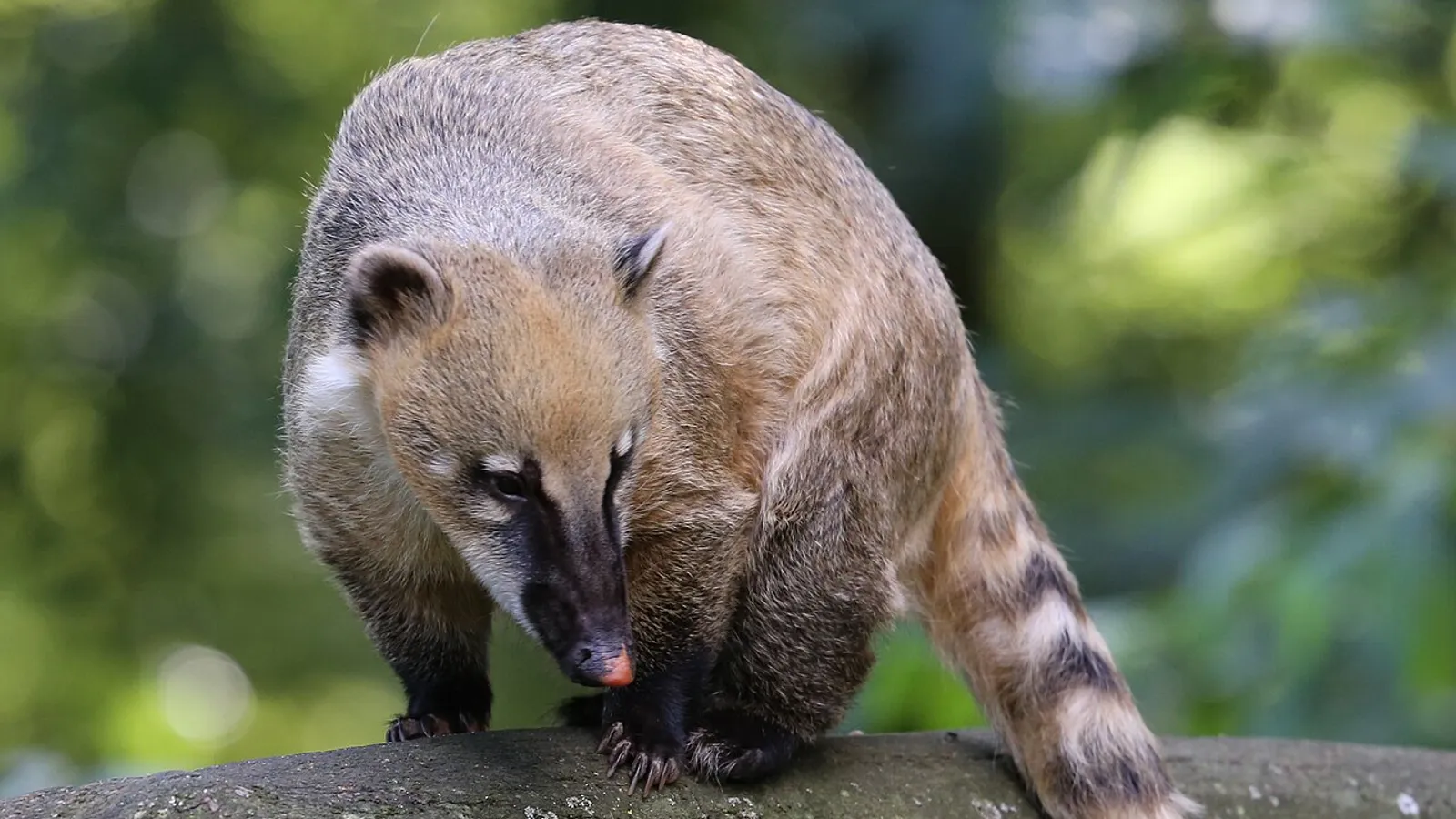
— Where the name comes from
Nasua is the Latin nasus, “nose”, doubled in the binomial to insist on the only thing that matters about this animal: a long, extremely mobile snout, which swivels through sixty degrees and which it uses to rummage among leaves. Coati comes from the Tupi kua’ti, made of cua, “belt”, and tim, “nose” — “belt-nose”, because it sleeps with its snout tucked under its belly.
— Facts
- Group
- Mammals · Mammalia
- Order
- Carnivores
- Habitat
- Rainforest, dry forest, wooded savannah, from sea level to 2,500 m
- Range
- South America, from Colombia to northern Argentina
- Size
- 41–67 cm of body plus a tail nearly as long, 3–7.2 kg
- Diet
- Omnivore — invertebrates, fruit, small vertebrates, eggs
- Lifespan
- 7–8 years in the wild, up to 17 in captivity
— Characteristics
- 01
The females live in noisy bands of up to thirty; adult males live alone.
- 02
The ringed tail is held almost always upright: it keeps the group together in tall grass.
- 03
Its ankles rotate backwards, letting it come down trunks head first.
— What sets it apart
For two centuries naturalists described two different animals: the coati, which lives in clamorous bands, and the “coatimundi”, solitary and larger, taken for a species of its own. They were the same animal. Adult males leave the band and live alone, returning only to mate, and the Guaraní words coatí mundé mean precisely “lone coati”. The error found its way into the books, and in English coatimundi is still today a common name for the whole species.
