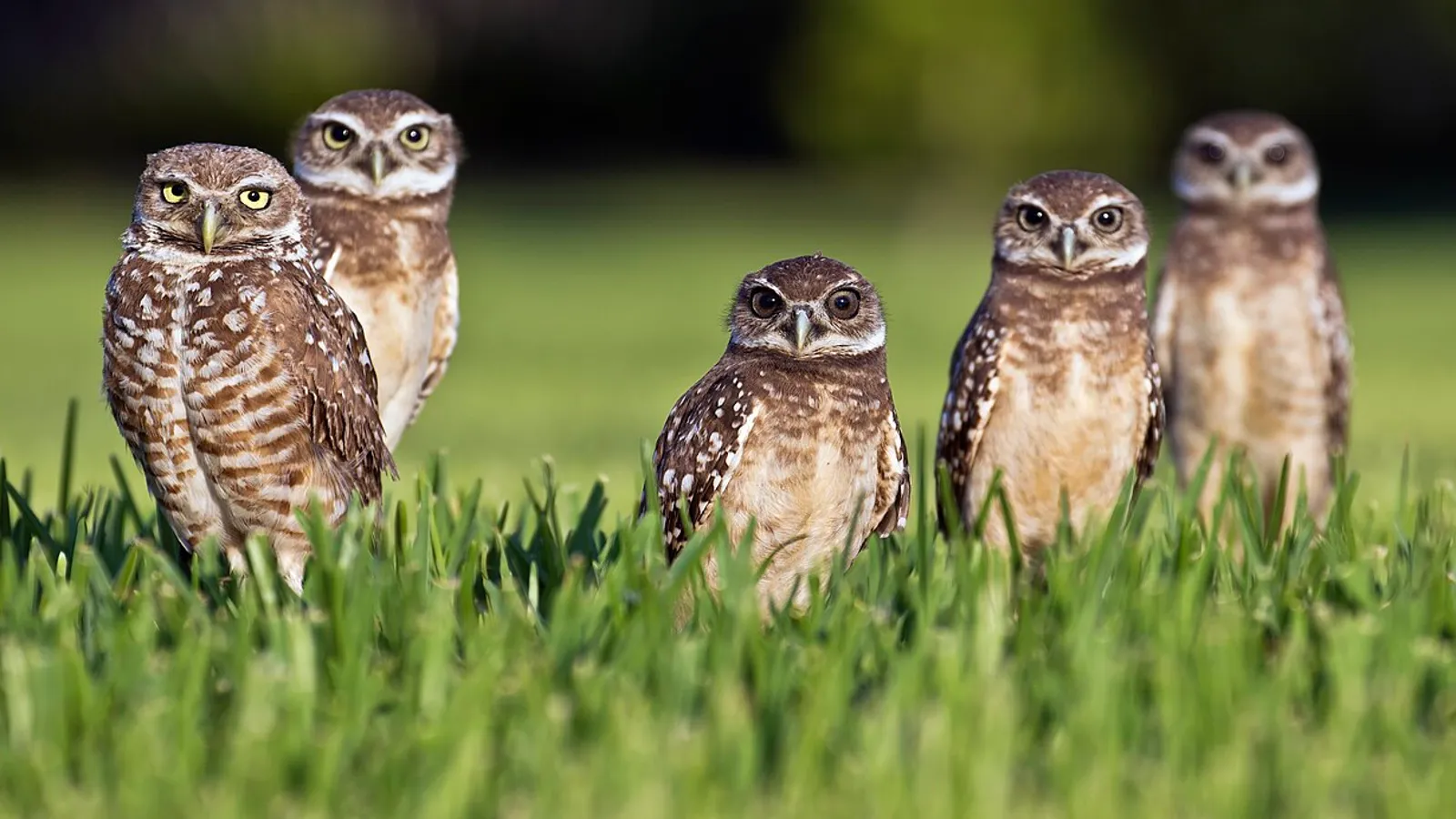
Burrowing owl
Athene cunicularia
— Where the name comes from
Athene is the goddess Athena, whom the Greeks associated with the owl as a symbol of wisdom; the same genus holds the European little owl. Cunicularia comes from cuniculus, which in Latin meant both the rabbit and the tunnel it digs: “the miner”. The name was given in 1782 by the Chilean Jesuit Juan Ignacio Molina, who knew the bird from the plains of his country.
— Facts
- Group
- Birds · Aves
- Order
- Owls
- Habitat
- Prairie, desert, pasture, and golf courses and airports too
- Range
- The Americas: from southern Canada to Argentina, Florida and the Caribbean
- Size
- 19–28 cm, wingspan 50–61 cm, 140–240 g
- Diet
- Insects, especially beetles; small rodents, lizards, frogs
- Lifespan
- Up to 9 years in the wild
— Characteristics
- 01
It has long, sparsely feathered legs, the legs of a bird that walks more than it perches.
- 02
It is active by day as well, standing guard at the burrow entrance.
- 03
It moves into the abandoned burrows of prairie dogs and ground squirrels.
— What sets it apart
It defends itself and hunts with two conjuring tricks. Disturbed in the burrow, the chicks give a hiss that imitates a rattlesnake’s rattle almost perfectly, and a predator poking its snout into the dark has good reason to pull it out. The adults, meanwhile, collect cattle and horse dung and scatter it around the entrance: an experiment published in Nature in 2004 showed that it attracts dung beetles, which end up straight in the owl’s diet. It is not mess: it is bait.