
West Indian fuzzy chiton
Acanthopleura granulata
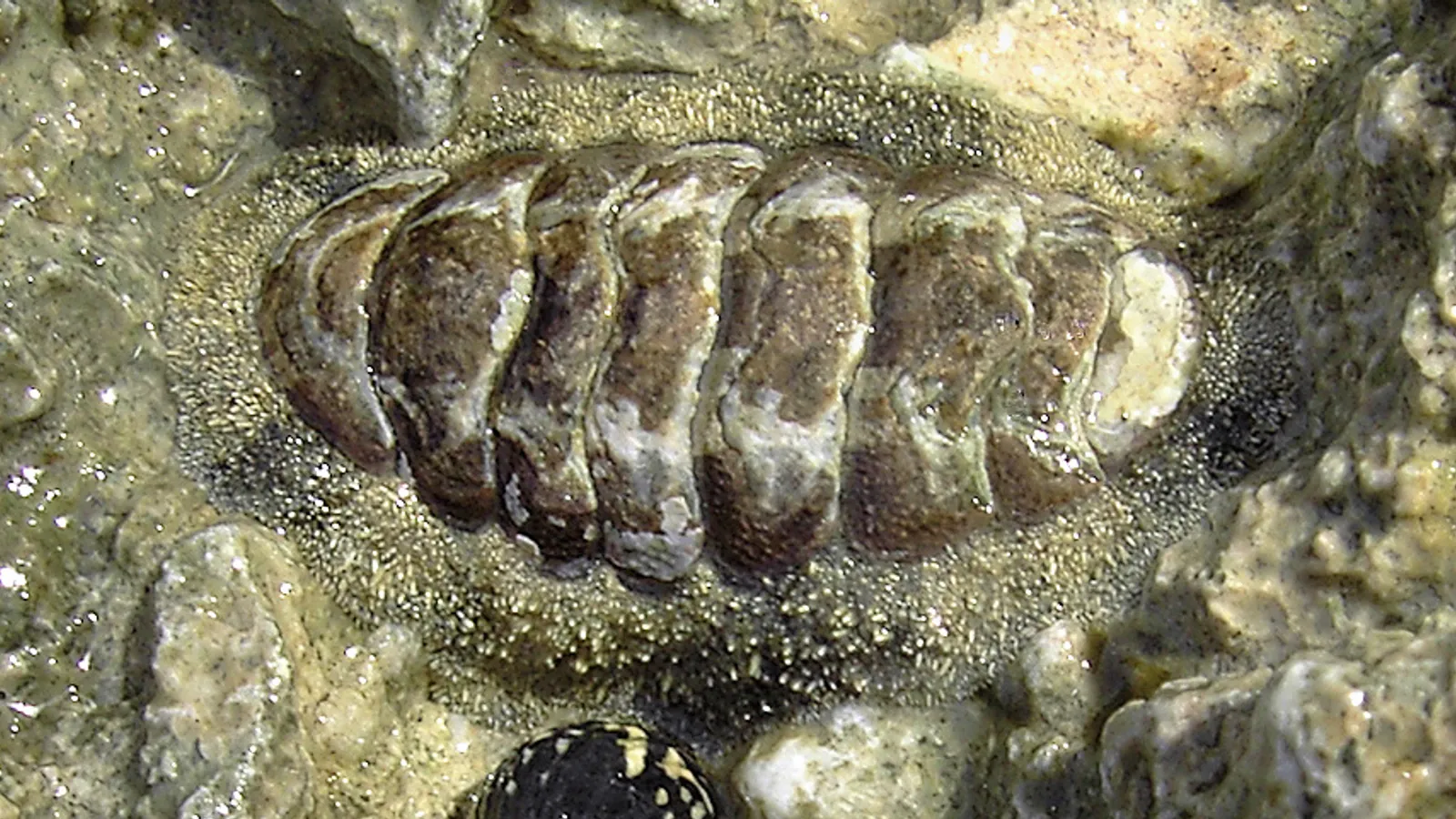
— Where the name comes from
Chitṓn in Greek was the tunic worn next to the skin: the name alludes to the eight dorsal plates covering the animal like the scales of a fabric armour. Acanthopleura is “spiny-sided”, from ákantha and pleurá, for the girdle of prickles surrounding the plates. Granulata describes the surface.
— Facts
- Group
- Molluscs · Mollusca
- Order
- Chitons
- Habitat
- Wave-beaten rocks in the intertidal zone
- Range
- The Caribbean and western tropical Atlantic
- Size
- 5–7 cm
- Diet
- Algae rasped from the rock
- Lifespan
- 10–12 years
— Characteristics
- 01
Eight articulated plates let it roll into a ball.
- 02
It returns every time to exactly the same spot on the rock.
- 03
It has hundreds of eyes built into the plates of its armour.
— What sets it apart
It has eyes made of stone. Inside the dorsal plates are hundreds of lenses of aragonite — the same mineral as the shell — forming true eyes able to make out the outline of a predator a few tens of centimetres away. They are the only known eyes with lenses of calcium carbonate rather than protein, and each lens is a single crystal oriented to focus both in air and in water. The trade-off is structural: where the eyes are, the armour is weaker, and the animal pays in protection what it gains in sight. Its teeth are mineral too: they contain magnetite, and are among the hardest biological materials known.
