
Garden snail
Cornu aspersum
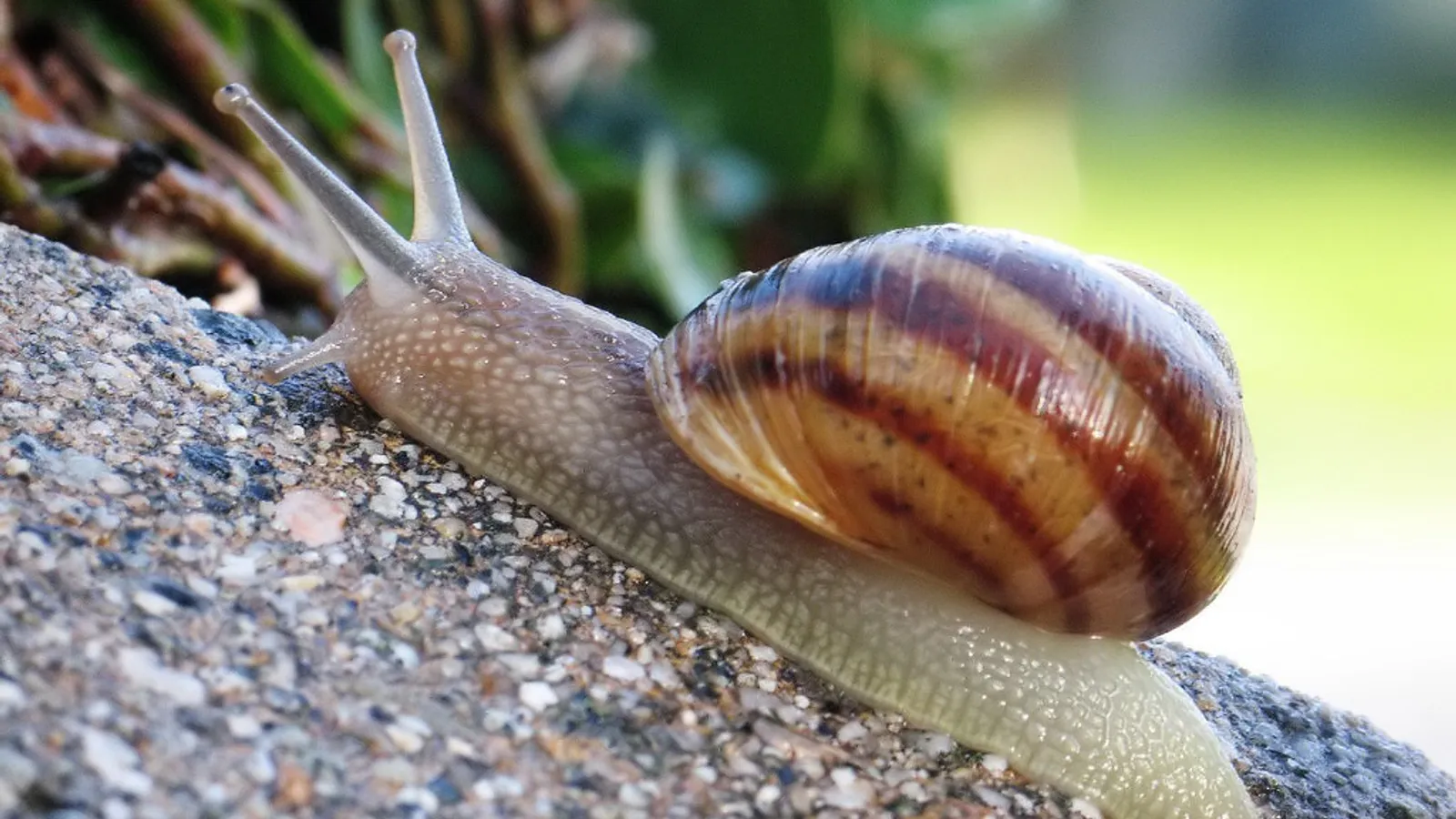
— Where the name comes from
Cornu is the horn, for the spiral of the shell; aspersum means “sprinkled”, for the brown flecking on a pale ground. The Italian chiocciola comes instead from the Latin cochlea, the spiral — the same word that names the cochlea of the inner ear and, in Italian, the @ sign of an email address, which in English is only a commercial “a” but across half of Europe is an animal again: snail in Dutch, little monkey in Polish, elephant’s trunk in Danish.
— Facts
- Group
- Molluscs · Mollusca
- Order
- Land snails
- Habitat
- Gardens, vegetable plots, damp walls, Mediterranean scrub
- Range
- Mediterranean in origin; introduced to every continent
- Size
- Shell 25–40 mm
- Diet
- Leaves, flowers, fruit, algae on walls
- Lifespan
- 2–5 years
— Characteristics
- 01
Its tongue, the radula, carries over twenty thousand tiny teeth.
- 02
It is hermaphrodite: two individuals fertilise one another.
- 03
It spends summer and winter sealed behind a hardened plug of mucus.
— What sets it apart
Courtship begins with a stabbing. Before mating, each partner fires into the other a calcareous dart a few millimetres long — the “love dart” — which does not fertilise anything but injects a substance that raises the chances of its own sperm being stored rather than digested. Both being hermaphrodite, the conflict is symmetrical and each tries to do to the other what the other is doing to it. It is from this dart, on the most widely held hypothesis, that the image of Cupid’s arrow comes.
