
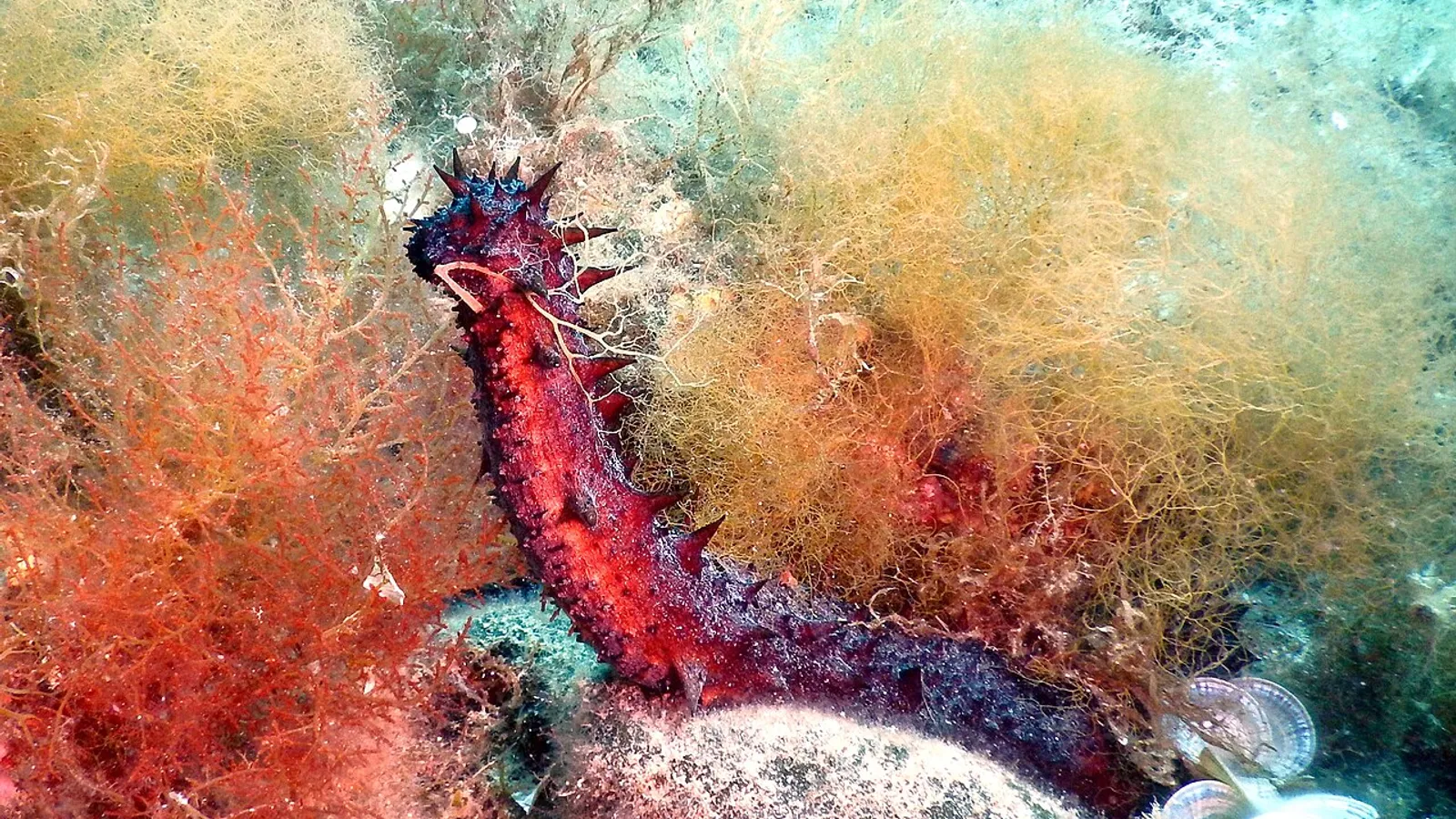
Tubular sea cucumber
Holothuria tubulosa
— Where the name comes from
Holothoúrion is a word appearing in Aristotle for some unidentified sea creature, which modern naturalists recycled for this group without knowing for certain what the philosopher had in mind. Tubulosa gives the shape. The common name is a greengrocer’s description instead, and the same image appears in English, sea cucumber, and German, Seegurke.
— Facts
- Group
- Echinoderms · Echinodermata
- Order
- Sea cucumbers
- Habitat
- Sandy bottoms and posidonia meadows, down to 100 metres
- Range
- Mediterranean and eastern Atlantic
- Size
- 20–35 cm
- Diet
- Organic detritus sifted from the sediment
- Lifespan
- 5–10 years
— Characteristics
- 01
If attacked it expels part of its gut and then regrows it.
- 02
The body can go from rigid to almost liquid in seconds.
- 03
It swallows sand, digests the organic film on it and returns it clean.
— What sets it apart
Its body changes state like a programmable material. The skin is a “mutable” connective tissue: under nervous control the collagen fibres bind or unbind, and the animal goes in seconds from rigid as a rubber tube to soft as pudding, soft enough to pour into a crack it could never otherwise enter. Bioengineers study it for materials that change stiffness on command — brain electrodes that go in hard and soften once inside. As a defence, instead, it eviscerates: it expels its gut at the attacker and rebuilds it in a few weeks.
