
Dusky grouper
Epinephelus marginatus
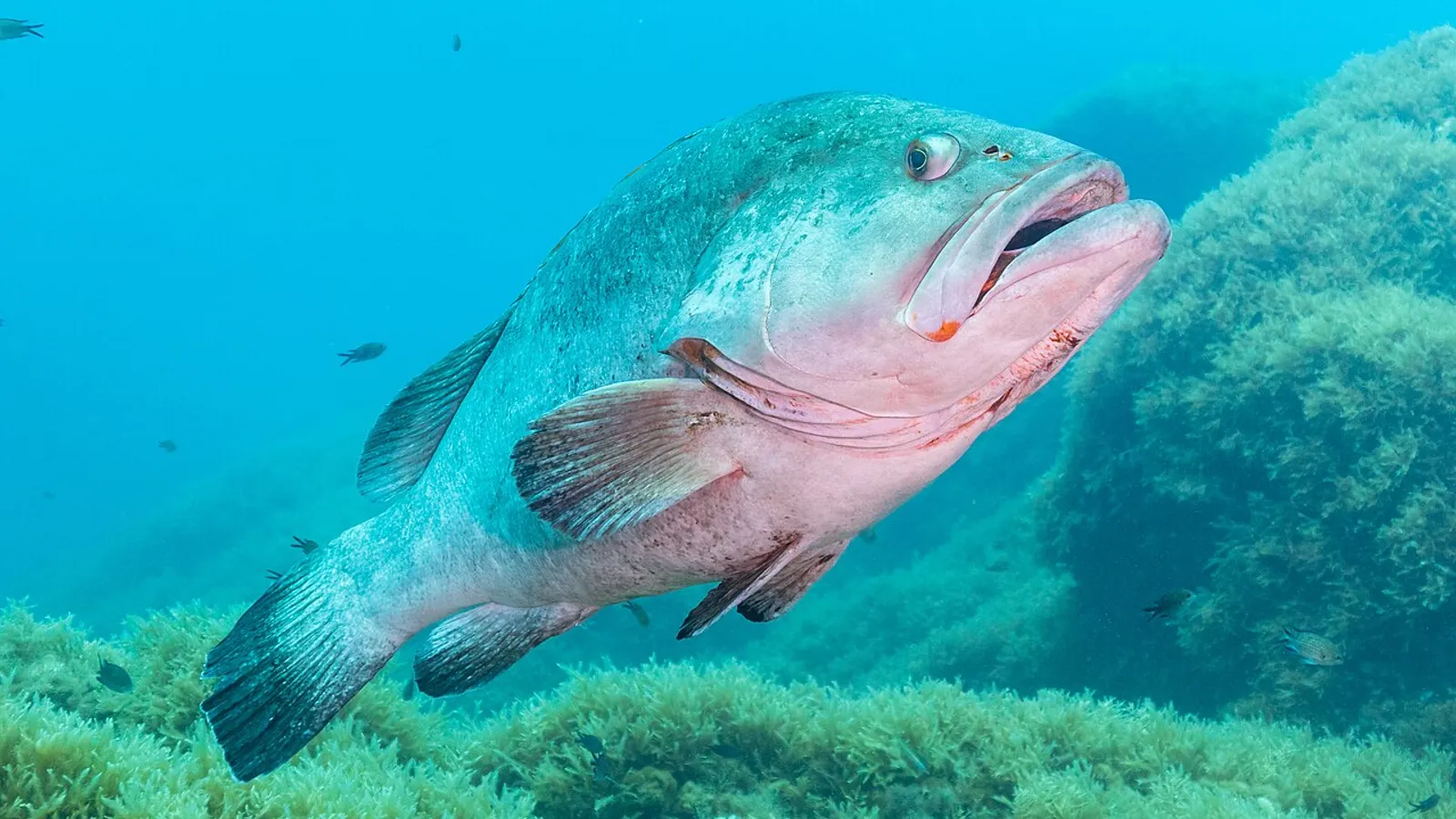
— Where the name comes from
Epinephelus comes from the Greek epinephélos, “clouded”, for the pale blotches on a dark ground that look like clouds; marginatus refers to the white edge of the fins. The Italian cernia probably derives from the Greek acherna by way of Sicilian, and across the Mediterranean it names the same sedentary, curious fish.
— Facts
- Group
- Fish · Actinopterygii · Chondrichthyes
- Order
- Perch-likes
- Habitat
- Rocky reefs, caves and boulder falls between 10 and 200 metres
- Range
- The Mediterranean, the eastern Atlantic, southern Brazil
- Size
- 60–100 cm, up to 150 cm; 5–30 kg, record 60 kg
- Diet
- Octopus, crustaceans, fish
- Lifespan
- 50 years
— Characteristics
- 01
It spends its whole life in the same den, which it defends from any intruder.
- 02
It is born female and becomes male at around ten to twelve years old.
- 03
It sucks prey in by creating a vacuum with its enormous mouth.
— What sets it apart
It is the emblem of marine reserves, for a measurable reason: being sedentary, long-lived and easy to approach, it is the first species to vanish where there is fishing and the first to return where fishing stops. In Mediterranean protected areas established in the 1980s grouper density rose ten- or twentyfold within a couple of decades, and average size with it — which counts double, because a grouper becomes male only after ten years: without old individuals, a population stops producing males at all.
