
Short-snouted seahorse
Hippocampus hippocampus
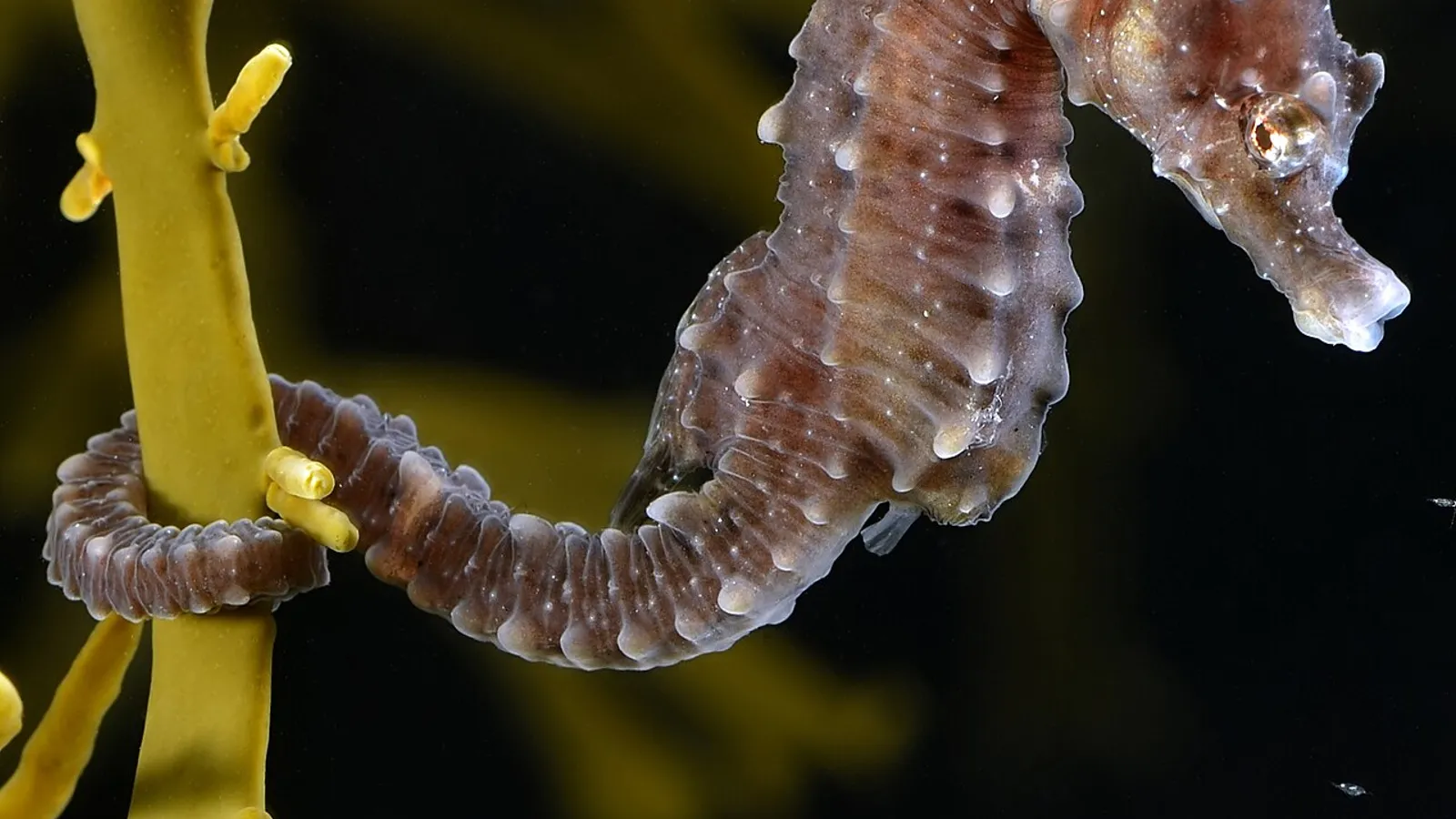
— Where the name comes from
From the Greek híppos, horse, and kámpos, sea monster: the hippocampus was Poseidon’s mount. The same word today names a structure in our own brain, whose shape reminded the early anatomists of the animal.
— Facts
- Group
- Fish · Actinopterygii · Chondrichthyes
- Order
- Pipefishes and seahorses
- Habitat
- Seagrass meadows and shallow weedy bottoms
- Range
- The eastern Atlantic and the Mediterranean
- Size
- 10–15 cm
- Diet
- Carnivore — small crustaceans sucked in through the snout
- Lifespan
- 3–5 years
— Characteristics
- 01
Swims upright, driven by a dorsal fin that beats 35 times a second.
- 02
The tail is prehensile and there is no caudal fin.
- 03
The eyes move independently.
— What sets it apart
It is the male that is pregnant. The female lays her eggs into a pouch on the male’s belly; he fertilises them, feeds them through a rudimentary placenta, regulates their salinity and finally gives birth with muscular contractions. No other animal known has a true male pregnancy, with nutrients passed from the father to the embryos.
