
Przewalski's horse
Equus przewalskii
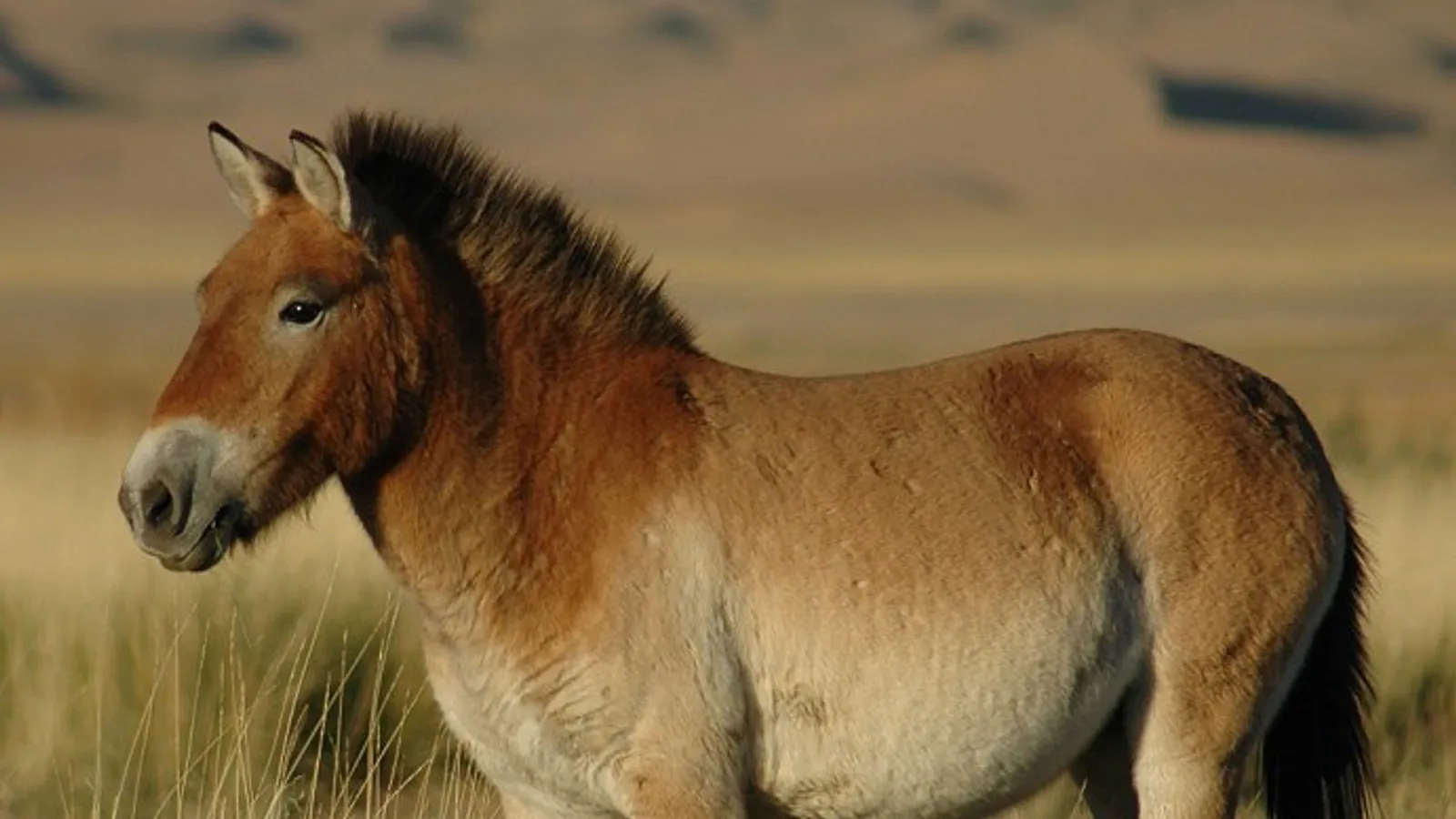
— Where the name comes from
The name recalls Nikolai Przhevalsky, a Russian officer and explorer who in 1878 brought back a skull and a hide from Central Asia, making the animal known to European science. In Mongolian it is called takhi, “spirit” — and that name says something ours does not: to the herders of the steppe it was not a wild horse, it was a presence. It is the only horse never domesticated in any form.
— Facts
- Group
- Mammals · Mammalia
- Order
- Odd-toed ungulates
- Habitat
- Arid steppe, semi-desert grassland
- Range
- Mongolia and China, in reintroduced populations; extinct in the wild until the 1990s
- Size
- 120–146 cm at the withers, 250–360 kg
- Diet
- Herbivore — steppe grasses, shrubs, bark in winter
- Lifespan
- 20–25 years
— Characteristics
- 01
It has 66 chromosomes against the domestic horse’s 64, and the two interbreed to give fertile hybrids.
- 02
The mane is short and upright, with no forelock: it never falls to one side.
- 03
It has never been domesticated, and no domestic population descends from it.
— What sets it apart
It went extinct in the wild around 1969, and for twenty years survived only in zoos: every living animal descends from just twelve captured between the 19th and 20th centuries. Reintroductions to Mongolia began in 1992 and now number hundreds of free-ranging animals. Some of those horses live in the Chernobyl exclusion zone, where they were released in 1998: with no people around, the herd has grown in one of the most contaminated places on the planet.
