
Great green bush-cricket
Tettigonia viridissima
— Where the name comes from
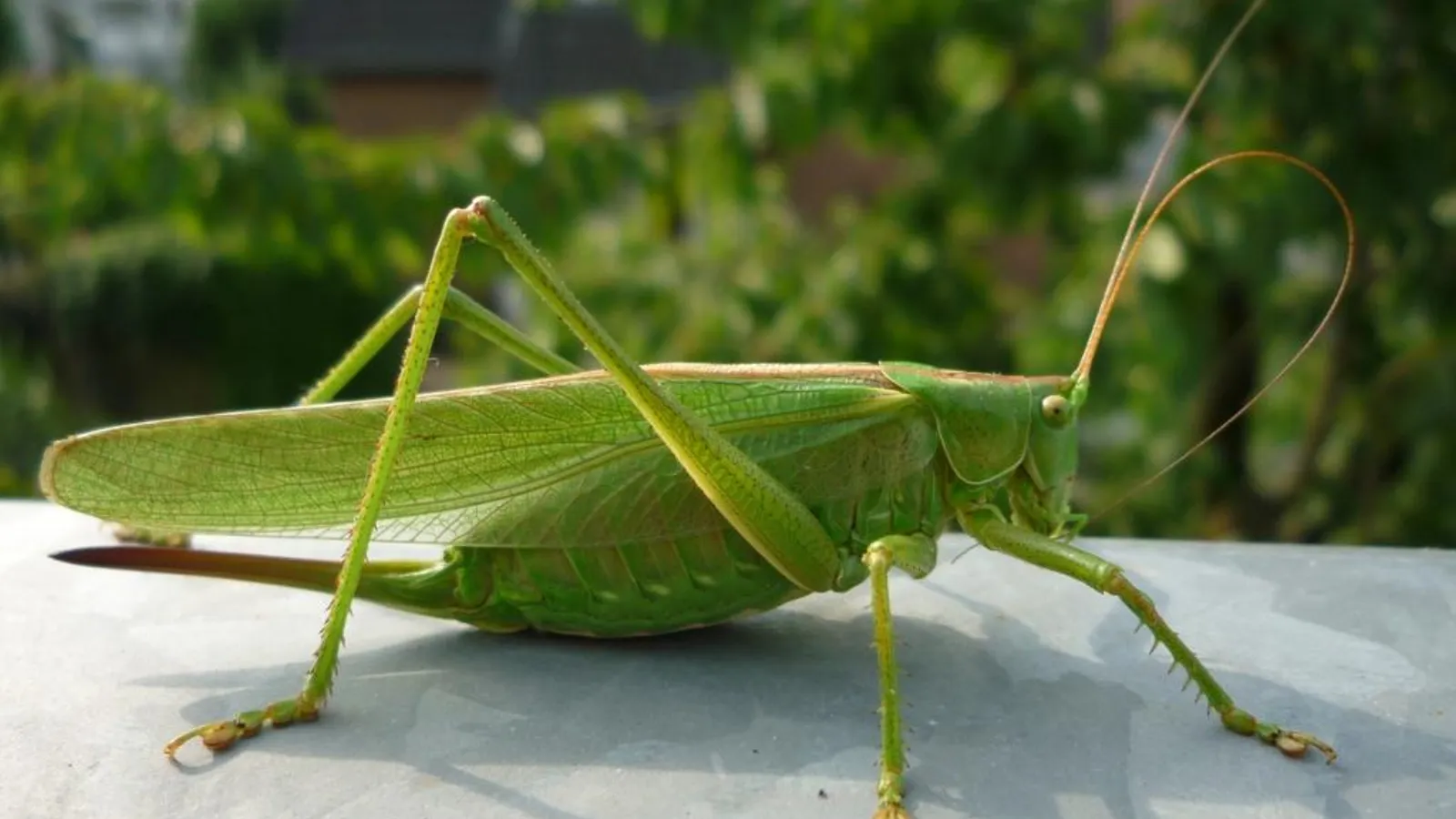
Tettigonia comes from tettix, which in Greek was the cicada: the first naturalists heard this insect’s chirring and likened it to the summer song of cicadas, though it belongs to a different order. Viridissima is a Latin superlative, “greenest”, and it is no exaggeration: it is a uniform, saturated green that covers even the legs and the antennae, which are longer than the body.
— Facts
- Group
- Insects · Insecta
- Order
- Grasshoppers and crickets
- Habitat
- Tall grassland, hedges, rough margins, shrubs
- Range
- Europe, western Asia, North Africa
- Size
- 28–42 mm, with antennae longer than the body
- Diet
- Omnivorous: insects, larvae, tender leaves
- Lifespan
- 1 year; the eggs overwinter in the soil, sometimes for two winters
— Characteristics
- 01
Very long antennae distinguish it from locusts, which have short ones.
- 02
The female has a sabre-shaped ovipositor as long as her abdomen.
- 03
It is largely a predator, not a herbivore as it appears.
— What sets it apart
The distinction between bush-crickets and locusts lies in the antennae, and it is not a detail: the long-antennaed kinds like this one are mostly predators, hunting caterpillars and flies and biting if picked up, while the short-antennaed locusts are vegetarian and form swarms. The song is produced by rubbing the wings together and contains ultrasound the human ear cannot catch: what we hear is only the lower part of a much wider signal. The female drives her sabre ovipositor into the ground and lays her eggs there, and they can wait as long as two winters before hatching.
