
Little Barrier giant weta
Deinacrida heteracantha
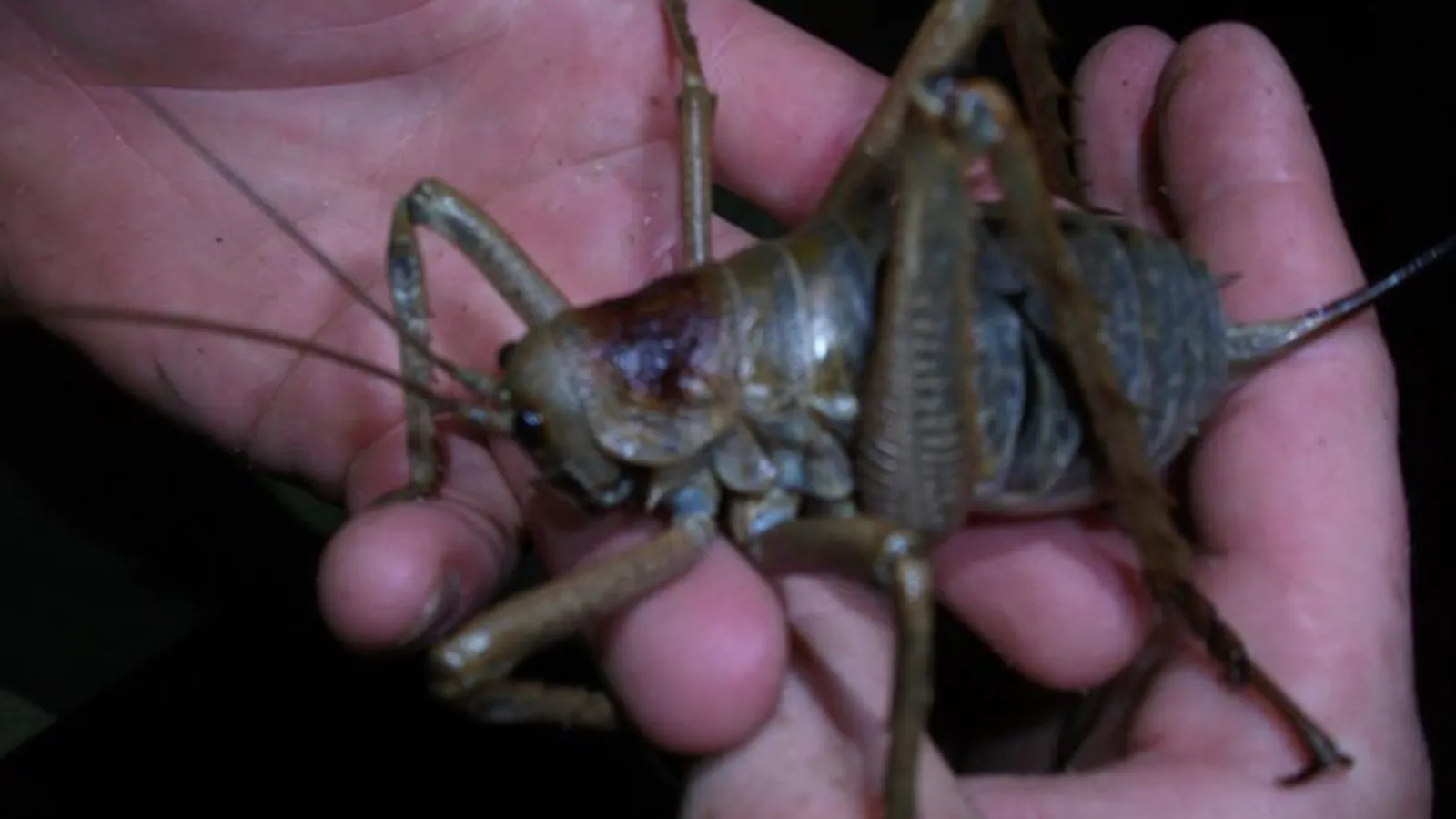
— Where the name comes from
Deinacrida means “terrible grasshopper”, from deinós and akrís: it is the same deinós as in the dinosaurs, “fearfully great”, and for an insect that outweighs a sparrow it is a name earned. Heteracantha means “with unlike spines”, after the irregular rows of spines on the legs. Weta is instead a Māori word, short for wētāpunga, which is translated as “god of ugly things”.
— Facts
- Group
- Insects · Insecta
- Order
- Grasshoppers and crickets
- Habitat
- Native forest; by day in tree cavities
- Range
- Little Barrier Island, New Zealand
- Size
- Up to 10 cm of body and over 70 g in a gravid female
- Diet
- Leaves and fruit
- Lifespan
- About 2 years
— Characteristics
- 01
It is among the heaviest insects in the world.
- 02
It does not jump: it is too heavy, and walks.
- 03
It survives only on an island where rats have been eradicated.
— What sets it apart
New Zealand had no land mammals, and the place rodents occupy elsewhere was taken by insects: this weta is, ecologically, a mouse — it eats leaves, lives in cavities, moves by night, and is the same size. When rats arrived on ships the animal had no defences, and the giant weta vanished from the mainland entirely, surviving on a single island. Its story is now the most cited case of “ecological replacement”: proof that a role in nature belongs to no particular group of animals but is taken up by whoever happens to be there when the place falls vacant.
