
Northern cardinal
Cardinalis cardinalis
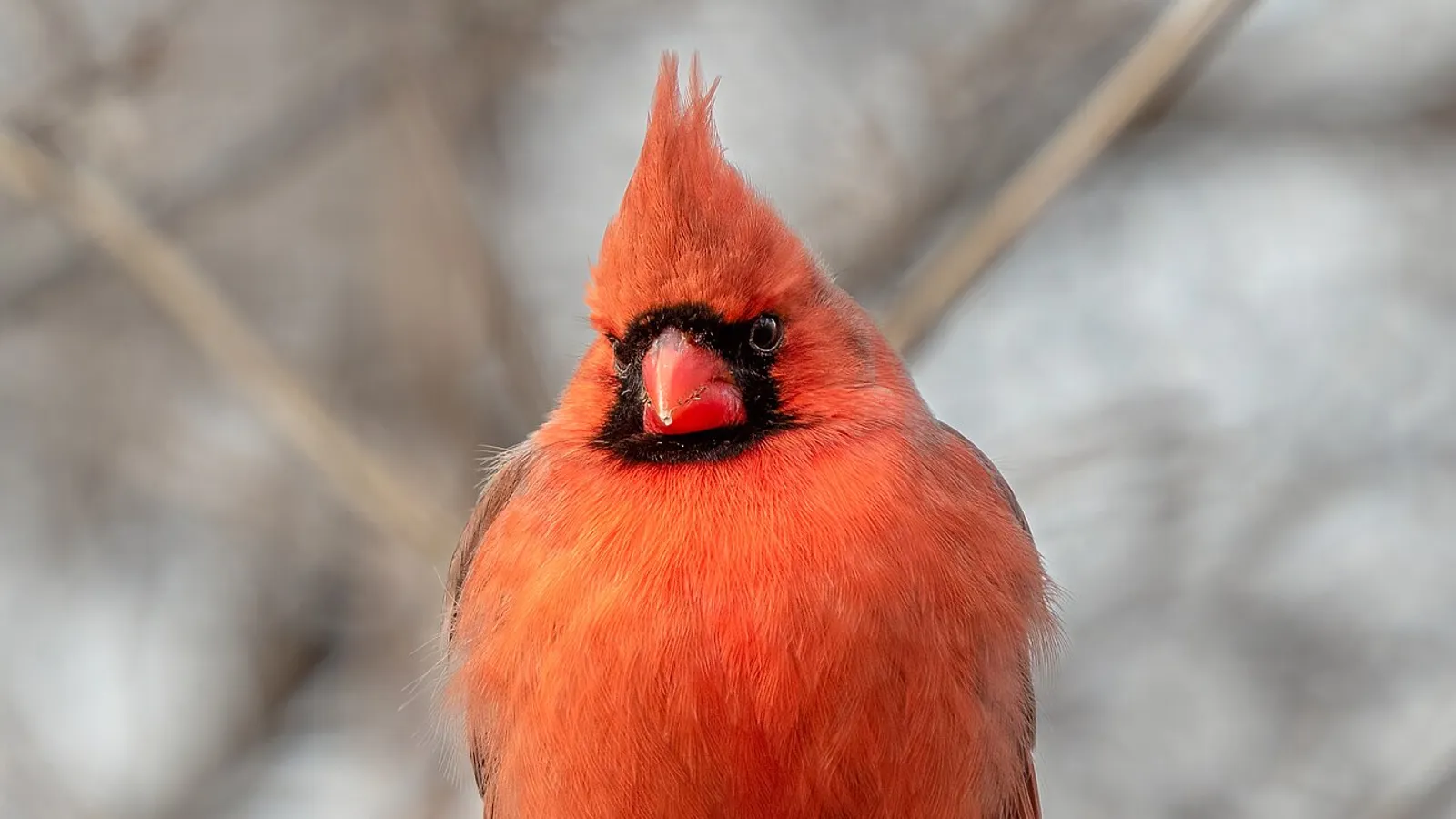
— Where the name comes from
It takes its name from the scarlet robes of the cardinals of the Church, and that title in turn comes from cardo, the hinge of a door: cardinals were the priests “hinged” to a church in Rome. The most famous red in American gardens therefore carries, at two removes, the name of a piece of ironmongery.
— Facts
- Group
- Birds · Aves
- Order
- Passerines
- Habitat
- Hedges, open woodland, gardens, woodland edges
- Range
- The eastern United States, Mexico, Guatemala and Belize
- Size
- 21–23 cm, wingspan 25–31 cm, 42–48 g
- Diet
- Seeds, grain, berries, insects
- Lifespan
- 15 years in the wild
— Characteristics
- 01
The male is bright red, the female olive-brown with a coral bill.
- 02
The female sings too, which is rare among temperate songbirds.
- 03
The red comes from carotenoids in the food: a poor diet means a faded bird.
— What sets it apart
Every so often one turns up divided down the middle: red on one side, grey on the other, with the border running straight down the breast. These are bilateral gynandromorphs, individuals with male cells on one side of the body and female cells on the other, the result of an error in the very first division of the egg. In birds, sex is settled cell by cell rather than by hormones alone, which is why the phenomenon shows so clearly — in a species whose sexes are opposite colours, the error becomes visible to anyone looking out of the window.
