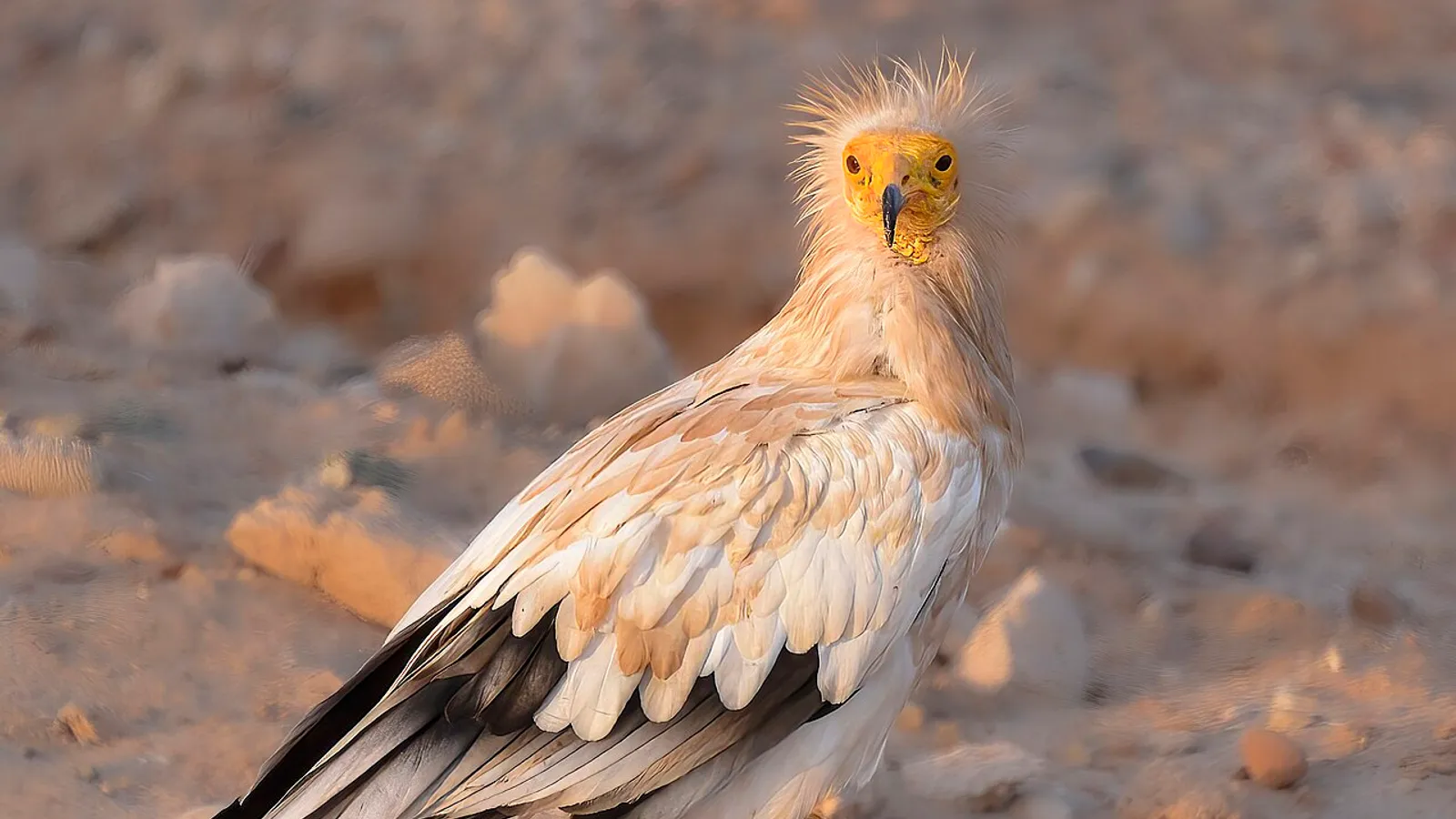
Egyptian vulture
Neophron percnopterus
— Where the name comes from
Neophron comes from a myth told by Antoninus Liberalis: Neophron, to take revenge on his friend Aegypius, seduced Aegypius’s mother, and Zeus ended by turning both men into vultures. The same tale gives its name to Aegypius, the genus of the cinereous vulture. Percnopterus is Greek, perknós, “dark”, and pterón, “wing”: the body is white but the flight feathers are black. In ancient Egypt it was so familiar that its profile became a hieroglyph, the one for the sound Egyptologists transcribe as aleph.
— Facts
- Group
- Birds · Aves
- Order
- Diurnal birds of prey
- Habitat
- Cliffs, gorges, dry steppe and pastoral country
- Range
- Southern Europe, Africa, the Middle East, Central Asia and India; about ten pairs in Italy
- Size
- 55–70 cm, wingspan 155–180 cm, 1.6–2.4 kg
- Diet
- Carrion, refuse, eggs, livestock dung
- Lifespan
- Over 20 years in the wild
— Characteristics
- 01
Its face is bare and yellow, brightest in healthy adults.
- 02
It is the smallest vulture in Europe, and the only one that migrates to Africa.
- 03
It breaks ostrich eggs by throwing stones at them.
— What sets it apart
In 1966 Jane Goodall and Hugo van Lawick filmed an Egyptian vulture in the Serengeti picking up a stone in its beak and hurling it at an ostrich egg, too thick to break by pecking, until the shell gave way. It was one of the first documented uses of tools by a bird. Just as strange is the colour of its face: the yellow comes from carotenoids, which the vulture obtains partly by eating livestock dung, and a brighter face tells others that the bird is well fed. It is endangered above all by poisoned baits and by power lines along its migration routes.