
Goodfellow's tree-kangaroo
Dendrolagus goodfellowi
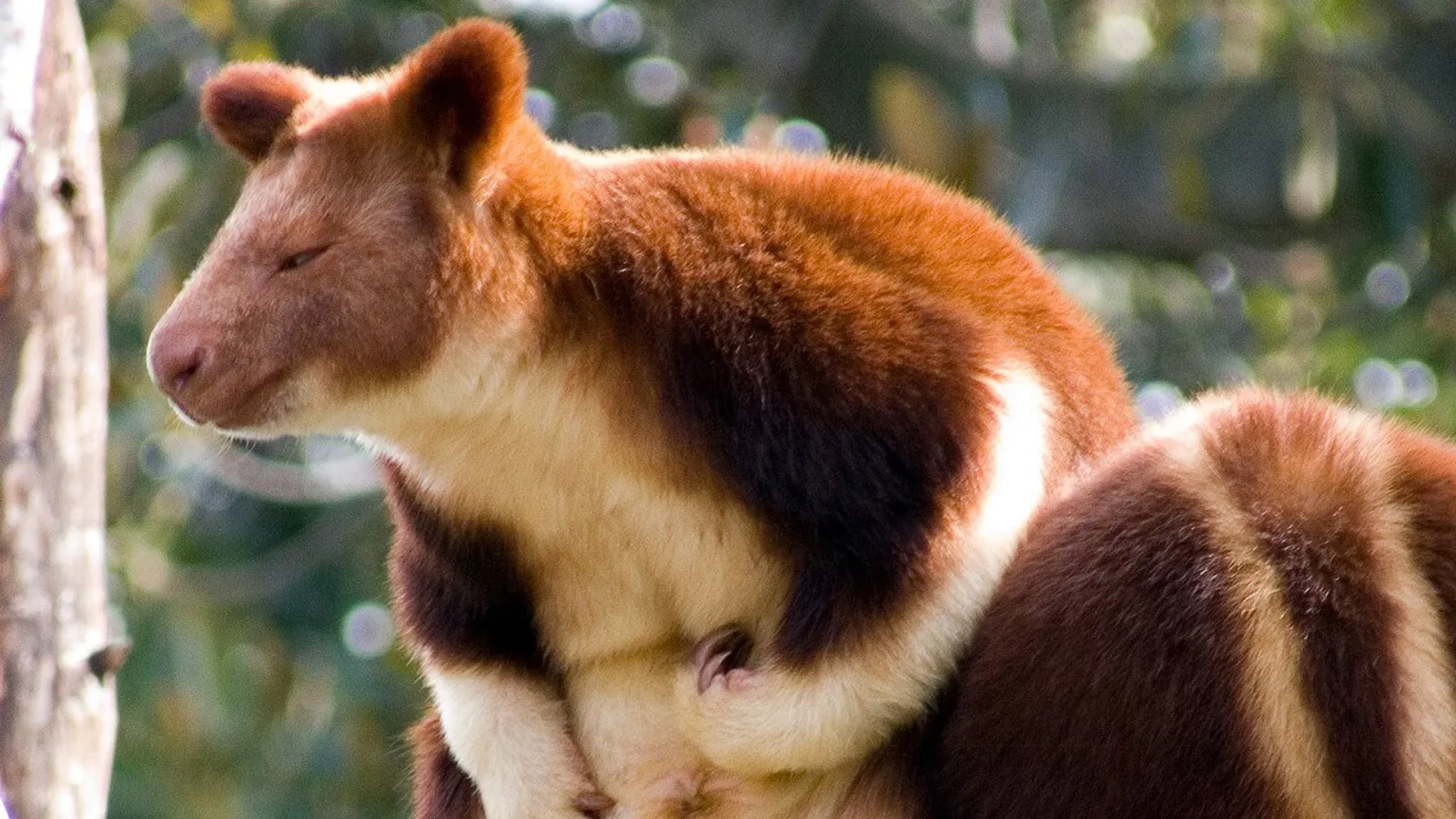
— Where the name comes from
Dendrolagus is “tree hare”, from the Greek déndron and lagṓs — whoever named it saw an animal bounding among branches and reached for the nearest comparison, getting the order, the class and the continent wrong. Goodfellowi recalls Walter Goodfellow, an English collector who explored New Guinea in the early 20th century. It is a kangaroo that has gone back up the trees its ancestors came down from.
— Facts
- Group
- Mammals · Mammalia
- Order
- Diprotodont marsupials
- Habitat
- Montane rainforest, between 680 and 2,800 m
- Range
- New Guinea, the mountains of central and eastern Papua New Guinea
- Size
- 55–77 cm of body plus a nearly equal tail, 7–10 kg
- Diet
- Herbivore — leaves, fruit, flowers, bark
- Lifespan
- 14 years in the wild, over 20 in captivity
— Characteristics
- 01
The forelimbs are far more powerful than in other kangaroos, for climbing.
- 02
It can jump to the ground from fifteen metres without hurting itself.
- 03
Its hind legs move independently, which kangaroos on the ground cannot do.
— What sets it apart
It is a journey back, and the body shows it. Tree-dwelling marsupials came down to the ground and became kangaroos, specialising the hind legs for hopping and losing the ability to move them one at a time; then this line climbed back up, and had to retrace part of that road in reverse — regaining strong arms, curved claws and the alternating gait of the hind legs. It has not gone back to being the animal it started as: it is a kangaroo that climbs with solutions of its own.
