
Common chameleon
Chamaeleo chamaeleon
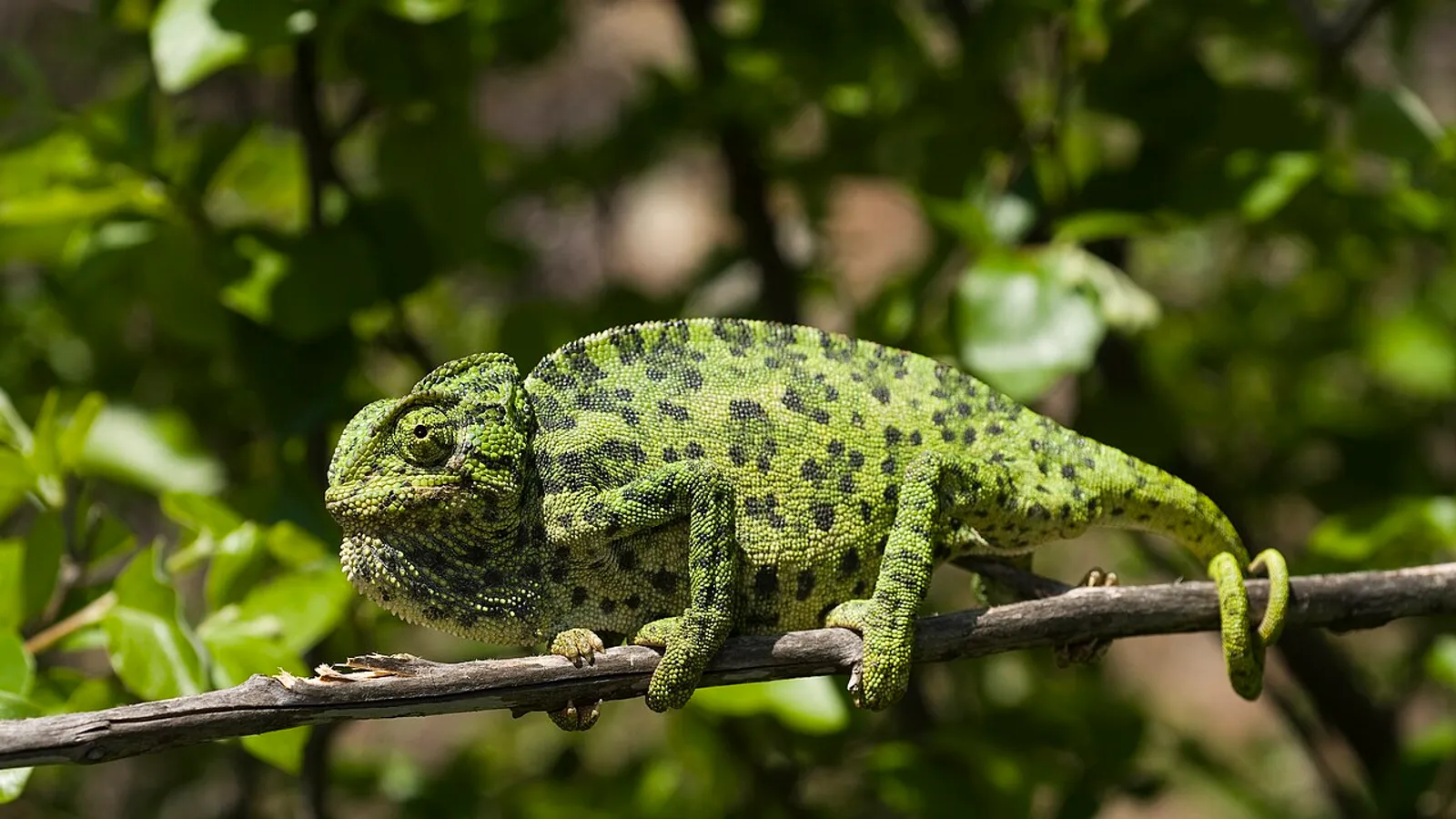
— Where the name comes from
Chamaeleo is from the Greek khamailéōn, “ground lion”, from khamaí, on the ground, and léōn, lion: perhaps for the mane-like crest, or for the haughty air. It is the only chameleon found in Europe, and the species on which most of the myths about these reptiles — usually wrong — are built.
— Facts
- Group
- Reptiles · Reptilia
- Order
- Squamates
- Habitat
- Mediterranean scrub, thicket, olive groves
- Range
- The Mediterranean basin, North Africa, the Near East
- Size
- 20–30 cm including tail
- Diet
- Insectivore — insects taken with the tongue
- Lifespan
- 4–6 years
— Characteristics
- 01
The eyes swivel independently of one another, covering nearly 360 degrees.
- 02
The tongue, longer than the body, fires at prey in a fraction of a second.
- 03
The prehensile tail coils into a spiral and acts as a fifth limb among the branches.
— What sets it apart
The chameleon does not change colour to hide, as the cliché has it: it does so mainly to communicate — anger, courtship, submission — and to regulate temperature, darkening to absorb heat. And it does not use pigments that move about, but microscopic crystals in the skin which, drawing closer or further apart, reflect different wavelengths. A chameleon’s colour is, literally, light bent by the structure of its own skin.
