
Asian giant hornet
Vespa mandarinia
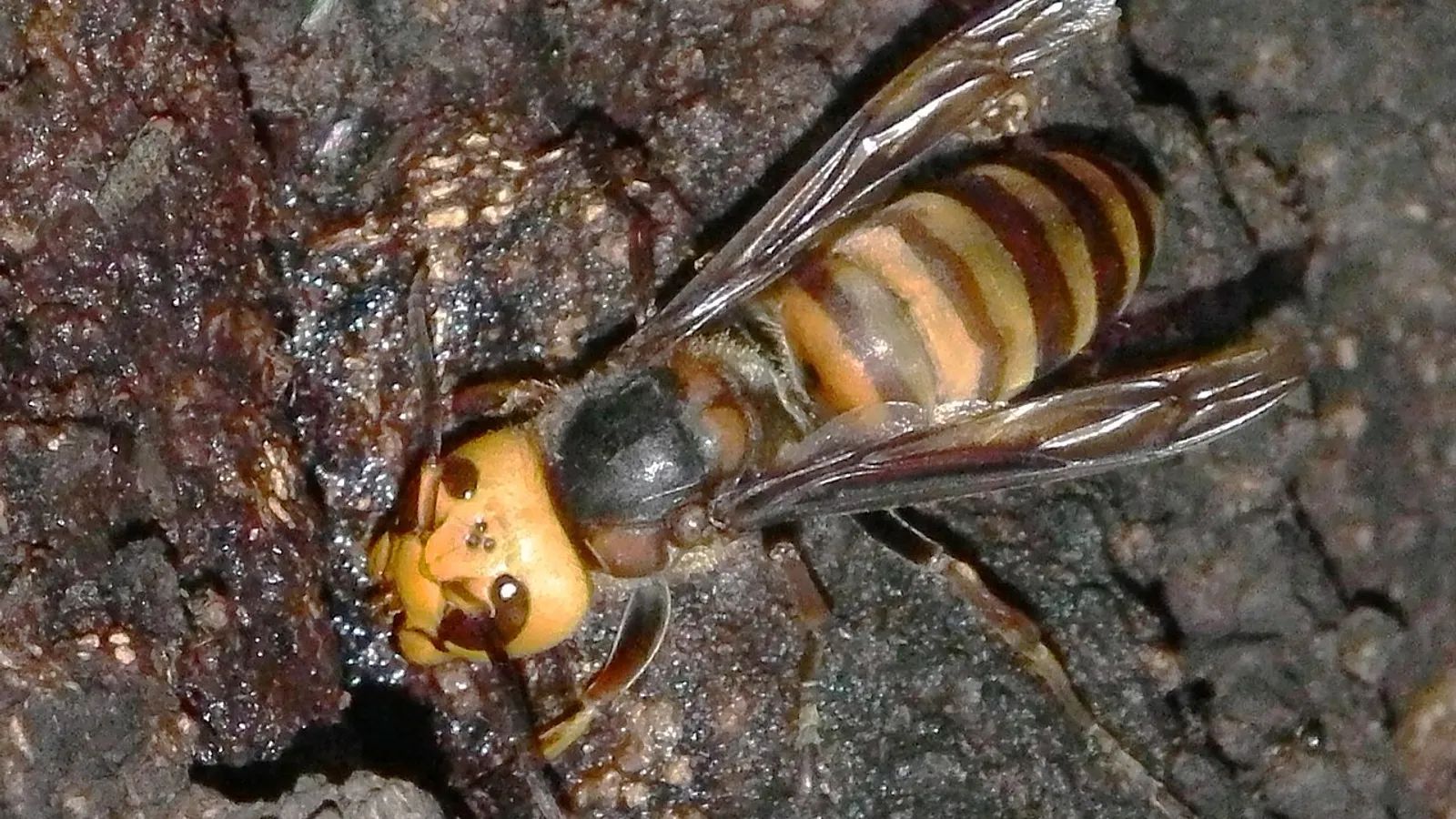
— Where the name comes from
Mandarinia recalls the mandarins, the high officials of the Chinese empire, who wore silk robes of yellow and orange: this hornet’s head is that colour, and whoever described it saw in it a courtly dignity. The word “mandarin”, incidentally, is not Chinese but Portuguese, adapted from the Malay mantri, the counsellor — a European name for an Asian office, given to a Japanese insect.
— Facts
- Group
- Insects · Insecta
- Order
- Bees, wasps and ants
- Habitat
- Hill woodland; nests in underground cavities
- Range
- East Asia: Japan, Korea, China, Taiwan, eastern Russia
- Size
- Worker 35–40 mm, queen up to 55 mm; the largest hornet in the world
- Diet
- Insects, above all other bees and wasps; sap as an adult
- Lifespan
- The colony one season; the queen a year
— Characteristics
- 01
The sting is six millimetres long and the venom dissolves tissue.
- 02
A group of thirty destroys a hive of thirty thousand bees.
- 03
It flies at forty kilometres an hour and covers eighty kilometres a day.
— What sets it apart
European honeybees have no answer to an attack: the hornet beheads the workers one by one and carries off the brood. But the Japanese honeybee, which grew up with this predator, has found one that does not use the sting: when a scout enters the hive, five hundred bees press around it and begin vibrating their flight muscles. The temperature at the centre rises to forty-seven degrees. The bees tolerate up to fifty, the hornet dies at forty-five: they cook it, exploiting a margin of three degrees.
