
Southern ground hornbill
Bucorvus leadbeateri
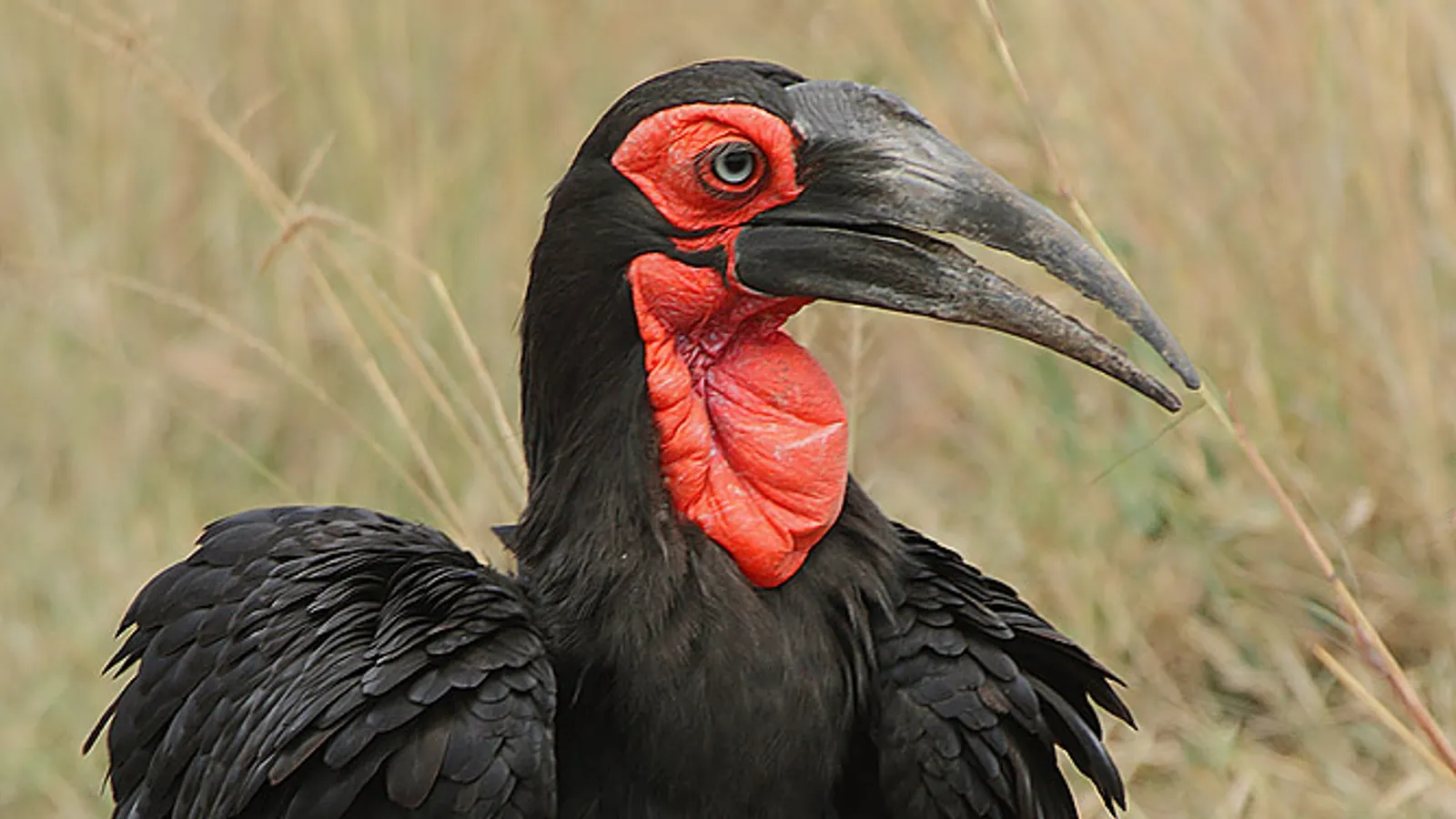
— Where the name comes from
Bucorvus puts together the hornbill and the Latin crow: a bird with the helmet of the first and the colour of the second. Leadbeateri recalls Benjamin Leadbeater, a London taxidermist and natural history dealer who supplied half of Europe with specimens in the nineteenth century — one of those names that sit in the nomenclature not for a discovery but for a shop.
— Facts
- Group
- Birds · Aves
- Order
- Hornbills
- Habitat
- Savannah, wooded grassland, open bush
- Range
- Eastern and southern Africa
- Size
- 90–129 cm, wingspan 180 cm, 2.2–6.2 kg
- Diet
- Insects, snakes, lizards, tortoises, hares, birds
- Lifespan
- 50–70 years
— Characteristics
- 01
It walks all day in family parties, hunting on the ground.
- 02
The bare skin of the throat is red in males, blue and red in females.
- 03
The call is a deep booming at dawn that is mistaken for a lion.
— What sets it apart
It raises one chick every nine years. The group lays two eggs, but the second chick hatches days after the first and always dies: it is a reserve in case the first fails. At that rate, a population that loses a few adults does not recover quickly, which is why it is disappearing from South Africa. Among the Zulu and the Venda, killing a ground hornbill brings drought, and it is a belief that for centuries worked better than any law: it protected the one species that could not afford to be hunted.
