
Great hornbill
Buceros bicornis
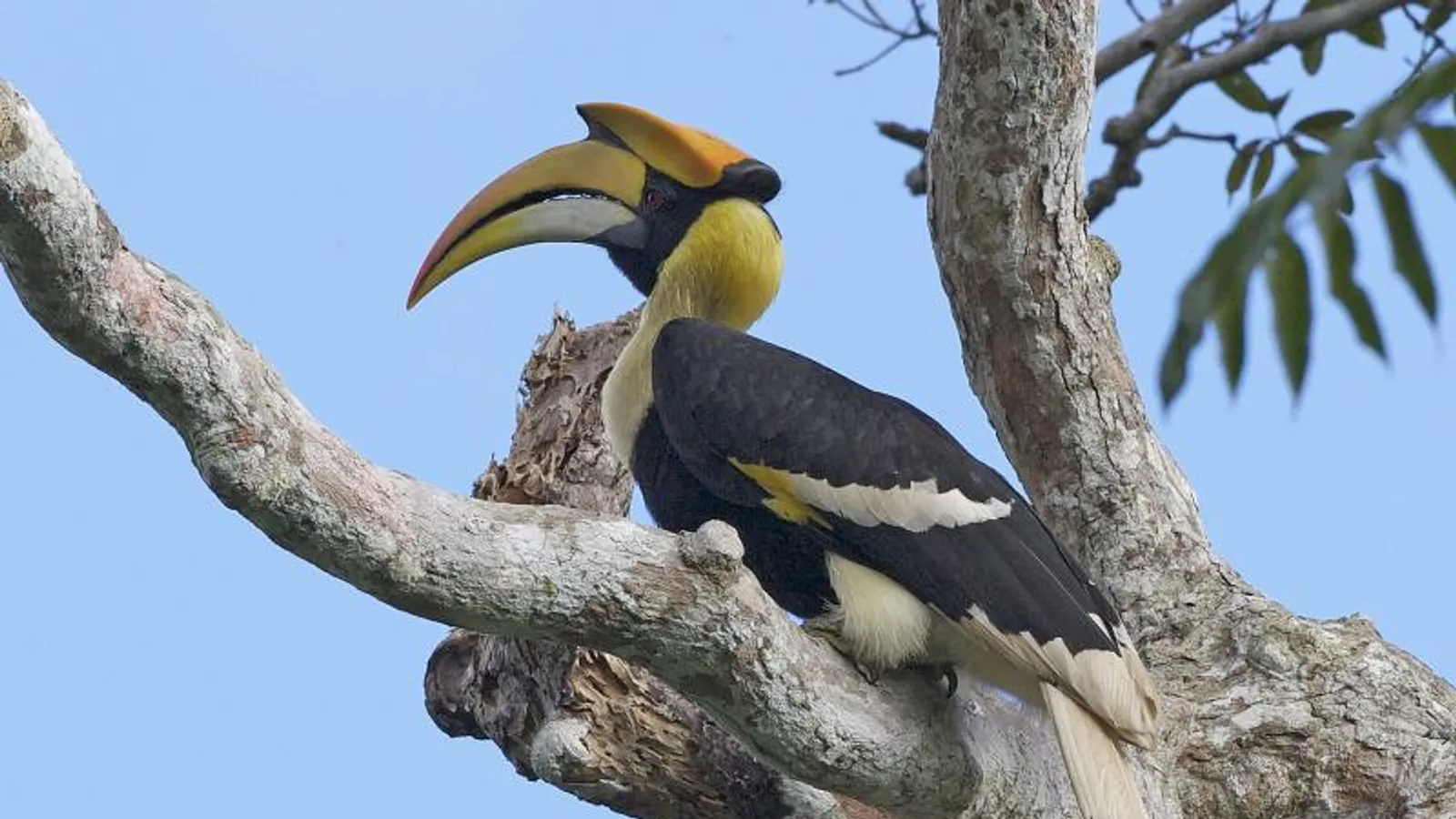
— Where the name comes from
Buceros is “ox horn”, from boûs and kéras, for the hollow structure it carries above the bill; bicornis says the same thing a second time in Latin, referring to the two points into which that helmet divides in front. It is one of the few structures in the animal kingdom that serves neither for fighting nor for defence: it is empty inside and works as a sounding box.
— Facts
- Group
- Birds · Aves
- Order
- Hornbills
- Habitat
- Mature rainforest with great hollow trees
- Range
- India, the eastern Himalaya, Indochina, Sumatra
- Size
- 95–130 cm, wingspan 150 cm, 2.2–4 kg
- Diet
- Figs and other fruit, insects, small vertebrates
- Lifespan
- 35 years in the wild, over 50 in captivity
— Characteristics
- 01
The wingbeat carries hundreds of metres: it sounds like a locomotive.
- 02
It swallows figs whole and brings them up far away, sowing the forest.
- 03
The lashes above its eyes are long and black like a mammal’s.
— What sets it apart
The female walls herself in alive. She enters a cavity in an enormous tree and seals it from the inside with mud, fruit and her own droppings, leaving a vertical slit a finger wide; there she lays, moults every feather at once and stays for four months, fed by the male through the crack. It is the most radical security system in existence, and it has an equally radical flaw: if the male dies, everything inside the trunk dies with him. Fell the big trees and the species goes, and that is exactly what is happening.
