
Dark-edged bee-fly
Bombylius major
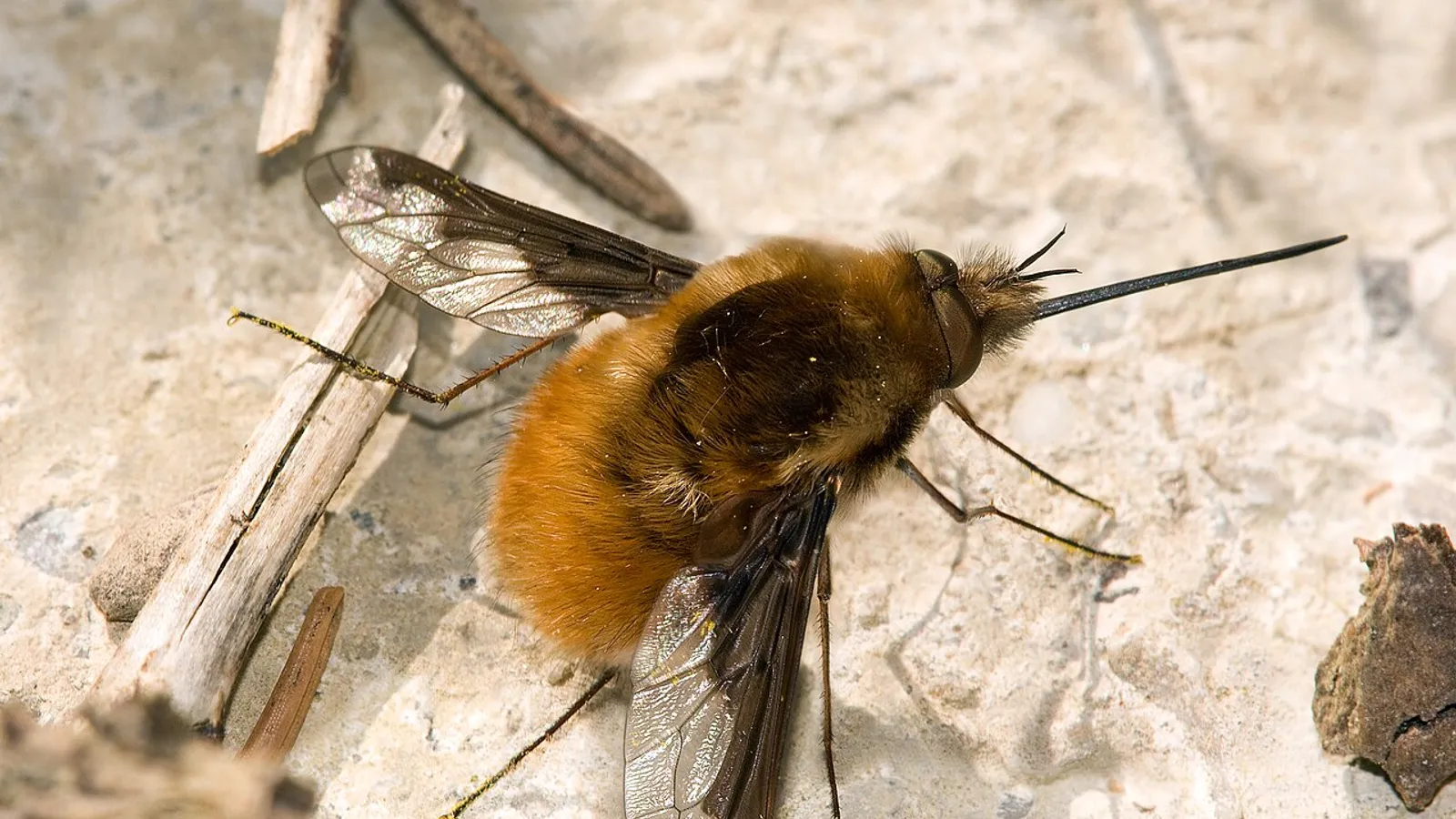
— Where the name comes from
Bombylius comes from the Greek bombýlios, which named both a humming insect and a narrow-necked vessel that gurgles as it pours: the root is bómbos, the deep booming sound. It is therefore “the hummer”, and anyone who has heard it stop in mid-air before a primrose knows the name is exact. Major distinguishes the larger species from its relatives.
— Facts
- Group
- Insects · Insecta
- Order
- Flies
- Habitat
- Sunny clearings, gardens, grassy banks in spring
- Range
- Europe, Asia, North America, North Africa
- Size
- 8–12 mm of body; proboscis half as long as the body again
- Diet
- Nectar as an adult; the larvae of solitary bees as a larva
- Lifespan
- A few weeks; it flies only in spring
— Characteristics
- 01
It looks like a small furry bumblebee, but is a fly with no sting.
- 02
The stiff, protruding proboscis does not pierce: it reaches the base of flowers.
- 03
It hangs in mid-air while feeding, like a hummingbird.
— What sets it apart
The female does not lay her eggs: she throws them. Hovering above the entrance to a solitary bee’s nest, she flicks her abdomen and hurls the eggs towards the hole, having first coated them in dust and sand gathered from the ground so that they are heavier and fly further. The larva that emerges enters the cell, waits until the bee grub has grown, and then eats it. It is a parasite that strikes from a distance, from above, without ever landing.
