
American bison
Bison bison
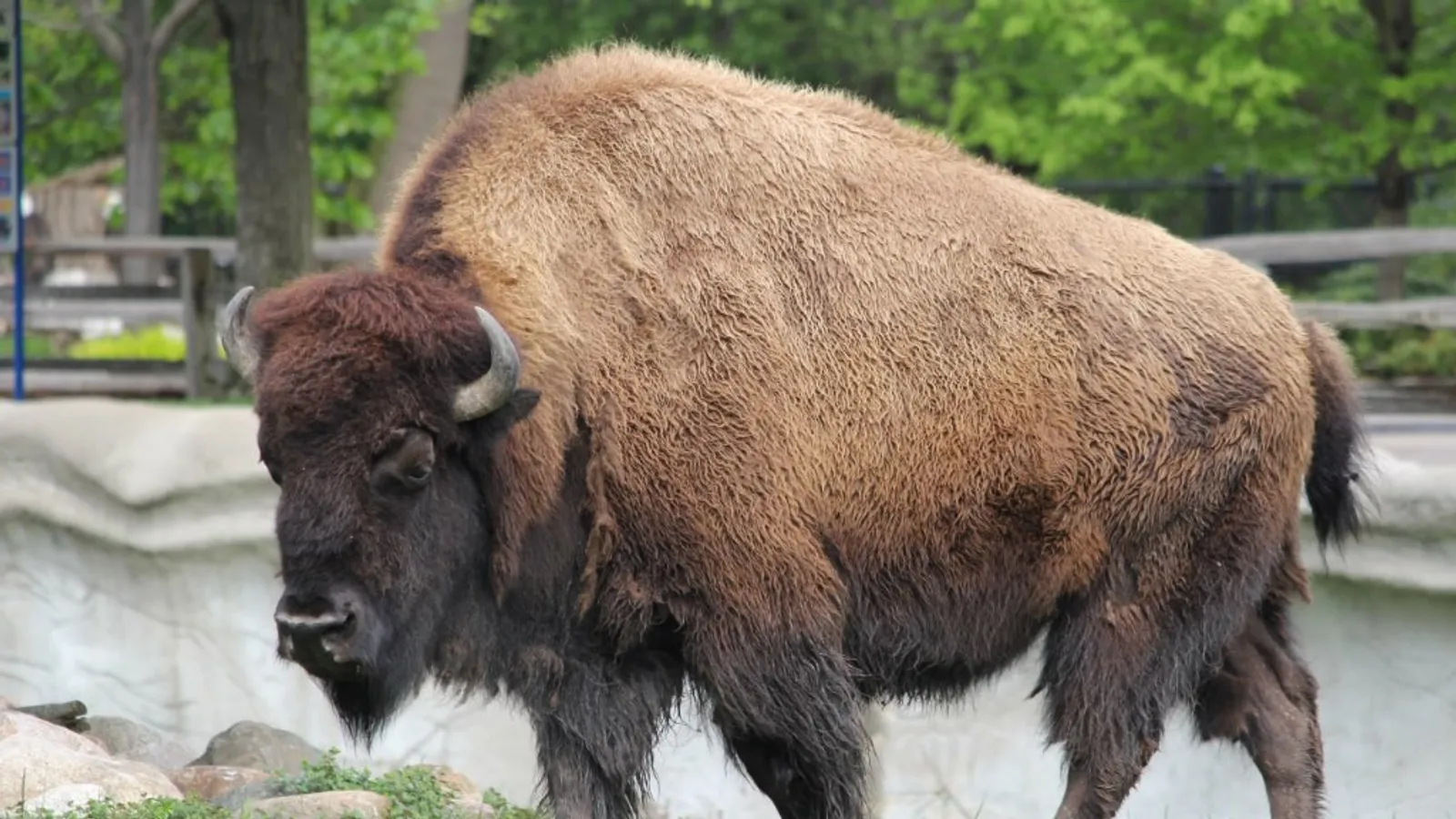
— Where the name comes from
Bison is Latin, taken from the Germanic wisand, the same root as the “wisent”, the European bison. The word may recall the animal’s musky smell. Americans commonly call it buffalo, but it has nothing to do with the true buffaloes of Africa and Asia: another colonial misnaming.
— Facts
- Group
- Mammals · Mammalia
- Order
- Even-toed ungulates
- Habitat
- Great plains, temperate savannah, open woodland
- Range
- North America, today in protected herds and on ranches
- Size
- 210–350 cm, 400–1,000 kg
- Diet
- A grazing herbivore — prairie grasses and sedges
- Lifespan
- 15–25 years
— Characteristics
- 01
It is the heaviest land mammal in North America.
- 02
The muscular hump over the shoulders carries the massive head that shovels snow aside to find grass.
- 03
For all its bulk it runs at 55 km/h and clears fences nearly two metres high.
— What sets it apart
Perhaps thirty million lived in North America; by the end of the 19th century, after deliberate extermination — used among other things as a weapon against the native peoples who depended on them — a few hundred were left. The species was saved at the last moment by a handful of ranchers and by one of the first conservation projects in history. Almost every bison alive today descends from that remnant.
