
Western house martin
Delichon urbicum
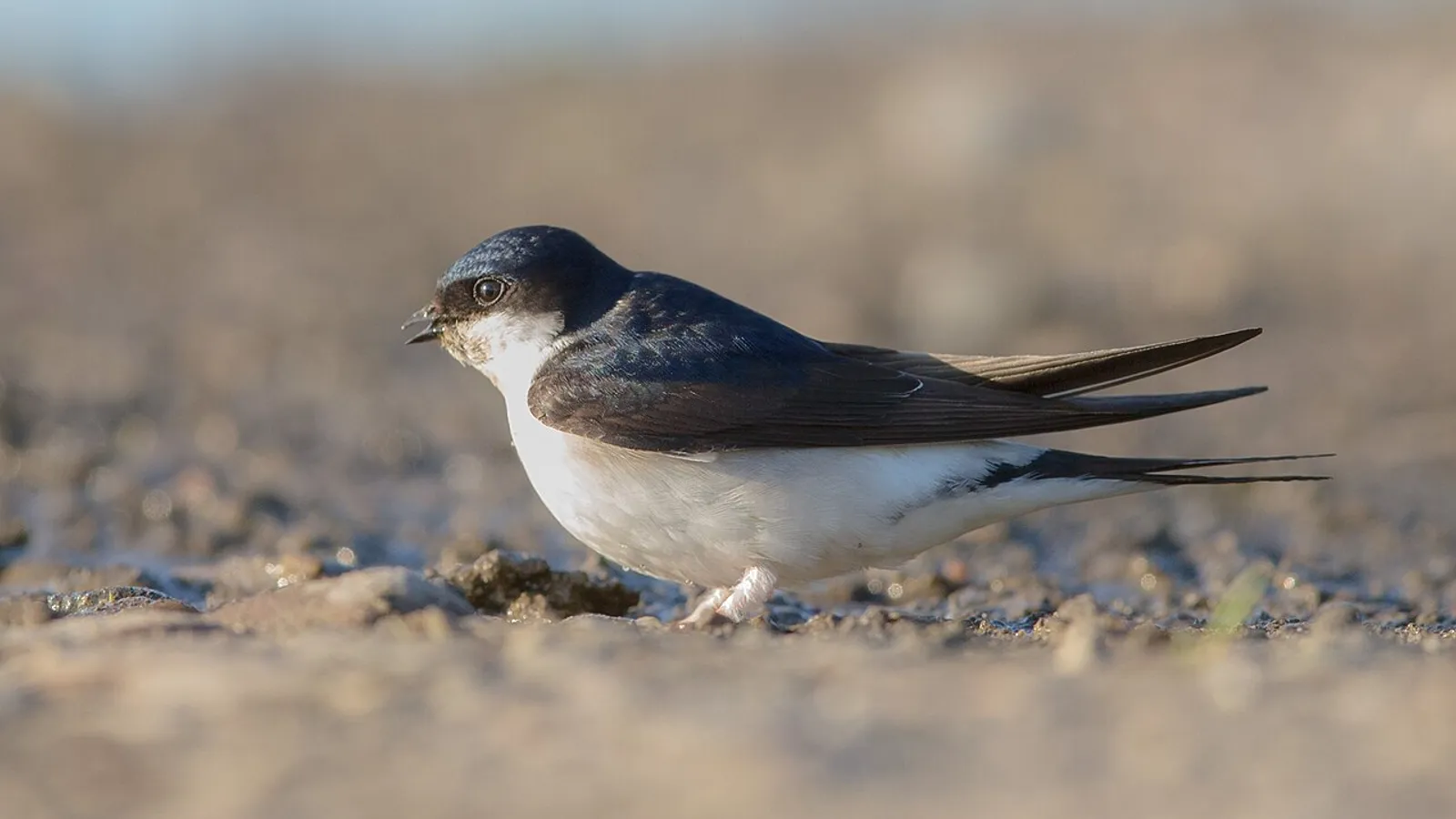
— Where the name comes from
Delichon is an anagram of Chelidon, the Greek for swallow: two English naturalists in 1854, needing to separate this genus from the true swallows, could think of nothing better than to shuffle the letters. It is one of the very few scientific names built as a word puzzle. Urbicum means “of the town”, and indeed it glues its nest under the eaves.
— Facts
- Group
- Birds · Aves
- Order
- Passerines
- Habitat
- Towns and villages, cliffs, bridges, under eaves
- Range
- Europe, North Africa, Asia; winters in sub-Saharan Africa
- Size
- 13–15 cm, wingspan 26–29 cm, 15–23 g
- Diet
- Insects caught in flight, often at high altitude
- Lifespan
- 4 years in the wild
— Characteristics
- 01
It has a white rump, which tells it from the swallow even at a distance.
- 02
It builds a closed half-dome nest with a single entrance hole.
- 03
Its legs are covered in white down right down to the toes.
— What sets it apart
The nest is made of a thousand pellets of mud fetched one at a time from a puddle, carried in the bill and glued with saliva: the pair takes about ten days, and if the mud dries too fast the building site stops. For centuries nobody knew where it went in winter — Gilbert White, in the eighteenth century, suspected it hid in river mud — and the full answer arrived only recently, with geolocators the size of a fingernail: above the forests of Central Africa, where nobody had ever gone to look.
