
Fin whale
Balaenoptera physalus
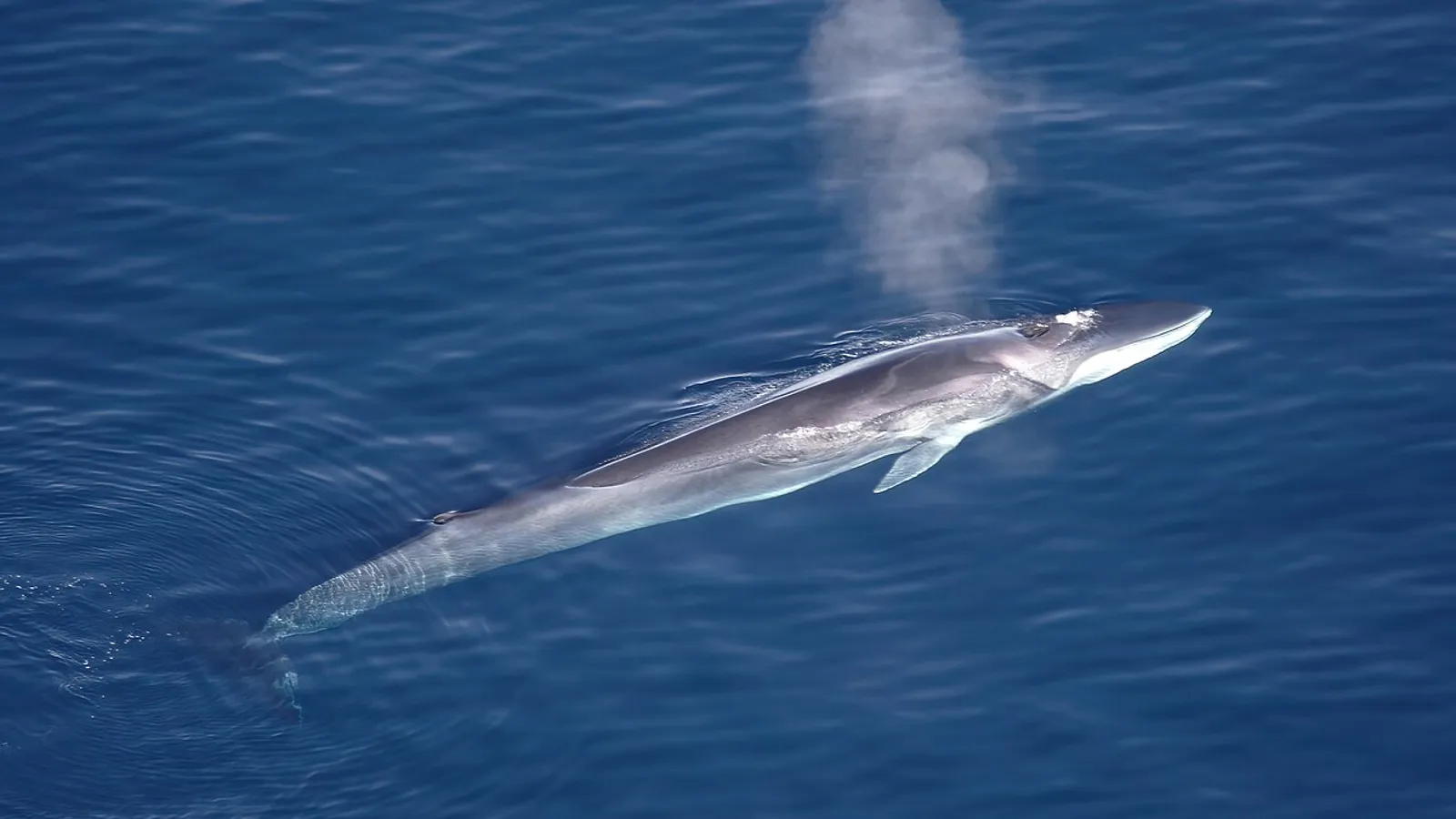
— Where the name comes from
Balaenoptera joins the Latin balaena, “whale”, and the Greek pterón, “wing”: the whale with a fin, because unlike the right whales it carries a sickle-shaped dorsal. Physalus comes from physáō, “to blow”, and recalls the six-metre spout that gives away its presence. It is the second largest animal that has ever lived, after the blue whale, and the fastest of the great cetaceans.
— Facts
- Group
- Mammals · Mammalia
- Order
- Cetaceans
- Habitat
- Open sea and deep water, from the poles to the tropics
- Range
- Every ocean; a regular presence in the Mediterranean, with a population of its own
- Size
- 18–24 m long, 40–80 tonnes
- Diet
- Filter feeder — krill, small shoaling fish, copepods
- Lifespan
- 80–90 years
— Characteristics
- 01
It is asymmetrical: the right jaw is white and the left dark, unique among vertebrates.
- 02
It reaches 40 km/h, which earned it the nickname greyhound of the seas.
- 03
Its 20 Hz calls are among the most powerful sounds any animal makes, and carry hundreds of kilometres.
— What sets it apart
That very low call, at the edge of our hearing, has a curious history: during the cold war American military sonar recorded it constantly without knowing what it was, and for years it was filed as noise of unknown origin. Only in the 1960s was it understood that those regular pulses were fin whales. The same listening arrays built to track Soviet submarines have since been declassified and become the instrument with which the great whales are counted and followed across the oceans.
