
Common acorn barnacle
Semibalanus balanoides
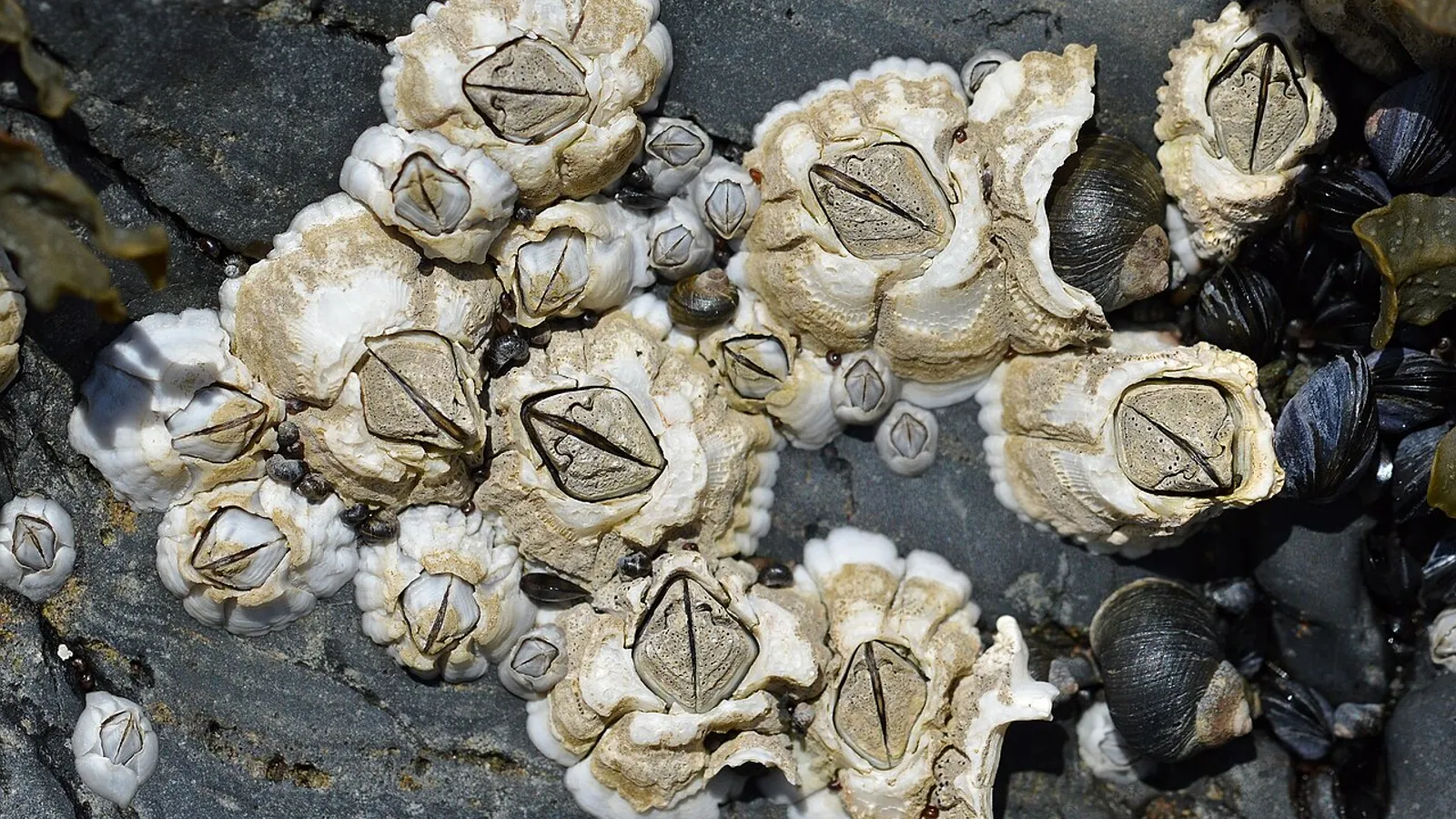
— Where the name comes from
Balanus is the Greek bálanos, the acorn: the calcareous cone these animals build on the rocks resembles an acorn planted in stone, and in English they are indeed acorn barnacles. It is the same word that in anatomy names the glans, for the same similarity of shape — and neither use knows about the other.
— Facts
- Group
- Crustaceans · Malacostraca · Maxillopoda
- Order
- Acorn barnacles
- Habitat
- Rocks of the intertidal zone, exposed to the waves
- Range
- North Atlantic, European and North American coasts
- Size
- 1–1.5 cm across
- Diet
- Plankton filtered when the tide covers the rock
- Lifespan
- 5–10 years
— Characteristics
- 01
The cement with which it fixes itself is among the toughest in nature.
- 02
It closes its apical plates and stays sealed through the whole low tide.
- 03
It covers rocks at densities of tens of thousands per square metre.
— What sets it apart
On this animal it was worked out what sets boundaries in nature. In the 1950s Joseph Connell noticed that on Scottish rocks the common barnacle occupies the lower band and another species the upper one, and tried removing each in turn: he found that the upper limit is set by how much desiccation the animal can bear, and the lower one by the competition of its neighbour, which simply levers it off by growing underneath. It was the first experimental demonstration that physical and biological factors draw the two opposite edges of the same range, and it still opens the ecology textbooks.
